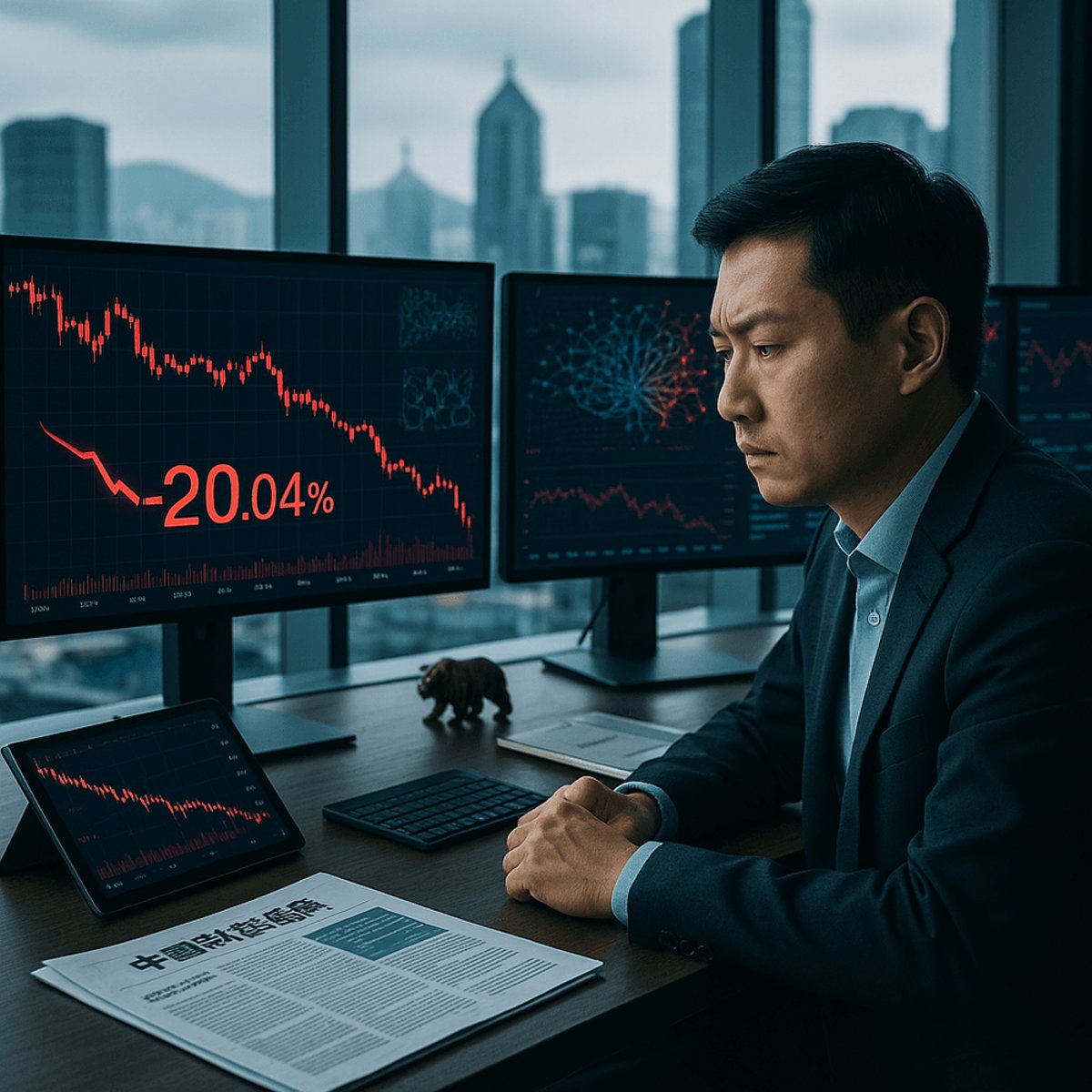
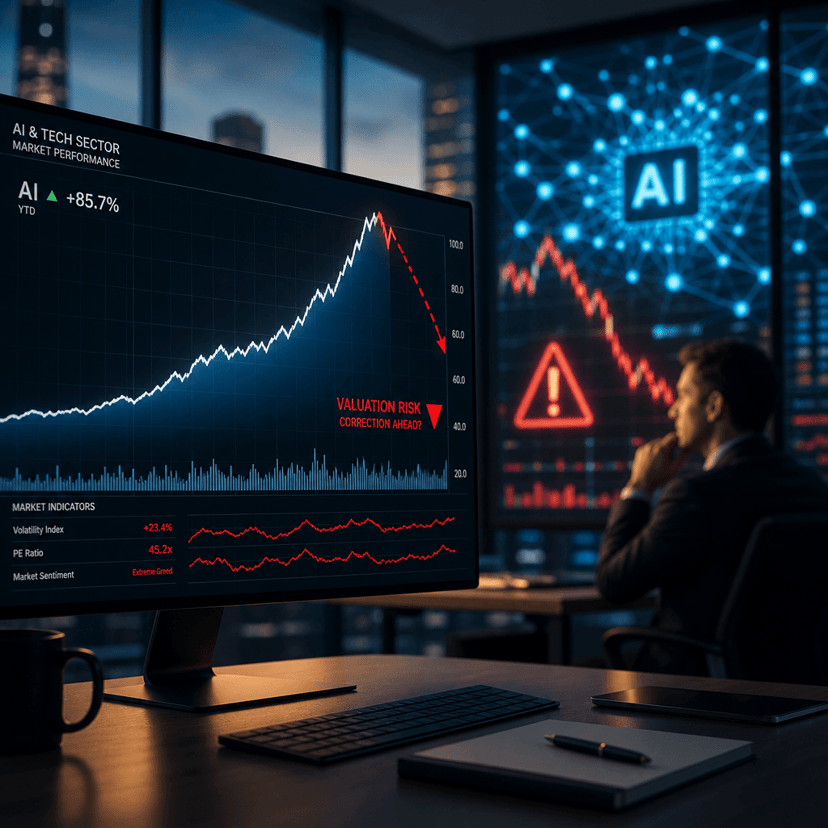
China's tech giants are bleeding value at a pace that's catching Wall Street off guard. The Hang Seng Tech Index tumbled into bear market territory Thursday, sliding over 20% from its October peak as fears of new tax hikes and AI-driven market chaos converge. What looked like a solid recovery rally just months ago has turned into a sixth straight day of losses, leaving investors scrambling to figure out whether this is a buying opportunity or the start of something worse.
The Hang Seng Tech Index, packed with mainland China's biggest internet and tech names, fell more than 1% Thursday morning in Hong Kong trading. That pushed the benchmark down just over 20% from its October peak - the technical threshold that officially marks bear market territory. It's a brutal reversal for an index that was riding high on optimism about China's economic recovery and AI ambitions just a few months back.
The immediate trigger? Tax anxiety. Market participants are pointing fingers at fears of a possible value-added tax increase on internet services, according to Qi Wang, investment strategist at UOB Kay Hian. The worry isn't coming out of nowhere - China already implemented a VAT hike on certain telecom services, and now investors are worried internet platforms could be next on the chopping block.
Speculation spread like wildfire earlier this week, with rumors extending to online gaming and other digital transactions. That sent shockwaves through a sector that's already been beaten down by years of regulatory crackdowns. Chinese officials moved quickly Tuesday to dismiss speculation about a gaming industry levy, but the damage was done. Trust is fragile when you've spent years watching Beijing tighten the screws on tech.
"The sell-off in recent days is driven by concerns over possible VAT tax increase on internet services, online gaming and other online transactions," Wang told CNBC. "This follows the recent VAT increase on certain telecom services."
But the tax fears are only part of the story. China's tech woes are colliding with broader chaos in global technology markets, driven by mounting fears that AI is about to disrupt entire software categories. Phelix Lee, senior equity analyst at Morningstar, described the situation as "a barrage of negative news globally."
Lee pointed to reports that Anthropic is rolling out an AI plugin that automates chunks of legal work - the kind of development that sends legaltech firms into panic mode and fuels broader software selloffs. Then there's the reported tension between Nvidia and OpenAI, which is building risk-off sentiment in the hardware AI trade just as investors were getting comfortable with sky-high valuations.
"We have Anthropic reportedly rolling out an AI plugin that automates bits of legal work, sparking fears in legaltech firms and fueling the broader software sell down," Lee said. "Then we have VAT hike rumors on Chinese internet firms and risk-off sentiment builds in the hardware AI trade as there are reports of rupture between Nvidia and OpenAI."
It's a perfect storm of regulatory uncertainty and technological disruption, hitting at a moment when global markets are already jittery. Chinese tech stocks, which had clawed their way back from brutal 2022 lows, are now facing questions about whether the rally was built on solid ground or just wishful thinking.
Still, not everyone's hitting the panic button. Some institutional investors are viewing this as a correction rather than the start of a prolonged downturn. Lorraine Tan, director of equity research for Asia at Morningstar, characterized the recent weakness as concentrated in pockets that had previously outperformed.
"I regard the action as a healthy pullback and it's largely concentrated in sectors that have probably overshot fair values," Tan said. That's a polite way of saying some of these stocks got ahead of themselves and needed to cool off.
Vey-Sern Ling, managing director at Union Bancaire Privée, echoed that sentiment, arguing that the fundamental outlook for Chinese tech hasn't materially deteriorated despite the lack of near-term catalysts. "Catalysts have been somewhat lacking for the sector," Ling admitted. "Recently, there's also been regulatory noise in travel and e-commerce, which we think are specific rather than systemic, as well as some worries about value-added tax."
Ling's take is that this is noise, not signal. "Fundamentally nothing has changed to derail our positive outlook," he said. "Valuations continue to be supportive, sector earnings have potential to rebound, and AI may provide a stream of catalysts ahead."
That optimism might sound reasonable on paper, but it's a tough sell to investors who've watched six straight days of declines wipe out months of gains. The reality is that Chinese tech stocks are caught in a vise - squeezed by domestic regulatory uncertainty on one side and global AI disruption fears on the other.
The tax issue isn't going away quietly. Even with officials denying plans for a gaming levy, the fact that VAT hikes are already hitting telecom services keeps the door open for future policy moves. And in China's regulatory environment, what starts as a rumor can quickly become reality if Beijing decides it needs more revenue or wants to exert more control over the tech sector.
Meanwhile, the AI disruption narrative is only getting louder. As tools like Anthropic's legal automation plugin demonstrate real-world capabilities, investors are starting to price in the risk that entire software categories could get commoditized. That's bad news for companies that built their moats on proprietary software - and it's particularly worrying for Chinese tech firms trying to compete globally while navigating domestic constraints.
The Hong Kong market, which serves as the primary trading venue for many of China's biggest tech names, is now a focal point for global investors trying to gauge where Chinese tech is headed. The 20% drawdown from the October peak isn't just a number - it represents a fundamental shift in sentiment from cautious optimism to genuine concern.
The bear market classification is official, but the bigger question is what comes next. If institutional investors like Morningstar and Union Bancaire Privée are right, this is just a correction in an otherwise intact recovery story - a chance to buy quality names at better prices. But if the tax fears materialize or AI disruption accelerates faster than expected, Chinese tech could be in for a much rougher ride. With catalysts scarce and uncertainty running high, the next few weeks will tell us whether investors are catching a falling knife or spotting a genuine opportunity. For now, the path of least resistance is down.