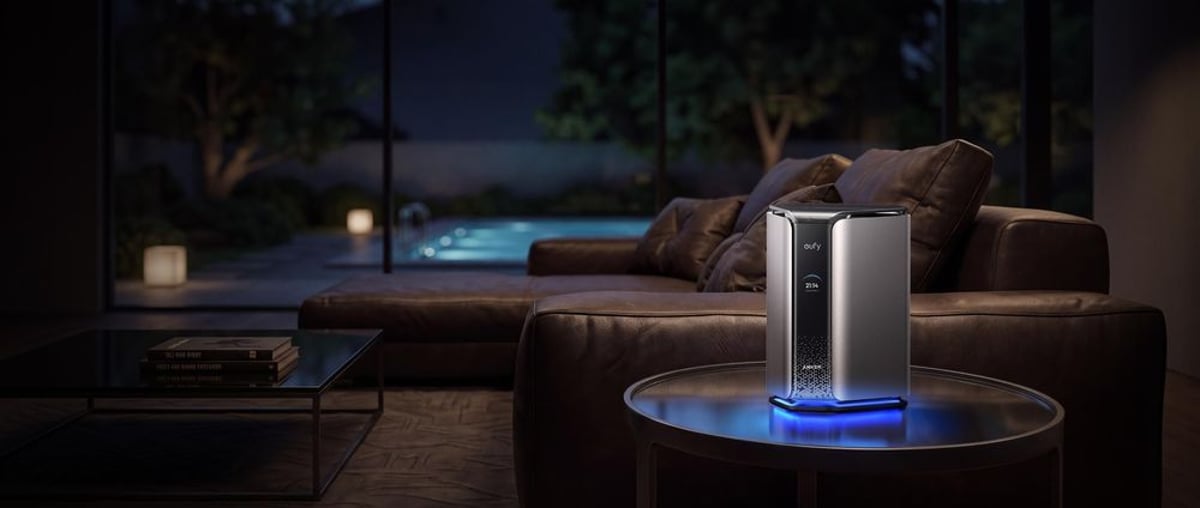
Anker just gave smart home security a brain of its own. At IFA Berlin this week, the company unveiled the Eufy MindBase, a local AI hub that runs an on-device large language model to process camera footage without ever sending it to the cloud. It's a bold bet on privacy-first AI, and it signals Anker wants Eufy to be the connective tissue for your entire smart home, not just your cameras.
Anker isn't just selling more cameras this week. It's making a play to become the operating system of your smart home. The company took the stage at IFA in Berlin to unveil the Eufy MindBase, a local AI hub built to process security camera footage entirely on-device, using a large language model that Anker developed in-house. No cloud round-trip, no footage leaving the house. That's the pitch, and it's a meaningful one in a category where privacy concerns have dogged nearly every major player.
The timing isn't an accident. Smart home security has spent the past few years wrestling with a trust problem. Consumers want the convenience of AI-powered detection, package alerts, facial recognition, the works, but they've grown wary of handing raw video of their living rooms and front doors over to corporate servers. Eufy itself has stumbled here before, facing scrutiny in past years over how it handled cloud storage and encryption claims. MindBase reads like a direct answer to that history: keep the compute local, keep the data local, and let the hardware do the heavy lifting instead of a data center somewhere else.
What makes MindBase interesting isn't just that it's a camera brain. Anker is explicitly calling it the "central brain for the home," and the framing matters. According to The Verge's reporting, the device supports Matter, the cross-platform smart home standard backed by Amazon, Google, and Apple, which means MindBase isn't locked into being a Eufy-only accessory. It's positioning itself as a hub that can talk to other smart home gear regardless of brand, with security as the entry point and broader home automation as the long game.
That's a notable strategic shift for a company that built its name on affordable cameras and robot vacuums. Local AI processing at the edge has become the industry's new battleground, with companies racing to prove they can deliver cloud-level intelligence without the cloud-level privacy trade-offs. Apple has leaned into on-device processing with its Home app and HomeKit Secure Video, while Google and Amazon have taken more hybrid approaches with their Nest and Ring ecosystems, respectively. Anker's move to build its own LLM specifically for this purpose suggests it sees on-device AI not as a nice-to-have feature, but as a core differentiator worth the engineering investment.
MindBase didn't launch alone. Anker also introduced the TrackLight Cam S1, a new S4 video doorbell, and a window-mounted camera, rounding out a lineup clearly designed to work in concert with the new hub. Security remains the beachhead, but Anker's own framing suggests it's thinking well past cameras. A hub that stores footage locally, runs AI inference locally, and speaks Matter is, in theory, a foundation for controlling lights, locks, thermostats, and whatever else gets added to the smart home stack down the line.
The bigger question is whether consumers will trust another company's promise of "it stays on your device." Local processing solves one trust problem but introduces new ones around hardware reliability, update support, and whether the on-device model can match cloud-based AI's accuracy over time. Anker hasn't detailed pricing or availability specifics beyond the IFA unveiling, and how MindBase performs in real homes, with real Wi-Fi congestion and real edge cases, will determine whether this is a genuine leap forward or just a clever pitch. For now, it's a signal that the smart home industry's next fight won't just be about better cameras. It'll be about who controls the brain behind them, and where that brain actually lives.
For readers tracking the smart home space, MindBase is worth watching not because it's another camera hub, but because it represents a bet that on-device AI can win back consumer trust where cloud processing lost it. If Anker can actually deliver local intelligence without sacrificing accuracy or convenience, it sets a template other smart home players will have to answer. If it can't, it's just another gadget at a crowded trade show. Either way, the direction is clear: the next phase of smart home AI is moving out of the cloud and into the box sitting on your shelf.