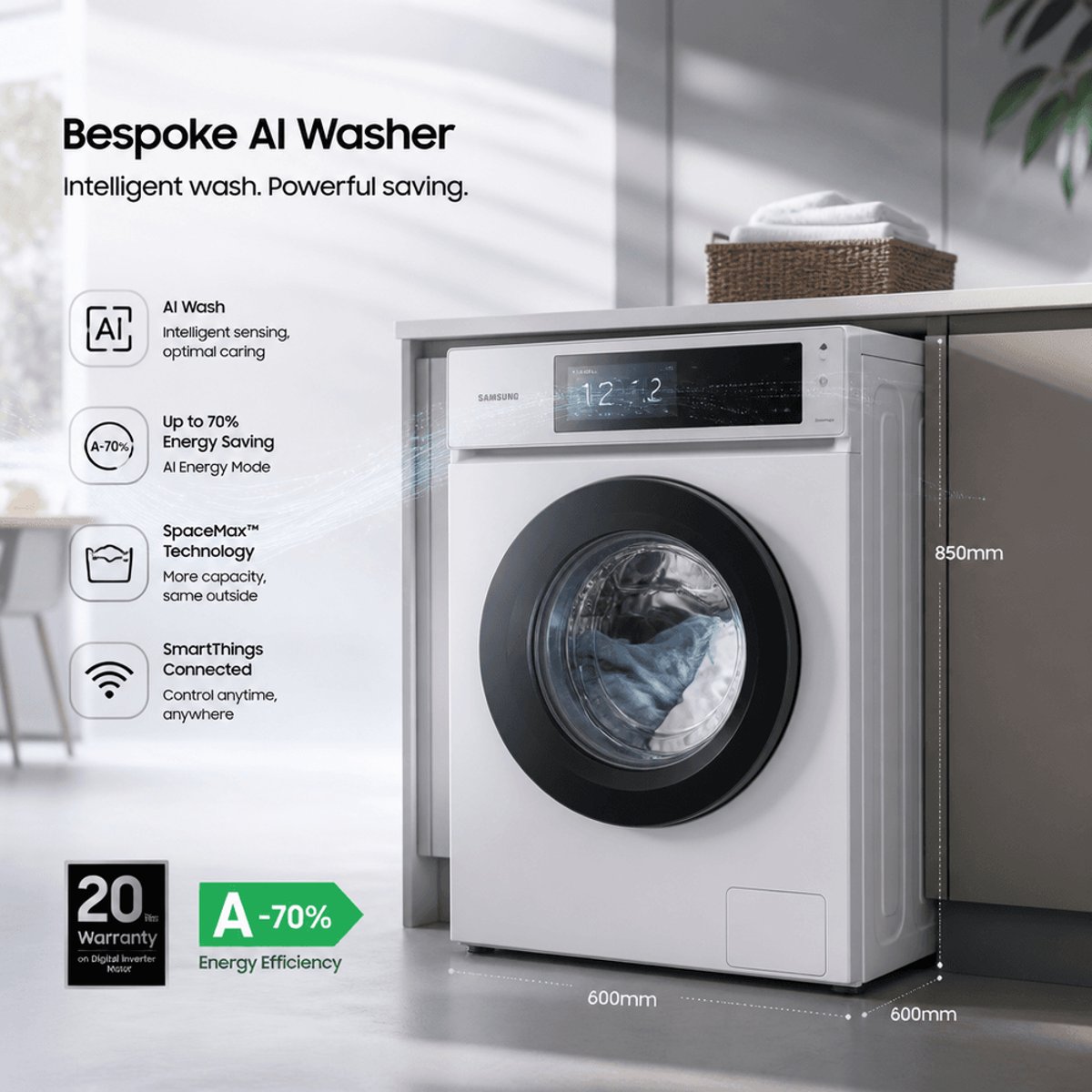
Samsung is bringing two new washing machines to IFA 2026 that tackle a problem laundry engineers have wrestled with for years: how do you wash bigger loads without burning more electricity? The company's new Bespoke AI Washer lineup includes a 10kg model rated at A-70% energy efficiency and a 13kg unit that somehow squeezes extra capacity into a standard European 600mm depth. Both machines go on display in Berlin starting September 2.
Samsung is once again trying to prove that bigger laundry loads and lower energy bills don't have to be mutually exclusive. The company announced it will showcase two new Bespoke AI Washer models at IFA 2026 in Berlin, and the headline numbers are hard to ignore: a 10kg washer engineered for A-70% energy efficiency, and a 13kg large-capacity model that still fits inside a standard 600mm depth footprint typical of European kitchens and utility rooms.
The unveiling happens at Humboldt Carré as part of Samsung's role as official main sponsor of the IFA Creator Hub, running September 2 through 6. It's the latest step in a multi-year push the company has been on since IFA 2024, when it first introduced an A-55% Bespoke AI Washer, followed by an A-65% version at IFA 2025. This year's A-70% model pushes that efficiency curve further while also growing capacity from 9kg to 10kg compared to its predecessor, the WF90H09C4S, according to Samsung's own testing data.
"At Samsung, we are continually challenging the traditional trade-offs between energy efficiency, capacity and convenience," Hyoung Min Park, VP and Head of the Customer Experience Team of the Digital Appliances Business at Samsung Electronics, said in a statement via Samsung Newsroom. "During IFA 2026, we're demonstrating how innovation can help consumers save energy, handle larger loads and enjoy a more intelligent and convenient laundry experience."
That trade-off Park's referencing is a real engineering headache. Washing more clothes typically means more water, more heat, and more electricity. Samsung says it got around this by tweaking motor efficiency, thermal management, and wash-cycle design all at once rather than optimizing just one variable. The result, per the company's internal testing, is an Energy Efficiency Index of 15.5, or 15.3 kWh per 100 cycles, which comes out to being up to 70.2% more efficient than the minimum threshold required for a Class A rating under EU Regulation No. 2019/2014. Worth noting: these figures haven't gone through final EPREL registration testing yet, and Samsung says actual results may vary depending on how people actually use the machine.
The 13kg model tells a different but related story. Rather than chasing efficiency gains, this washer is solving a space problem. European appliance buyers are often boxed in by kitchen and utility-room dimensions, so Samsung leaned on its SpaceMax technology, essentially redesigning the internal mechanics to fit a larger drum without changing the external dimensions, to keep the unit within a 24-inch form factor. That means bulkier loads like bedding or winter coats can go in a machine that still slots into the same cabinetry cutout as smaller washers.
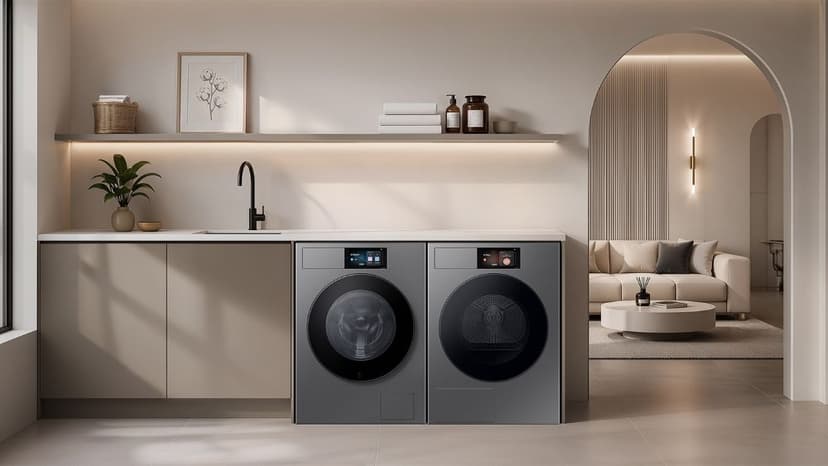
Design-wise, Samsung is leaning into its mono-body aesthetic, which gives the washer a more unified, less industrial look, paired with a slim front frame and a large touch display that's visually merged with the detergent compartment. From that screen, users can control wash cycles or tap into SmartThings for personalized laundry settings, though that requires a Wi-Fi connection and a Samsung account, and it only works on Android and iOS devices.
Both new washers also ship with a feature Samsung calls Auto Open Door, which slowly cracks the door open after a cycle finishes to let residual moisture escape. It's a small quality-of-life touch aimed at the age-old complaint about washers smelling musty if left sealed shut too long.
It's worth flagging that these are development-stage display models, not confirmed retail products. Samsung hasn't locked in specifications or a launch timeline, and the company explicitly says commercial availability is still to be determined. Still, the pattern here fits Samsung's broader appliance strategy of using IFA as a proving ground each year, incrementally pushing efficiency numbers (55% to 65% to 70% year over year) while expanding capacity, a strategy that puts pressure on rivals like LG and Bosch to match both the efficiency claims and the space-saving engineering heading into 2027 buying cycles.
None of this changes the laundry game overnight since these are still pre-production showcase units without a confirmed release date. But the trajectory matters. Samsung's been running this same playbook at IFA for three years straight, shaving energy consumption year after year while quietly growing drum capacity, and that consistency signals where the whole appliance industry is likely headed. If you're shopping for a washer in the next year or two, expect efficiency ratings and SpaceMax-style space tricks to become the new normal rather than a flashy exception.