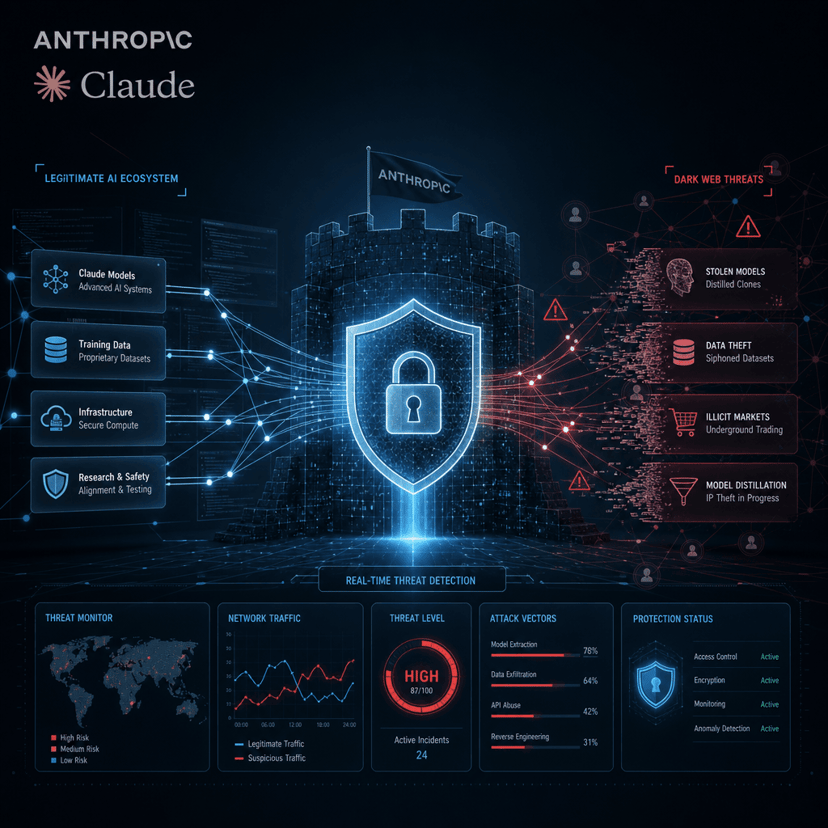
Anthropic's fight to protect its frontier AI models just got a lot messier. According to a new CNBC report, foreign adversaries have been illegally accessing the company's proprietary systems, distilling them into cheaper knockoffs, and quietly reselling those copies on dark web marketplaces. It's the clearest sign yet that the AI arms race has spilled into black-market territory, and Washington is watching closely.
Anthropic has a theft problem, and it's playing out somewhere most executives never expected to look: the dark web. According to CNBC, foreign adversaries have found ways to illegally tap into Anthropic's proprietary AI systems, extract their underlying knowledge through a technique known as model distillation, and turn around and sell cut-rate copycat versions to buyers who'd rather not pay Anthropic's enterprise prices.
Distillation itself isn't new or inherently illegal. It's a legitimate research technique where a smaller "student" model learns to mimic the outputs of a larger "teacher" model, and plenty of labs use it internally to shrink costs. What's different here, per the CNBC report, is that the source models were accessed without authorization in the first place, then used to train competing products that get quietly hawked on underground marketplaces at a fraction of the cost of the real thing.
This isn't happening in a vacuum. The industry's still processing fallout from last year's controversy involving China's DeepSeek, which OpenAI and Microsoft accused of improperly distilling their models to build a cheaper rival. That episode put distillation, and the murky legal territory around it, on every AI lab's radar. Anthropic's situation looks like an escalation: instead of a well-funded competitor allegedly bending the rules, this involves outright illegal access feeding a black-market resale operation.
"We're seeing a pattern where nation-state-linked actors treat model theft the same way they'd treat industrial espionage in semiconductors or pharma," one cybersecurity researcher familiar with AI supply-chain threats told CNBC. That comparison matters, because it reframes the conversation from a niche AI licensing dispute into something closer to national security policy, the kind of framing that's already shaped export controls on Nvidia chips headed to China.
Anthropic, for its part, has spent the past two years building out safety and security infrastructure specifically meant to prevent this kind of leakage, including tighter API rate-limiting and anomaly detection meant to flag suspicious usage patterns that look like scraping for training data. But dark web resale adds a wrinkle that's much harder to police than a competitor's public product launch. Once a distilled model is out there being sold anonymously through encrypted marketplaces, there's no storefront to send a cease-and-desist to.
The timing lines up with broader Washington anxiety about China's AI ambitions. Lawmakers have already pushed for stricter export controls on advanced chips, and this latest report gives them fresh ammunition to argue that model weights and training techniques deserve similar protection. Expect renewed calls for legislation that treats frontier AI model theft more like the export of sensitive defense technology than a garden-variety intellectual property dispute.
For competitors like OpenAI, Google, and Meta, the episode is a reminder that whatever security headaches they're managing internally, they're not unique to any one lab. Every company sitting on a valuable frontier model is now a target, and the tools available to defend against distillation-based theft are still catching up to the sophistication of the people trying to steal it.
What happens next probably depends on how aggressively Anthropic and US regulators respond. If the company can trace the theft back to specific actors, that could trigger real diplomatic friction, not unlike the chip export fights that have already strained US-China tech relations. If it can't, the incident becomes another data point in a growing argument that AI labs need something closer to the security posture of a defense contractor than a software startup.
This story is bigger than one company's bad week. It's a preview of how the AI industry's next big fight might not be fought in courtrooms or press releases, but in the shadowy corners of the dark web, where stolen models get repackaged and resold before anyone even notices they're gone. Anthropic's experience is a warning shot for every AI lab betting its business on proprietary models, and a signal to policymakers that protecting AI IP might soon require the same urgency currently reserved for chips and defense tech.