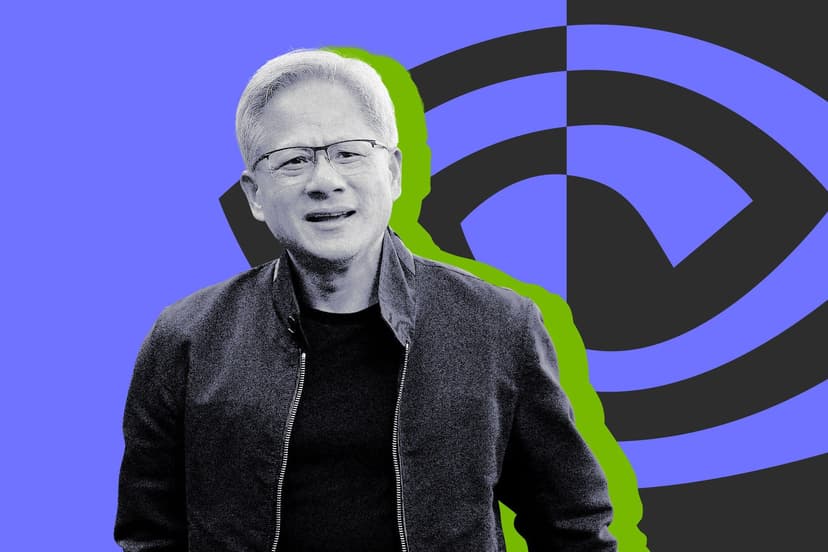
Nvidia has agreed to acquire Hugging Face in a deal worth almost $13 billion, according to CNBC. The move hands the world's most valuable chipmaker control over the internet's biggest open-source AI hub, and it comes just weeks after Hugging Face reportedly approached Nvidia CEO Jensen Huang about a potential tie-up.
Nvidia just made its boldest move yet to lock down the entire AI stack. The chip giant has agreed to acquire Hugging Face, the open-source platform that's become the de facto home for machine learning models and datasets, in a deal valued at almost $13 billion, according to CNBC. It's the kind of deal that makes you sit up, not because Nvidia needed more AI credibility, but because it's now buying the very community layer that developers use to build on top of everyone's chips, including its rivals'.
According to the report, Hugging Face actually approached Huang about the acquisition a few weeks ago, not the other way around. That's a notable detail. It suggests Hugging Face's leadership saw the writing on the wall, that staying independent in an AI landscape increasingly dominated by a handful of infrastructure giants was getting harder, and decided to get ahead of it rather than get squeezed out.
"With Hugging Face, we'll expand access to AI for developers and institutions worldwide," Huang told CNBC, framing the deal as an extension of Nvidia's mission rather than a defensive land grab. But make no mistake, this is also about control. Nvidia already dominates the chips that train and run AI models. Owning Hugging Face, the platform where hundreds of thousands of those models actually get shared, downloaded and fine-tuned, gives Nvidia a front-row seat on where AI development is headed next, and arguably a say in how it gets there.
Hugging Face built its reputation as the neutral ground of AI, a place where researchers from Google, Meta, Microsoft-backed OpenAI, and countless startups could all publish models side by side, regardless of whose cloud or chips powered them. That neutrality is exactly what made the company so valuable, and it's also what makes this acquisition a little uncomfortable for competitors. If Nvidia now owns the biggest open hub for model distribution, does that hub stay neutral, or does it quietly start favoring Nvidia's own hardware and software stack?
This deal doesn't happen in a vacuum. Nvidia has spent the last two years turning itself from a chip supplier into something closer to an AI infrastructure conglomerate, investing in cloud providers, model developers, and now, apparently, the community platforms that glue the whole ecosystem together. It's a strategy that echoes what we've seen play out across the industry, where the line between chipmaker, cloud provider, and AI lab keeps getting blurrier by the month.
[embedded image: Nvidia and Hugging Face logos side by side]
For Hugging Face, the deal offers something startups in this space rarely get, which is deep pockets and direct access to the compute that its own users are constantly begging for. Model training and fine-tuning are compute-hungry, and Hugging Face's community has long complained about GPU scarcity slowing down experimentation. Under Nvidia's roof, that bottleneck could ease considerably, assuming Nvidia follows through on the access promise Huang made.
The market reaction will be worth watching closely once trading resumes. Nvidia's stock has weathered plenty of AI-cycle volatility this year, and a nearly $13 billion acquisition, even for a company of Nvidia's scale, is the kind of move that tends to invite scrutiny from both investors and regulators. Antitrust watchdogs in the US and EU have already been circling Big Tech's AI investments, and a chipmaker buying up the platform that indexes the AI ecosystem is likely to draw fresh attention.
[video iframe: CNBC interview with Jensen Huang on the acquisition]
What happens next matters as much as the deal itself. Will Hugging Face keep operating as an open, chip-agnostic platform, or will it start nudging developers toward Nvidia's tools and cloud partners? Huang's comments suggest the company wants to frame this as an act of expansion rather than enclosure, but the AI community, understandably a little wary of consolidation these days, will be watching closely to see if that promise holds.
This deal marks a turning point in how consolidated the AI industry is becoming, with the world's dominant chipmaker now owning the community platform that much of the AI world relies on to build and share models. For developers and institutions, Huang's promise of expanded access sounds good on paper, but the real test will be whether Hugging Face keeps its open, neutral character or slowly becomes another arm of Nvidia's growing empire. Either way, rivals in AI and cloud computing now have one more reason to rethink their own dependence on Nvidia's ecosystem.