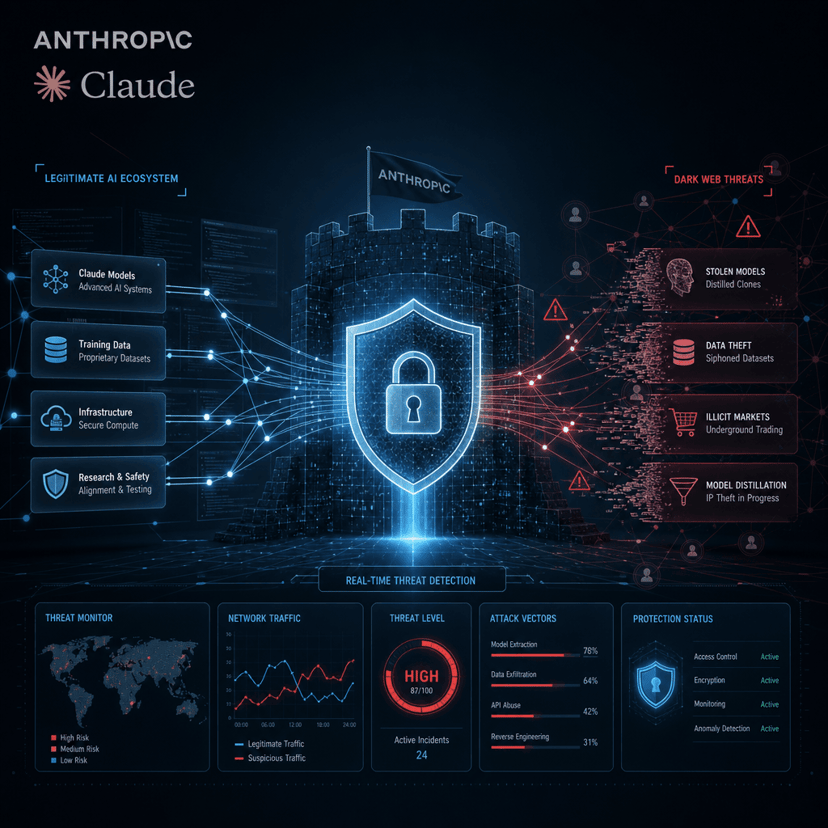
AI safety company Anthropic is rapidly scaling its cybersecurity-focused AI initiative, expanding Project Glasswing—now branded as Mythos—to 150 additional organizations spanning more than 15 countries. The move marks a significant acceleration from the model's initial April rollout to roughly 50 partners, signaling growing enterprise demand for AI-powered security tools as cyber threats become increasingly sophisticated.
Anthropic is pushing aggressively into the enterprise cybersecurity market with a major expansion of its specialized AI model. The company announced it's bringing Mythos—previously known as Project Glasswing—to 150 additional organizations across more than 15 countries, tripling its footprint in just two months.
The rapid scale-up comes after Anthropic initially released the model to about 50 partners in April specifically to test its capabilities in detecting cybersecurity vulnerabilities. According to CNBC, the model focuses on identifying security flaws that could leave enterprise systems exposed to attacks.
The timing couldn't be more critical. As organizations increasingly deploy AI systems across their infrastructure, the attack surface for cyber threats has expanded dramatically. Traditional security tools struggle to keep pace with AI-generated exploits and sophisticated phishing campaigns. That's created a massive opening for AI-native security solutions that can think like attackers.
Anthropic, best known for its Claude family of large language models, has been methodical about entering the enterprise market. Unlike rivals OpenAI and Google, which have pushed broad workplace productivity tools, Anthropic's bet on cybersecurity represents a more targeted enterprise play. The company's emphasis on AI safety—baked into its founding mission—makes security applications a natural fit.
The rebranding from Project Glasswing to Mythos also signals the model is moving beyond beta testing into broader commercial availability. Companies typically shed code names once they're confident in product-market fit and ready to scale. The fact that Anthropic is expanding to 150 organizations suggests the initial 50-partner cohort provided strong validation.
What remains unclear is how Mythos stacks up against established cybersecurity AI tools from companies like Microsoft, which has integrated security features into its Copilot suite, or specialized vendors like CrowdStrike and Palo Alto Networks that are embedding AI into their platforms. Anthropic's differentiation likely lies in its frontier model capabilities—Claude's reasoning abilities could theoretically spot complex, multi-stage attack patterns that narrower security models might miss.
The global expansion across 15+ countries also indicates Anthropic is building infrastructure to meet data residency and compliance requirements in different jurisdictions. That's no small feat for an AI company and suggests significant investment in international operations. Organizations in regulated industries like finance and healthcare need assurances that their security data won't leave specific geographic boundaries.
For enterprises weighing AI security options, Anthropic's expansion offers a new alternative backed by one of the best-resourced AI labs in the world. The company has raised billions from investors including Google and Salesforce Ventures, giving it the runway to compete in enterprise sales cycles that can take months or years to close.
The move also intensifies competition in the red-hot enterprise AI market. Every major AI lab is racing to prove it can generate revenue beyond consumer chatbots and API access. Cybersecurity represents one of the clearest ROI cases for AI—preventing a single major breach can justify years of software spending. If Mythos can demonstrate measurable security improvements, it could become a significant revenue driver for Anthropic.
What's particularly interesting is Anthropic's approach of testing with a limited partner group before expanding widely. That contrasts with the "ship fast and iterate" mentality common in consumer AI. The measured rollout suggests Anthropic is being cautious about potential false positives or security gaps that could damage customer trust in a high-stakes domain.
Anthropic's aggressive expansion of Mythos signals that enterprise AI is entering a new phase where specialized models for high-value use cases like cybersecurity are becoming table stakes. The company's ability to scale from 50 to 200 partner organizations in just two months suggests it's struck a nerve with enterprises desperate for better security tools. As AI-powered attacks grow more sophisticated, the race is on to see which AI lab can build the most effective defensive systems. For now, Anthropic is making a strong bid to own that category, leveraging its safety-first reputation into a concrete market advantage. The real test will be whether Mythos can detect threats that traditional tools miss—and whether enterprises are willing to trust their security to a relative newcomer in the space.