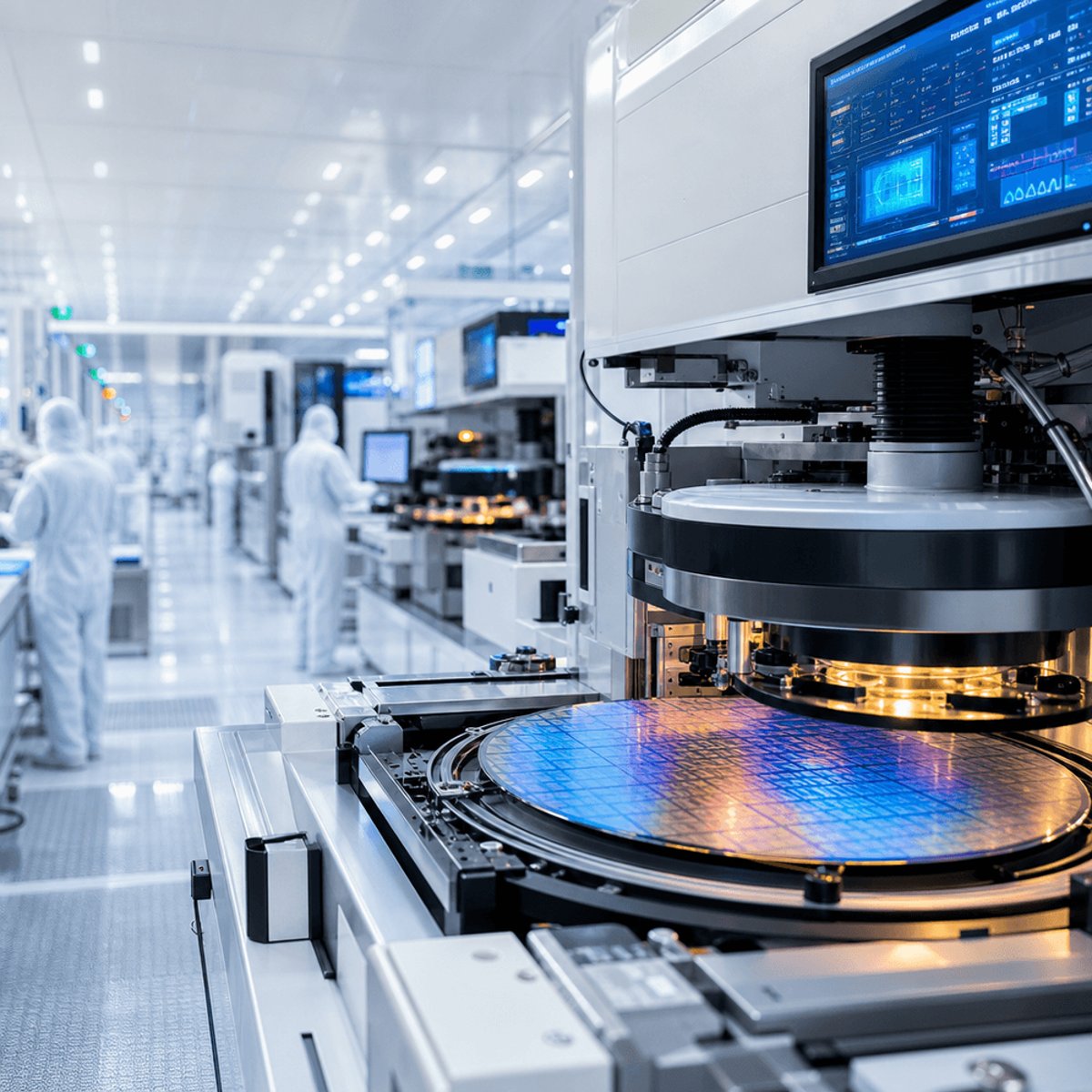
The world's leading chip manufacturer is doubling down on American soil. TSMC is accelerating construction of its Arizona semiconductor facilities, driven by what CFO Wendell Huang calls an AI 'megatrend' that shows no signs of slowing. The Taiwanese chipmaker's fresh investment signals a major bet that AI's appetite for cutting-edge processors will reshape global manufacturing for years to come, while also addressing growing pressure to reduce reliance on Asian production.
TSMC just made it clear where the chip industry is heading - and it's betting billions that AI will lead the way. In an exclusive interview with CNBC, CFO Wendell Huang revealed the company is ramping up investment in its Arizona manufacturing facilities faster than originally planned, citing 'robust customer demand' driven by artificial intelligence applications.
The acceleration comes as companies like Nvidia, Apple, and AMD race to secure advanced chip production capacity for AI processors. TSMC manufactures the most sophisticated chips in the world, including Nvidia's H100 and H200 AI accelerators that have become the backbone of generative AI infrastructure. With data center operators scrambling to build out AI capabilities, the company's advanced nodes are booked solid months in advance.
'The fresh investment comes on the back of robust customer demand,' Huang told CNBC, characterizing AI as a 'megatrend' that's fundamentally reshaping semiconductor requirements. It's a striking statement from a company known for conservative financial guidance - and it suggests TSMC sees AI demand as more than just a temporary spike.
The Arizona expansion represents more than just capacity. It's a strategic pivot for a company that has historically concentrated its most advanced manufacturing in Taiwan. TSMC's Arizona fabs are slated to produce chips using the company's cutting-edge 3-nanometer and eventually 2-nanometer processes - the same technology that powers the latest iPhone processors and will soon drive next-generation AI chips. By accelerating the timeline, TSMC is effectively bringing its crown jewels to American soil years ahead of what seemed possible just a few years ago.
The timing couldn't be more critical. U.S. lawmakers have pushed hard for domestic chip production through initiatives like the CHIPS Act, which allocated $52 billion to rebuild American semiconductor manufacturing. TSMC has already committed over $40 billion to its Arizona project, which will eventually include multiple fabrication plants. The accelerated buildout suggests the company is seeing returns on that investment faster than anticipated.
But there's a competitive angle here that can't be ignored. Intel is simultaneously racing to expand its own foundry business, hoping to challenge TSMC's dominance in contract chipmaking. Samsung, TSMC's closest rival in advanced process technology, is also eyeing AI chip production. By speeding up its Arizona timeline, TSMC is essentially staking out territory in the U.S. market before competitors can gain ground.
The demand picture backs up TSMC's bullishness. AI model training requires massive arrays of specialized processors, while inference - actually running AI models - is creating entirely new categories of chip demand. Companies are designing custom AI accelerators, edge AI chips, and specialized processors for everything from autonomous vehicles to robotics. All of that silicon needs to be manufactured somewhere, and TSMC's advanced processes are the gold standard.
Analysts have noted that AI represents a fundamental shift in semiconductor economics. Unlike previous computing waves that eventually plateaued, AI workloads keep growing more compute-intensive. Each new generation of language models requires exponentially more processing power, and companies like OpenAI, Google, and Microsoft are in an arms race to build bigger, more capable systems. That translates directly into chip orders.
The Arizona buildout also addresses a persistent supply chain vulnerability. When geopolitical tensions around Taiwan escalated in recent years, tech companies and governments alike realized how dependent the global economy had become on a single region for critical technology. TSMC's U.S. expansion provides a hedge against that risk, ensuring that even if Taiwan faces disruption, advanced chip production can continue.
For American tech giants, having TSMC capacity on domestic soil offers strategic advantages beyond just supply security. It enables closer collaboration on chip design, faster iteration cycles, and potentially better protection of proprietary technology. Apple, which has designed increasingly sophisticated custom silicon for its devices, could particularly benefit from having TSMC's advanced manufacturing capabilities just a few hours' flight from Cupertino instead of across the Pacific.
The accelerated timeline does raise questions about execution. Building semiconductor fabs is notoriously complex, requiring ultra-clean environments, precision equipment, and highly specialized workers. TSMC has faced challenges recruiting skilled technicians in Arizona and adapting its Taiwanese work culture to American labor practices. Speeding up construction could strain those already-tight resources. But Huang's comments suggest the company believes customer demand justifies pushing through those obstacles.
TSMC's bet on Arizona isn't just about building factories - it's a referendum on AI's staying power. By accelerating billions in U.S. manufacturing investment, the world's most important chipmaker is signaling that AI demand isn't hype, it's infrastructure. For tech companies racing to dominate the AI era, TSMC's expanded American capacity could be the difference between leading and falling behind. The bigger question now is whether competitors can keep pace, or if TSMC's head start in advanced U.S. manufacturing will cement its dominance for the next decade of computing.