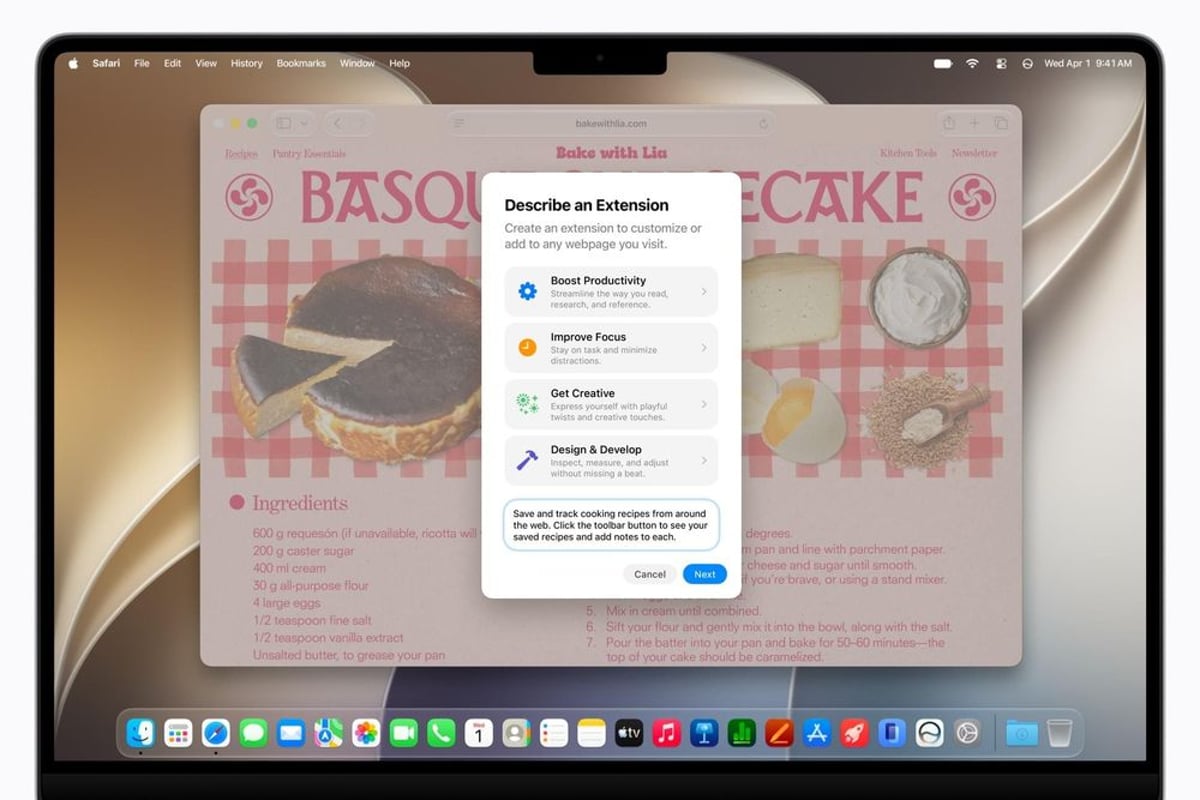
Apple just unveiled a solution to Safari's biggest weakness: its sparse extension library. The company demoed a new Apple Intelligence feature that lets users generate custom Safari extensions by simply describing them in natural language - no coding required. It's Apple's latest move to democratize development while addressing Safari's longstanding gap against Chrome and Firefox's massive extension ecosystems.
Apple is betting that AI can fix what years of developer outreach couldn't - Safari's anemic extension library. During a demo shared at its developer conference, the company showed off a feature that lets anyone become a Safari extension developer by typing what they want in plain English.
The demo was straightforward but striking. A user typed: "Save and track cooking recipes from around the web. Click the toolbar button to see your saved recipes and add notes to each." Apple Intelligence then generated a complete "Recipe Keeper" extension with a functional interface, data persistence, and toolbar integration. No JavaScript knowledge required. No Xcode wrestling. Just describe it and Safari builds it.
It's a direct assault on Safari's Achilles heel. While Google Chrome boasts over 137,000 extensions and Mozilla Firefox maintains a robust library of add-ons, Safari has struggled to attract third-party developers. The culprit? Apple's notoriously stringent development requirements and the smaller macOS/iOS developer base compared to the cross-platform reach of Chrome.
But Apple's approach sidesteps the traditional developer pipeline entirely. Instead of wooing more programmers to build for Safari, the company is turning its users into accidental developers. It's the same philosophy driving Apple's broader AI strategy - embedding intelligence so deeply into the OS that technical barriers dissolve.
The timing isn't coincidental. Microsoft has been aggressively pushing AI-powered coding tools through GitHub Copilot, while Google recently integrated code generation into its Gemini models. Apple's entering this race with a consumer-focused twist - you're not generating code to learn programming, you're generating functional tools to solve immediate problems.
Under the hood, this feature represents a significant technical challenge. Browser extensions aren't simple scripts - they require proper API calls, security sandboxing, and integration with Safari's extension framework. Apple Intelligence needs to understand not just what the user wants, but how to architect it within Safari's constraints. It's code generation with training wheels, but the training wheels are doing heavy lifting.
The competitive implications ripple beyond just browser wars. If users can conjure custom extensions on demand, the value proposition of Chrome's massive extension library shrinks. Why install a third-party recipe saver when you can generate exactly what you need? It's not about matching Chrome's 137,000 extensions - it's about making that number irrelevant.
Of course, questions remain. How complex can these AI-generated extensions get? Will they match the sophistication of hand-coded alternatives? And what happens when generated code has bugs or security vulnerabilities? Apple didn't detail the limitations during the demo, but the company's historically cautious approach to security suggests there will be guardrails.
The feature also signals Apple's broader AI positioning. While OpenAI and Google race toward general-purpose AI assistants, Apple continues betting on practical, task-specific intelligence. You won't get philosophical conversations from Apple Intelligence, but you might get a perfectly functional browser extension in seconds.
For Safari users who've long envied Chrome's extension ecosystem, this could be transformational. For developers who've built Safari extensions the traditional way, it's a warning shot. And for competitors watching Apple's AI strategy unfold, it's another data point in the company's playbook: identify friction, apply AI, make the competition's advantages obsolete.
Apple's AI-powered extension builder represents more than a feature update - it's a strategic repositioning of Safari's weakness as a potential strength. By letting users generate custom extensions on demand, Apple doesn't need to match Chrome's massive third-party ecosystem. It just needs to make that ecosystem less relevant. The real test comes when users push beyond simple recipe savers to complex productivity tools. If Apple Intelligence can scale to match that demand, Safari's extension problem might finally be solved - not by attracting more developers, but by making everyone a developer.