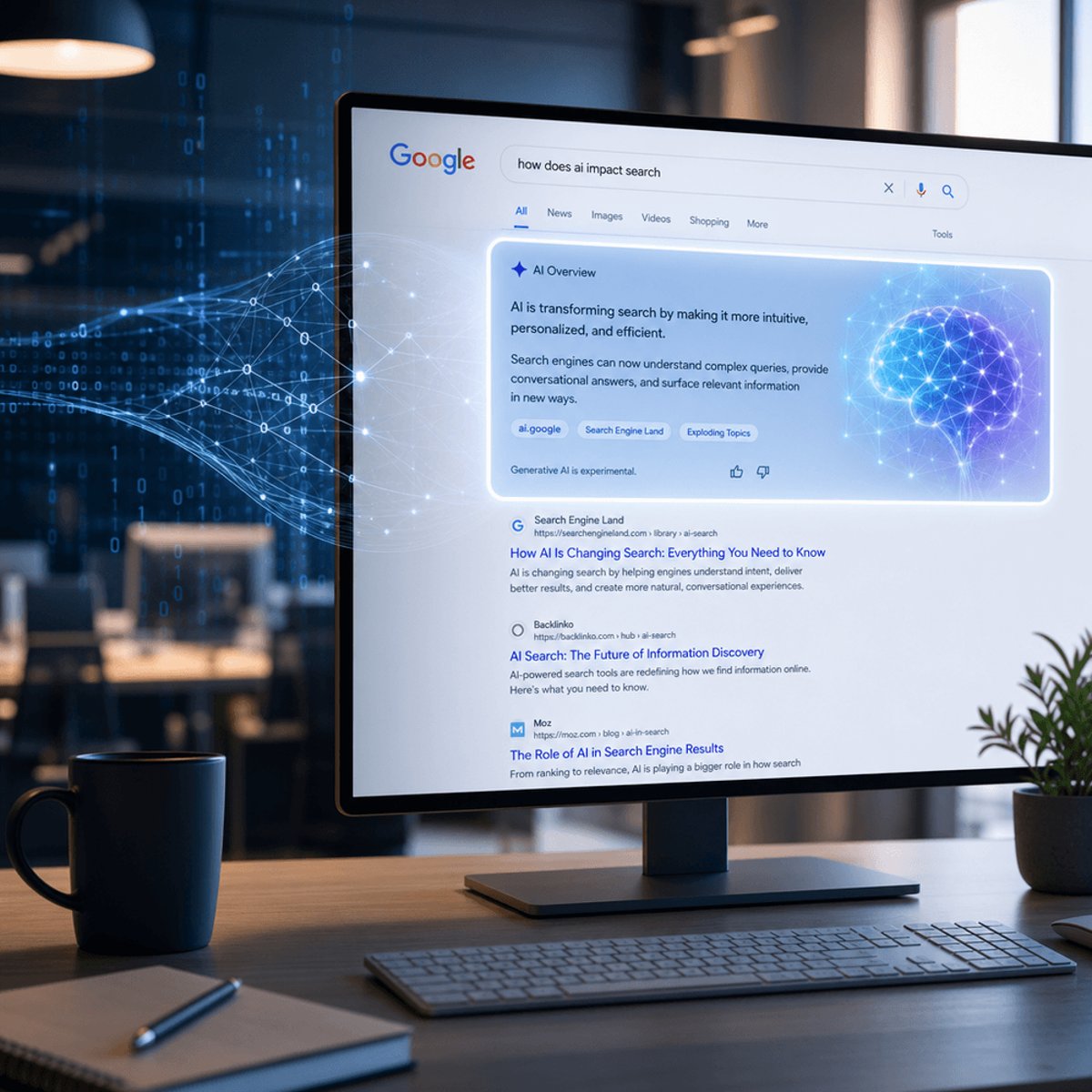
Google's AI Overviews now appear in 43% of all searches, according to new data that underscores just how rapidly AI-generated answers are becoming the default way people discover information online. The figure marks a dramatic acceleration since the feature's broader rollout earlier this year, fundamentally reshaping how billions of users interact with the world's dominant search engine and sending shockwaves through the SEO and publishing industries.
Google just crossed a threshold that changes everything about how the internet works. The company's AI Overviews - those AI-generated summaries that appear at the top of search results - now show up in 43% of queries, according to new research shared by TechCrunch. That's not a typo. Nearly half of all searches on the world's most-used search engine now serve up an AI-written answer before users ever see a traditional link.
The speed of this rollout is staggering. Google first introduced AI Overviews - previously called Search Generative Experience - in limited testing last year before expanding availability in May. Now, just months later, the feature has become the de facto search experience for hundreds of millions of daily queries. The 43% figure represents a seismic shift in online information discovery, one that's happening in real-time whether the industry is ready or not.
For publishers and content creators, the implications are immediate and existential. When Google's AI extracts and synthesizes information directly at the top of results, users have less reason to click through to original sources. Traffic patterns are already shifting. Several major publishers have reported double-digit declines in Google referral traffic over recent months, though few are willing to speak on the record given their dependence on the search giant. One digital media executive, speaking on condition of anonymity, described the situation as "watching our distribution model evaporate in slow motion."
The SEO industry is scrambling to adapt. Traditional optimization strategies focused on ranking in the top ten blue links suddenly matter less when AI Overviews dominate the valuable real estate above the fold. "We're seeing clients panic about visibility," says one search marketing consultant who requested anonymity. "The playbook we've refined over 20 years is being rewritten quarter by quarter." Some agencies are now advising clients to optimize specifically for inclusion in AI Overview citations, though the ranking factors remain opaque.
But Google isn't rolling this out blindly. The company has spent months refining the technology after early missteps, including the now-infamous incident where AI Overviews suggested putting glue on pizza. The current 43% deployment rate suggests Google is confident in the quality and user reception, even as it fundamentally alters the search experience that made the company a trillion-dollar enterprise.
The business model implications are equally profound. Google's advertising empire is built on those blue links - the sponsored results that appear alongside organic listings. AI Overviews change the entire dynamic. If users get their answers without clicking, where do the ads go? Google has started testing ads within AI Overview experiences, but the formats are still experimental. Analysts estimate that even a 10% reduction in click-through rates could impact billions in annual revenue.
Competitors are watching closely. OpenAI has been testing SearchGPT, while Microsoft's Bing has integrated similar AI capabilities through Copilot. Perplexity, the AI search startup, has built its entire model around conversational answers rather than link lists. Google's aggressive deployment of AI Overviews suggests the company sees AI-first search as inevitable and wants to own the transition rather than cede ground to upstarts.
Enterprise implications extend beyond just traffic concerns. Companies investing in content marketing and SEO as primary customer acquisition channels are reassessing their strategies. Some are pivoting toward direct distribution through email and social platforms. Others are experimenting with structured data markup and schema optimization to increase their chances of being cited in AI responses. The shift is forcing a fundamental rethinking of content ROI.
The technology powering this transformation traces back to Google's investments in large language models and its Gemini AI platform. The AI Overviews synthesize information from multiple sources, aiming to provide comprehensive answers while theoretically maintaining quality through citation links. But the execution remains imperfect. Users and fact-checkers continue to surface instances where the AI confidently presents incorrect or misleading information, raising questions about accountability when the source material gets abstracted away.
Regulatory scrutiny is also mounting. Publishers in Europe and the US have raised concerns that AI Overviews amount to content appropriation without fair compensation. Several media organizations are exploring legal challenges, arguing that Google is using their copyrighted content to generate answers that eliminate the need to visit their sites. The debate echoes earlier battles over Google News and snippet length, but with higher stakes given AI's ability to synthesize rather than just excerpt.
The 43% figure itself raises questions about Google's endgame. Is this a plateau, or will the company push toward AI Overviews appearing in 60%, 80%, or even 100% of searches? Google hasn't publicly stated a target, but the trajectory suggests continued expansion as the technology improves and user feedback remains positive. Internal metrics reportedly show that users engage more with AI Overview results, spending more time on the search results page itself.
For everyday users, the experience is undeniably convenient. Need a quick fact, a recipe conversion, or a summary of a complex topic? The AI Overview delivers it instantly without requiring navigation through multiple pages and ads. But convenience comes with trade-offs - the loss of serendipitous discovery, the flattening of diverse voices into a single synthesized answer, and the concentration of information power in one AI system controlled by one company.
Google's AI Overviews reaching 43% of searches isn't just a product milestone - it's a fundamental restructuring of how information flows online. Publishers, marketers, and SEO professionals are facing an existential reckoning as AI-generated answers replace traditional search results. The next few quarters will determine whether the industry can adapt to this new reality or if Google's dominance in search is about to trigger a wave of disruption across digital media. What's certain is that the internet we've known for the past two decades is changing faster than most anticipated, and the 43% figure is just the beginning.