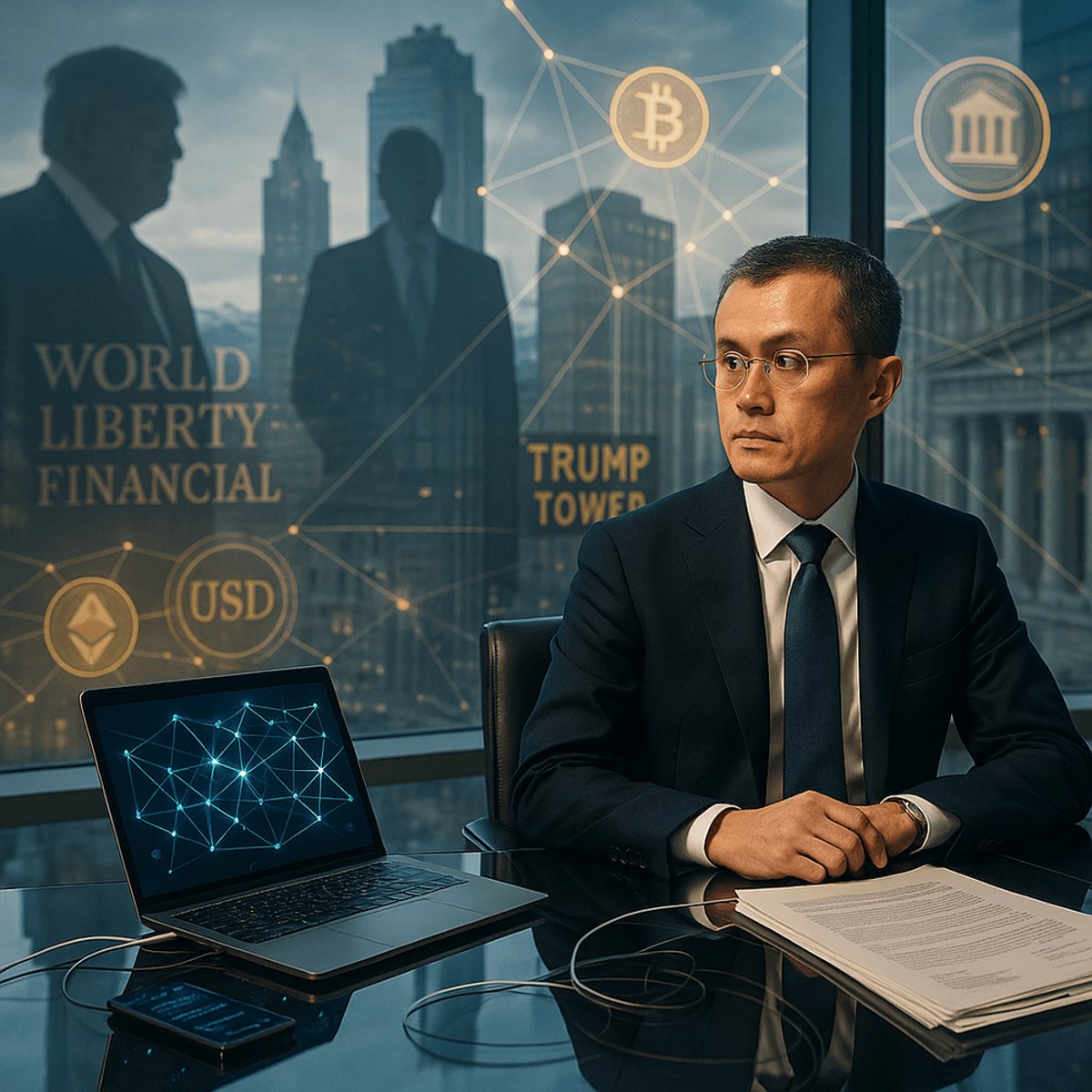
Changpeng "CZ" Zhao is pushing back against speculation linking his presidential pardon to business dealings with the Trump family. Speaking from Davos, the Binance founder flatly denied any commercial relationship exists, calling reports "misconstrued" after scrutiny intensified over a $2 billion Abu Dhabi investment using Trump-backed stablecoin USD1. The statement comes three months after Trump pardoned Zhao for money laundering charges that sent him to prison for four months.
The crypto world's most controversial comeback story just got more complicated. Changpeng "CZ" Zhao, fresh off a presidential pardon that erased his money laundering conviction, is now playing defense against accusations his freedom came with strings attached to the Trump family's burgeoning crypto empire.
"There's no business relationships whatsoever," Zhao told CNBC's Andrew Ross Sorkin Thursday from the World Economic Forum in Davos, his first major appearance since Trump wiped his record clean in October 2025. The denial is direct, but the optics tell a messier story that's got Washington's crypto skeptics asking questions.
The timeline raises eyebrows. Binance, still the world's largest crypto exchange despite its legal troubles, accepted a $2 billion investment from Abu Dhabi's state-owned firm MGX in March 2025. Nothing unusual there except the payment method: MGX used USD1, a stablecoin created by World Liberty Financial, the crypto venture run by President Trump's family. Seven months later, Trump pardoned Zhao.
"MGX is the investor. They choose USD1," Zhao explained to CNBC. "My request to them was they pay us in crypto. I don't want to deal with banks, really. Many people misconstrued that." He's framing it as a simple payment preference, nothing more than a founder who'd rather avoid traditional banking rails after his company paid $4.3 billion to settle with the Department of Justice in 2023.
But The Wall Street Journal reported that Binance didn't just accept USD1 as payment - the exchange also helped build the technology behind the stablecoin, citing sources familiar with the matter. Zhao told CNBC that Binance has since converted the investment out of USD1 "in portions over time," treating it like any other currency. "Stablecoin is just a currency for payment. Just because I accepted that, it doesn't mean I invested in the issuer of that," he said.
The connections don't stop at cryptocurrency. NBC News revealed that Binance recently hired lobbyist Charles McDowell's firm, Checkmate Government Relations, for $450,000. McDowell is a friend of Donald Trump Jr., and the disclosed lobbying work included pushing the White House and Treasury Department for "executive relief" and "financial services policy issues relating to digital assets and cryptocurrency." That's Washington-speak for pardons and regulatory rollbacks.
"There is a lot of media saying that there is some deal in place to get me the pardon," Zhao told CNBC at Davos. "As far as I know, that does not exist at all." He insists he's never even spoken with Trump directly. "The closest that I got to him was today when he was doing the Board of Peace session," Zhao said. "I was in the audience, about 30 to 40 feet away from him."
Trump himself backed up that claim in a CBS "60 Minutes" interview last November. "I have no idea who he is," Trump said when asked about Zhao. "I was told that he was a victim, just like I was and just like many other people, of a vicious, horrible group of people in the Biden administration." When pressed on why he issued the pardon, Trump said, "A lot of people say that he wasn't guilty of anything. And so I gave him a pardon at the request of a lot of very good people."
The "victim" narrative conveniently overlooks that Zhao pleaded guilty to enabling money laundering during his time leading Binance. He served four months in prison before his release in September 2024. Zhao stepped down as CEO as part of the plea deal but remains a major shareholder in the exchange, which still dominates global crypto trading volume despite the regulatory scrutiny.
The crypto industry is watching this closely. If Binance's ties to World Liberty Financial helped secure Zhao's pardon - even indirectly - it sets a precedent for how Trump-era crypto policy might work: transactional, family-connected, and willing to overlook serious financial crimes. Critics argue accepting payment in USD1 and potentially helping build its technology creates exactly the kind of business relationship Zhao is now denying.
World Liberty Financial hasn't commented on the nature of its relationship with Binance. The Trump family's crypto venture launched with promises to democratize decentralized finance but has faced criticism for potential conflicts of interest now that Trump is back in the White House. Using presidential pardons to clear the records of crypto executives with business ties to the family's ventures would take those conflicts to another level entirely.
Zhao's Davos appearance is part of his reemergence into the crypto elite after months in prison and under supervised release. He's positioning himself as a misunderstood founder who got caught in political crossfire, not a convicted criminal who facilitated money laundering at massive scale. Whether the industry buys that narrative may depend less on what he says in Switzerland and more on what additional details emerge about Binance's relationship with the Trump family's crypto ambitions.
Zhao's denials may be technically accurate - no direct business contracts between him and Trump - but the web of connections tells a different story. A $2 billion investment using Trump family stablecoin, lobbyists with White House access getting paid nearly half a million, and a pardon that arrived right on schedule. Whether that adds up to a quid pro quo or just convenient timing for the crypto industry's most embattled founder, the scrutiny isn't going away. Zhao wanted to avoid dealing with banks. Instead, he's dealing with questions about whether his freedom came at the cost of entangling Binance with America's most politically connected crypto project.