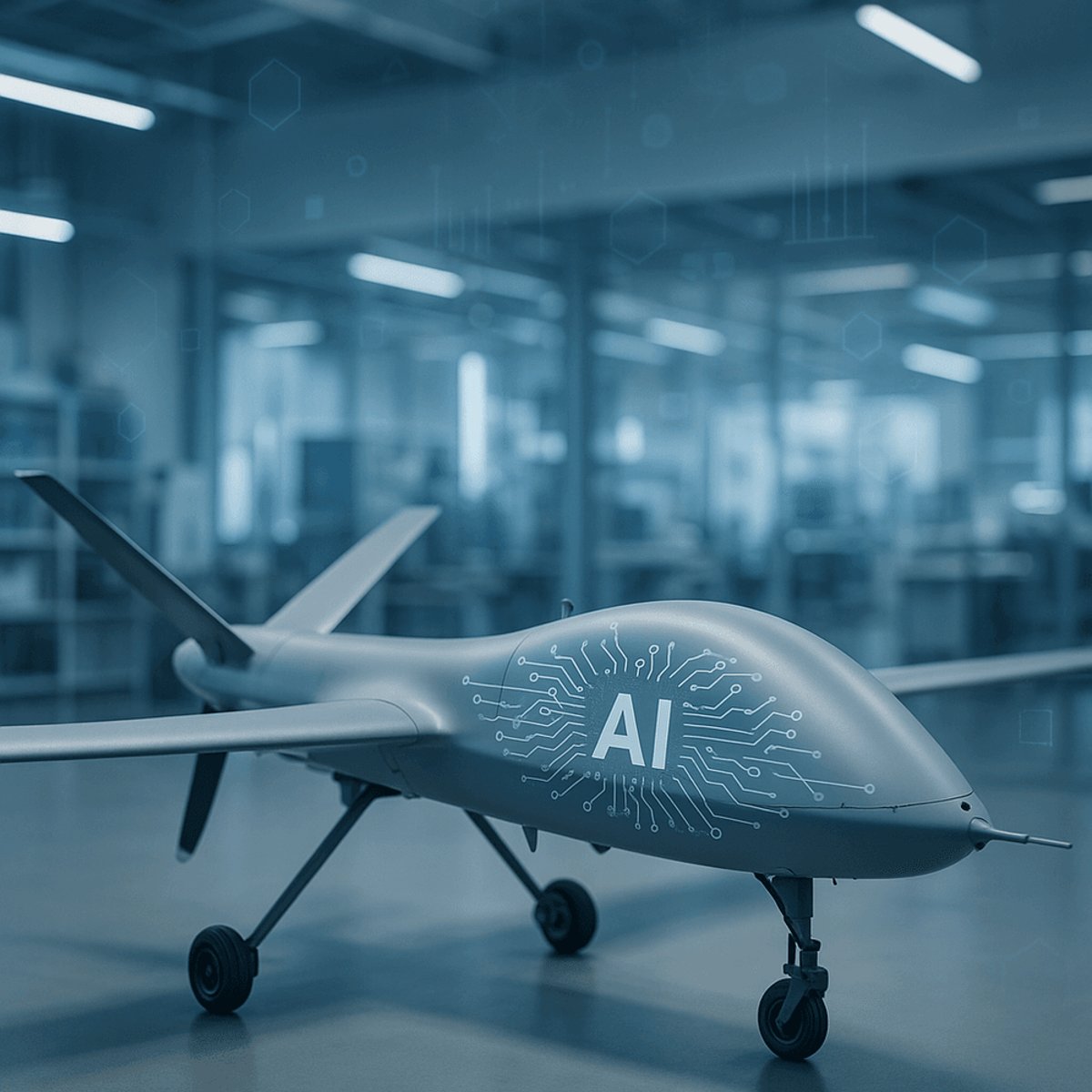
Bone AI just secured $12 million to take on Asia's $69 billion defense establishment with AI-powered robotics. The Seoul-based startup is already generating $3 million in revenue and landing seven-figure government contracts - all within its first year. Founded by MarqVision co-founder DK Lee, Bone represents a rare challenger to South Korea's manufacturing giants in the nascent defense-tech space.
South Korea's defense giants are sitting on $69 billion in order backlogs, yet virtually no startups have emerged to challenge them. That gap just got its first serious threat.
Bone AI closed a $12 million seed round led by Third Prime, with strategic investment from Kolon Group, to build what founder DK Lee calls a "physical AI" platform spanning autonomous drones, ground vehicles, and marine systems. The Seoul and Palo Alto-based startup is already pulling in serious revenue - $3 million in year one plus a seven-figure government contract - by moving fast and acquiring assets.
Lee's strategy is classic Silicon Valley meets Korean manufacturing prowess. Six months after launch, Bone acquired D-Makers, a local drone company, to instantly gain hardware IP and production capabilities. "Originally focused on AI models for robotics, Bone is now integrating its existing AI division with the newly acquired company, and more acquisitions are on the horizon," Lee told TechCrunch in an exclusive interview.
The founder put his money where his mouth is, personally committing $1.5 million - over 10% of the round. "That was important to me because I wanted to show both investors and my team that I'm fully invested, financially and emotionally, in this mission," he said.
This isn't Lee's first rodeo. His previous company MarqVision gave him deep AI experience, but also convinced him that the next frontier isn't digital - it's physical. After leaving MarqVision, he went full immersion mode: "going to robotics conferences like IEEE ICRA, cold-emailing the engineers behind Google RT-1/RT-2, and even walking up to Jim Keller, CEO of Tenstorrent, at a cafe."
Bone's timing couldn't be better. South Korea just became the second-largest arms supplier to European NATO members through the new EU-South Korea Security and Defence Partnership. Yet while Anduril commands a $30 billion valuation in the US and Europe's Helsing hit $13 billion, Asia's defense-tech startup scene remains practically nonexistent.
"Asia has yet to see the same level of adoption," Michael Kim, general partner at Third Prime, told TechCrunch. "As economies around the world focus on reindustrialization, not just the U.S., Bone sits at the intersection of sovereign AI, multipolarity, and reindustrialization."
The startup isn't just building drones - it's constructing what Lee calls "the industrial backbone that allows intelligent machines to exist at scale." Even Nvidia, the world's most valuable AI company, relies on Asian manufacturing partners. Bone wants to own that entire stack domestically.
"Our mission at Bone is to build the supply chain for Physical AI within South Korea, and then expand that capability to the U.S., Europe, and other allied countries," Lee explained. The company develops autonomous aerial, ground, and marine vehicles for defense clients, starting with drones for logistics support, wildfire detection, and anti-drone defense.
Kolon Group's strategic investment makes perfect sense - the South Korean industrial giant brings decades of advanced materials and manufacturing expertise that Bone needs to scale. "Many niche hardware players exist but haven't received Bay Area VC funding; Bone has a strong 'buy versus build strategy' to acquire and integrate these assets, accelerating product maturity and commercial traction," Kim noted.
Bone has already won selection in a South Korean government-backed logistics program deploying UAVs and UGVs powered by its autonomy stack. The company's rapid revenue growth - from zero to $3 million plus major contracts in under 12 months - suggests Lee's acquisition-driven approach is working.
While competitors like Samsung and LG dominate consumer electronics, South Korea's defense-tech startup ecosystem remains wide open. Bone's bet is that the same manufacturing excellence that built those global giants can now power a new generation of AI-driven defense companies.
Bone AI represents something rare in Asia's defense landscape - a startup bold enough to challenge established giants with Silicon Valley speed and Korean manufacturing muscle. Lee's acquisition-heavy strategy and early revenue traction suggest this isn't just another AI pipe dream, but a serious attempt to build the industrial backbone for next-generation defense systems. With geopolitical tensions rising and defense budgets expanding globally, Bone's timing to capture Asia's underserved market looks prescient. The real test will be whether they can scale their ambitious "physical AI" vision fast enough to compete with Anduril and other Western defense-tech unicorns.