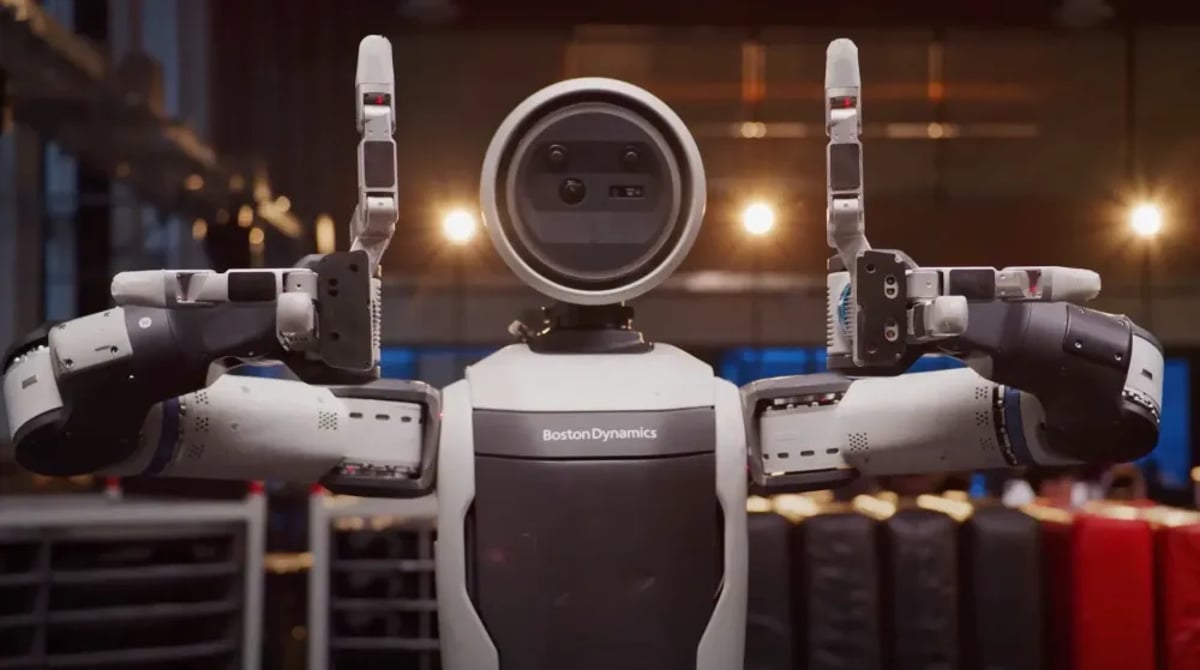
Boston Dynamics Goes All-In on Humanoids at CES
CES just delivered a defining moment for robotics.
Boston Dynamics announced strategic AI partnerships with Nvidia and Google DeepMind, while simultaneously unveiling the first production-ready version of its Atlas humanoid robot. This is not a concept demo or lab prototype. Atlas is officially ready for real-world deployment.
The message from Boston Dynamics is clear. Humanoid robotics has crossed from research into manufacturing reality.
Atlas Is No Longer a Prototype
The new Atlas represents a massive leap toward affordable, general-purpose humanoid robots, especially as U.S. companies race to close the gap with fast-moving Chinese consumer robotics firms already shipping at scale.
Atlas is built to work where humans work.
-
56 degrees of freedom, with mostly fully rotational joints
-
Human-scale hands featuring tactile sensing in fingers and palms
-
360-degree vision, allowing Atlas to detect people approaching from any direction as part of a holistic safety system
-
Lifts up to 110 pounds and reaches 7.5 feet
-
Water-resistant, capable of full-strength operation during industrial washdowns
-
Operates from -4°F to 104°F, designed for real factory and warehouse conditions
This is not a robot designed to impress on stage. It is designed to survive factory floors.
AI Partnerships That Matter
The partnerships with Nvidia and Google DeepMind are the real accelerant.
Nvidia brings AI compute, simulation, and robotics infrastructure, enabling faster training, better perception, and scalable deployment. DeepMind contributes cutting-edge reinforcement learning, control, and general intelligence research, pushing Atlas beyond scripted automation toward adaptable behavior.
Together, these partnerships position Atlas as a learning system, not a fixed machine.
Fast Training, Continuous Work
One of the most striking details is how quickly Atlas can be deployed.
-
Most new tasks can be trained in under one day
-
Atlas works about four hours continuously using dual swappable batteries
-
When power runs low, it autonomously navigates to a charging station, swaps its own batteries, and resumes work without human intervention
This dramatically lowers operational friction and labor overhead, two of the biggest barriers to industrial robot adoption.
A Networked Robot Workforce
Atlas robots do not learn in isolation.
Through Boston Dynamics’ Orbit platform, skills learned by one Atlas can be shared instantly with any other Atlas. Once a task is mastered, it becomes part of a growing collective intelligence.
This turns fleets of robots into compounding assets, where deployment speed and capability increase over time.
Why This Changes the Market
This announcement signals something bigger than a single robot launch.
-
Humanoid robots are now production-ready
-
AI-driven learning is replacing brittle automation
-
The U.S. is re-entering the humanoid race at scale
-
Factories, warehouses, and logistics centers are the first wave
Boston Dynamics is no longer just showcasing what robots can do. It is shipping what robots will do, every day, at work.
CES 2026 will be remembered as the moment humanoid robotics stopped being futuristic and started being inevitable.