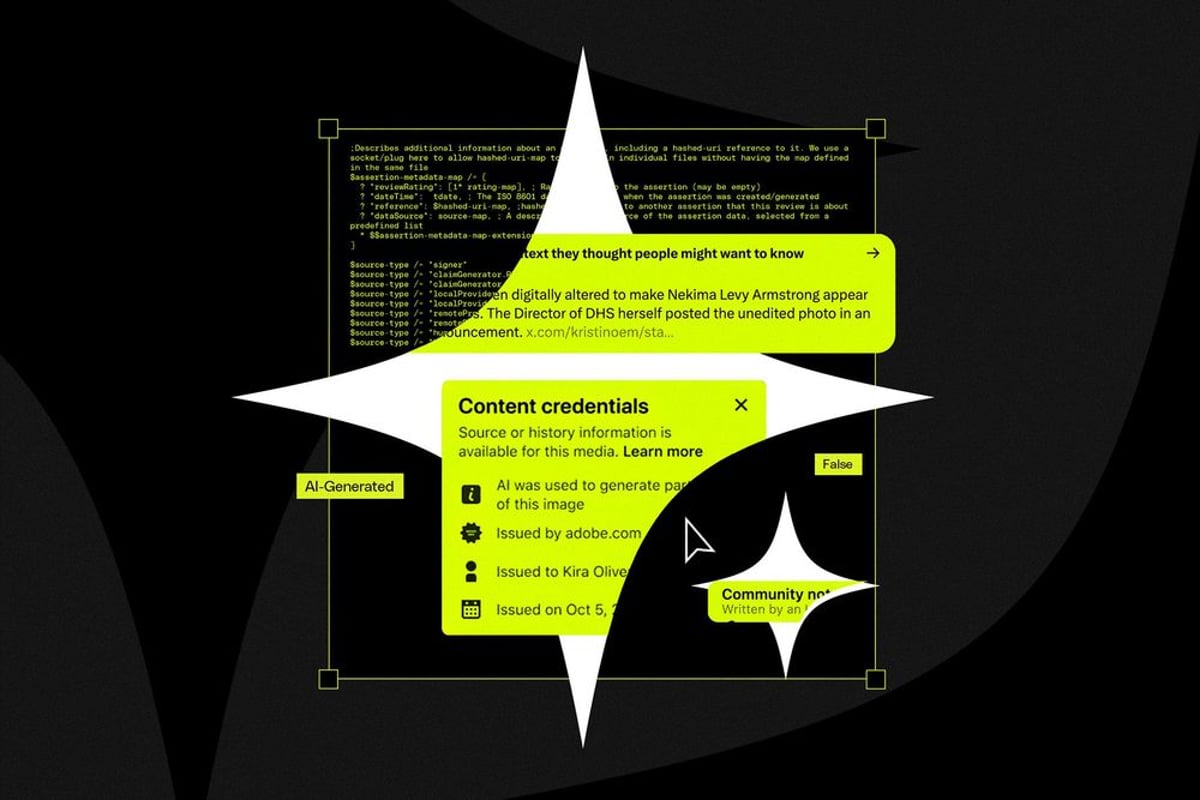
Adobe's C2PA authentication standard is collapsing under real-world pressure, according to a damning investigation by The Verge. The metadata system - backed by Meta, Microsoft, and OpenAI - was meant to label AI-generated content and verify authentic media. Instead, platforms strip the metadata during uploads, Apple refuses to join, and Instagram chief Adam Mosseri openly admits society must start with skepticism about all photos and videos. As deepfakes flood social platforms and even the U.S. government distributes AI-manipulated images, the war on consensus reality is being lost at the infrastructure level.
Adobe launched C2PA with a promise: embed tamper-proof metadata at the moment of creation, track every edit, and give platforms a way to authenticate real content versus AI-generated deepfakes. Two years later, the standard is imploding.
It's failed, Jess Weatherbed, who covers creative tools for The Verge, told the Decoder podcast this week. What C2PA was designed for and what companies are using it for are two different things.
The coalition behind C2PA reads like a who's who of tech power: Adobe, Meta, Microsoft, Google, OpenAI, and Qualcomm all sit on the steering committee. Sony, Leica, and Nikon embed the system in new camera models. Google Pixel phones write C2PA metadata to every photo. But in practice, none of it works.
The breakdown happens at distribution. When you upload an image to Instagram, LinkedIn, or Threads - all supposedly using the standard - the platforms strip out the metadata anyway. They have no idea what to do with it when they actually have it, Weatherbed said. According to internal Adobe discussions, even OpenAI admits the metadata is incredibly easy to strip to the point that online platforms might actually do that accidentally.
The most glaring gap? Apple won't join. Sources told Weatherbed the iPhone maker was involved in conversations but nothing moved forward. That's a fatal blow - Apple controls the majority of smartphone photography in developed markets, the exact cameras capturing protest footage, government overreach, and social movements that rely on visual proof.
Apple needs to be able to stand on its laurels about something, and nothing is going to offer them that at the minute, Weatherbed explained. The company watched Google and OpenAI loudly champion C2PA only to watch it fail in deployment.
Meanwhile, Instagram head Adam Mosseri dropped a bomb on New Year's Eve: For most of my life, I could safely assume photographs or videos were largely accurate captures of moments that happened. This is clearly no longer the case. His solution? Society must start with skepticism about all visual media. That's Instagram - a platform built entirely on photo sharing - telling 2 billion users to assume everything is fake.
Mosseri is just openly saying, 'We're using this thing and it doesn't work, but imagine if it did,' Weatherbed said. That's deeply unhelpful. The irony cuts deeper: Meta tried labeling AI content in 2023, slapped Made with AI tags on everything, and immediately faced creator backlash. They retreated. Now Mosseri wants to try again by labeling real content instead - exactly what C2PA was supposed to do.
The technical problems run deep. Modern smartphone cameras don't capture single moments - they merge multiple exposures into computational composites. Samsung got caught generating moon photos from scratch. Google says Pixel cameras capture memories, not reality. Where does C2PA draw the line? How do you define how much AI in something is too much AI? Weatherbed asked. Even basic editing features now trigger AI flags in metadata.
YouTube shows the disconnect. Google runs SynthID watermarking, supports C2PA, and embeds authentication in Pixel hardware. Yet there are AI videos all over YouTube that don't carry this, Weatherbed reported. When pressed, YouTube gives the same response every platform does: We're working on it. It's going to get there eventually.
It won't. X (formerly Twitter) was a C2PA founding member, then Elon Musk bought the platform and it vanished. TikTok technically supports the standard but inconsistently applies labels. Pinterest is now unusable for creatives trying to filter AI slop, Weatherbed said. The infrastructure to verify authenticity exists - platforms just won't implement it properly.
The profit motive explains why. AI companies and platforms are profiting off of all the stuff they're showing us, Weatherbed noted. YouTube CEO Neal Mohan announced the future of YouTube is AI after Google posted record earnings. Why would Meta kneecap AI content distribution when it drives engagement? Why would any platform slam on the brakes of development to figure out authentication?
Meanwhile, the U.S. government floods social media with AI-manipulated images. The White House publishes fabricated photos of arrests. The Department of Homeland Security distributes images modified to show people crying during deportations when they weren't. This isn't hypothetical misuse - it's a war on reality from literally the most powerful government in the history of the world.
C2PA has never stood up and said, 'We are going to fix this for you,' Weatherbed said. A lot of companies came on board and went, 'Well, we're using this and this is going to fix it for you when it works.' That's an impossible task. The standard was originally designed to help photographers prove authorship of creative work. Tech giants repurposed it as an AI safeguard, then half-heartedly deployed it, then watched it crumble under real-world conditions.
Only one platform is trying a different approach: Cara, an artist community, promises to ban all AI-generated artwork. But Weatherbed is skeptical. Anyone making those statements saying, 'Yeah, we're going to keep AI off the platform' - well how? They can't. Detection systems are built by the same AI companies creating the deepfakes.
The next phase will be regulatory, Weatherbed predicts. The UK's Online Safety Act already hints at mandatory labeling requirements. But unless regulations force every platform to uniformly implement authentication - and punish non-compliance - the metadata standard remains what it is today: a marketing badge tech companies wave around while doing nothing.
There is not going to be a point in the next three to five years where we sign on and go, 'I can now tell what's real and what's not because of C2PA,' Weatherbed concluded. That's never going to happen.
The failure of C2PA exposes a fundamental truth: tech platforms won't police AI content authenticity when it conflicts with engagement and profit. As Instagram's Mosseri admitted, society is shifting from trusting visual evidence by default to presuming everything is fake. That erosion of consensus reality - accelerated by government disinformation and platform negligence - can't be solved by metadata standards alone. Until regulatory pressure forces uniform adoption with real penalties, the infrastructure to distinguish real from AI-generated content will remain broken. We're entering an era where we all saw it no longer means anything, and the companies with the power to fix it have chosen not to.