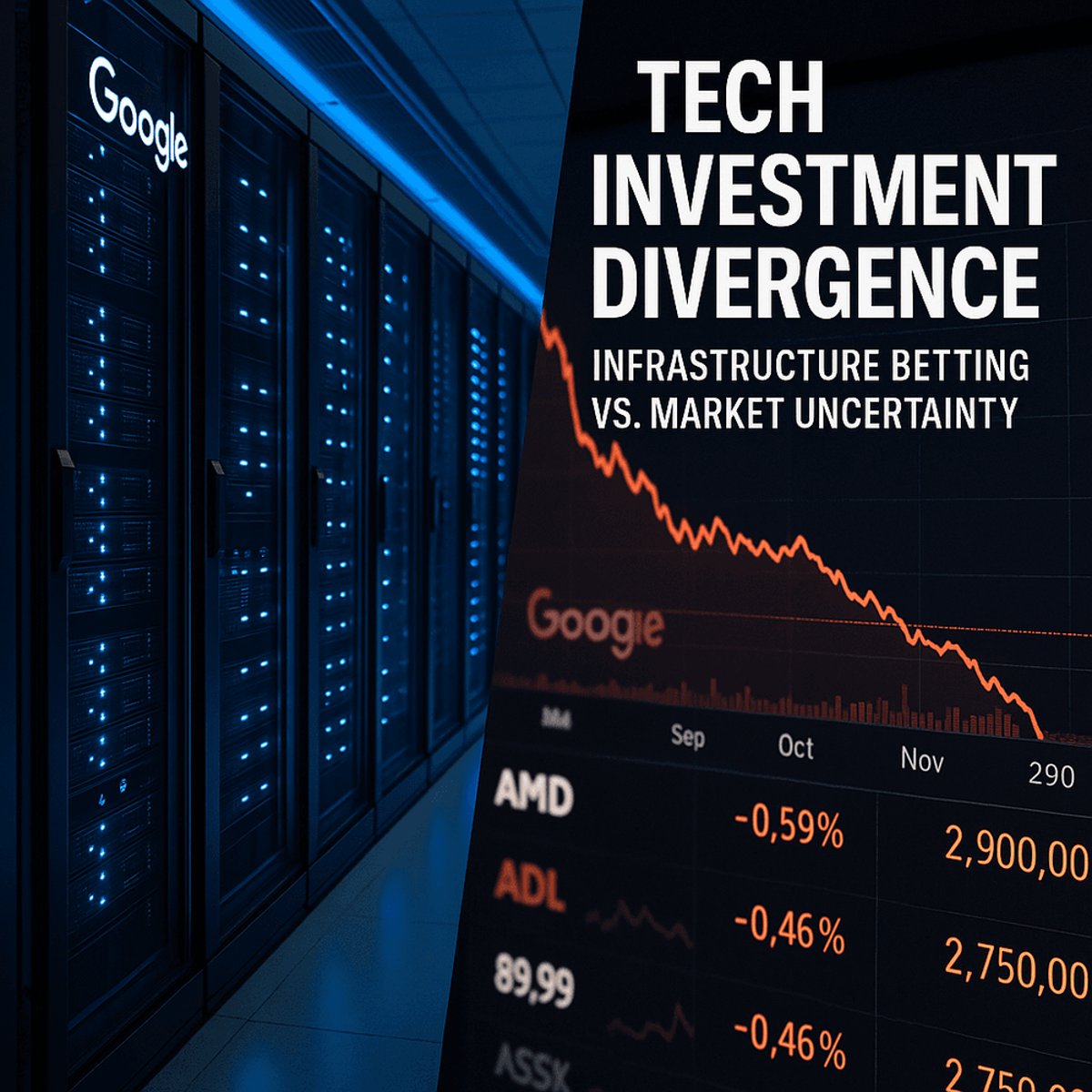
Google just dropped a bombshell that's rattling Silicon Valley. The search giant announced it's planning to spend up to $185 billion on capital expenditures in 2026 - more than doubling last year's spending - sending its stock tumbling 3% in after-hours trading despite beating earnings expectations. The massive infrastructure bet comes as the AI hardware market shows cracks, with AMD plummeting 17.3% on disappointing guidance and dragging down the entire sector.
Google parent Alphabet delivered a classic good news-bad news scenario that left Wall Street queasy. The company's fourth-quarter results beat analyst expectations across the board, with its cloud division posting a stunning 48% revenue jump from the prior year, according to CNBC's reporting. But the celebration was short-lived.
CFO guidance revealed that Google expects to pour between $175 billion and $185 billion into capital expenditures this year - a staggering sum that would more than double the company's 2025 spending. The announcement sent shares down as much as 3% in extended trading, as investors grappled with the reality that the AI arms race is about to get exponentially more expensive.
The timing couldn't be worse for AI hardware makers. AMD shares got absolutely hammered Tuesday, dropping 17.3% during regular trading after the chipmaker issued a disappointing first-quarter forecast that suggested AI chip demand might be cooling. The carnage spread across the sector, with Broadcom and Oracle also sliding as traders reassessed their AI exposure.
The Nasdaq Composite fell 1.51% while the S&P 500 retreated 0.51%, marking the index's fifth down session in six days. Only the Dow Jones Industrial Average managed to stay positive, up 0.53% thanks to strength in healthcare and industrial names like Amgen and Honeywell.
What's happening here is a classic case of diverging signals. Google is betting the farm that massive infrastructure investment will pay off - the company is essentially doubling down on data centers, chips, and networking equipment to power its AI ambitions. But AMD's brutal day suggests demand for those very components might be softening, at least in the near term.
CNBC Investing Club creator Jim Cramer isn't losing faith in the semiconductor space entirely. Speaking on CNBC's Squawk Box Asia, he praised South Korean chipmakers Samsung Electronics and SK Hynix as "visionary" companies he'd want to work for. The comment hints at a potential geographic shift in chip manufacturing leadership as American companies navigate volatile demand.
Wall Street analysts are starting to ask harder questions about profitability. CNBC Pro reported that several firms are expressing concerns over AMD's operating expenses and overall margins, suggesting the market's patience for growth-at-any-cost stories is wearing thin.
The massive spending Google is planning represents the infrastructure backbone for generative AI - think data centers packed with thousands of GPUs running large language models around the clock. These facilities require enormous investments in real estate, power, cooling systems, and networking equipment, not to mention the chips themselves. Google's willingness to more than double capex signals management believes the AI opportunity is worth the risk.
But here's the tension: If companies like AMD are seeing demand soften, who exactly is buying all this equipment? The answer might be that hyperscalers like Google, Microsoft, and Amazon are absorbing the lion's share of chip production, leaving smaller players scrambling for scraps. That would explain why AMD's enterprise and consumer segments might be struggling even as overall AI infrastructure spending explodes.
The broader market selloff in tech suggests investors are getting nervous about valuations after a historic run. AI stocks have been the market's darlings for the past year, but reality is setting in about the actual path to profitability. Building the infrastructure is one thing - monetizing it at scale is another challenge entirely.
Oil markets provided a brief distraction from tech turmoil, with crude prices slipping about 1% following reports that the U.S. and Iran will hold nuclear talks in Oman on Friday. Any easing of Middle East tensions could unlock additional supply and pressure prices further.
For now, the market is caught between two competing narratives. On one hand, Google's massive spending signals confidence that AI will transform computing and justify the investment. On the other, AMD's stumble suggests the path to AI profitability is bumpier than bulls expected. Which story wins out will likely determine whether this week's selloff is a healthy correction or the start of something more serious.
The collision between Google's unprecedented AI infrastructure spending and AMD's brutal guidance miss reveals the central tension in today's AI economy. Tech giants are placing trillion-dollar bets on artificial intelligence while the companies supplying the picks and shovels struggle to meet earnings expectations. For investors, the question isn't whether AI will transform computing - it's whether the current spending spree will generate returns fast enough to justify the astronomical costs. The next few quarters will reveal whether Google's $185 billion gamble represents visionary leadership or a cautionary tale about overinvestment in nascent technology.