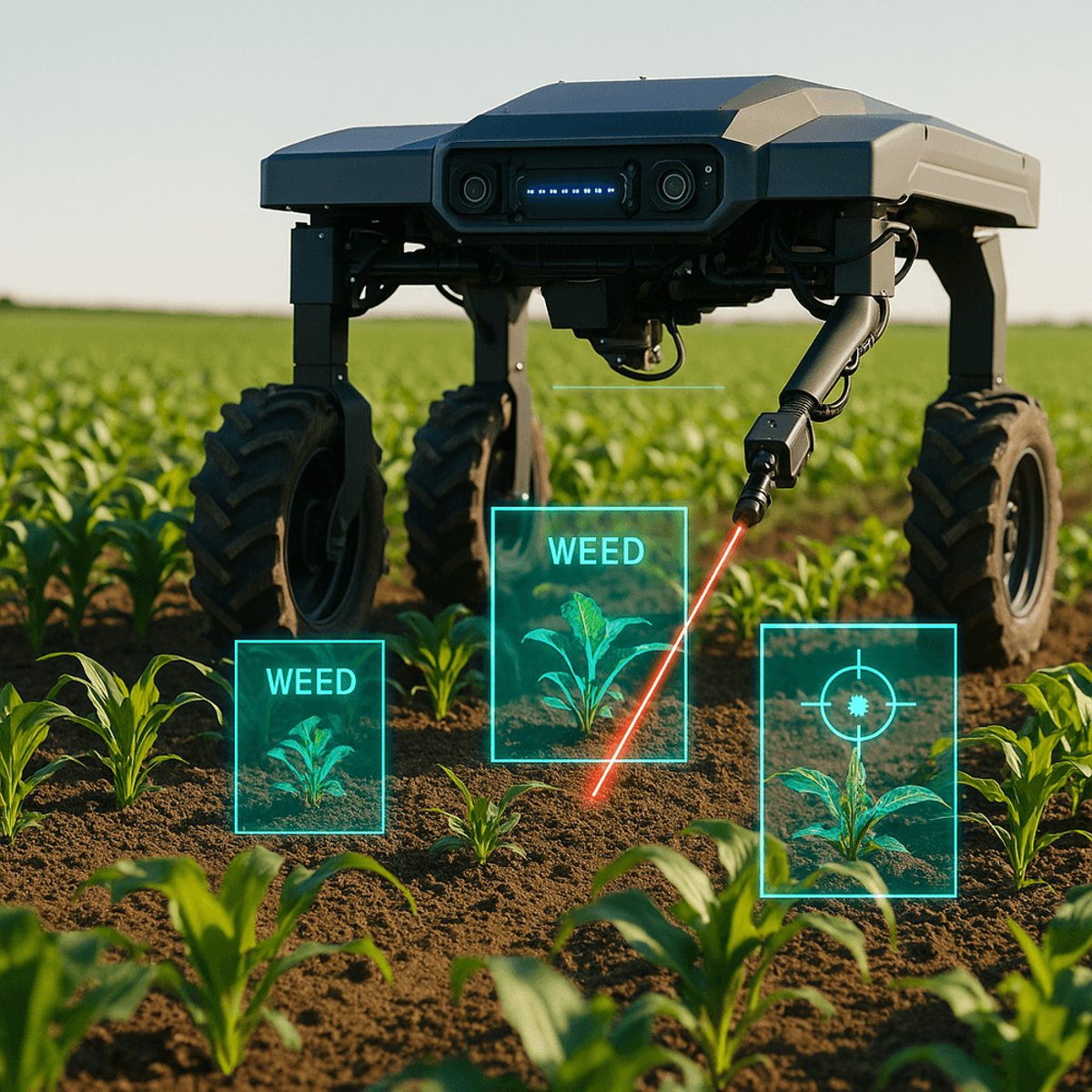
Carbon Robotics just dropped what might be agriculture's answer to ChatGPT. The Seattle startup's new Large Plant Model can identify and target any weed species instantly—no retraining required. For farmers using the company's laser-wielding robots across 100+ farms in 15 countries, this means pointing at a problem weed and telling the machine to kill it in real time, instead of waiting 24 hours for engineers to retrain the system. It's a shift from computer vision that needs constant hand-holding to AI that actually understands what it's looking at.
Carbon Robotics just solved one of agriculture's most frustrating AI problems. The company's new Large Plant Model can recognize any plant species on sight—even ones it's never encountered before—and immediately target them for elimination without a single line of new code or hours of retraining.
The Seattle-based robotics company announced the breakthrough Monday, marking a significant leap from traditional computer vision systems that choke every time they see something slightly different. Before LPM, Carbon Robotics' LaserWeeder robots needed roughly 24 hours of retraining whenever a new weed variety showed up—or even when a familiar weed looked different in new soil conditions.
"The farmer can live in real time and say, 'Hey, this is a new weed. I want you to kill this,' and that was something that had never been done before," CEO and founder Paul Mikesell told TechCrunch. "There's no new labeling or retraining because the Large Plant Model understands, at a much deeper level, what it's looking at and the type of plant."
The model powering Carbon AI—the brain inside the company's autonomous weed-killing fleet—learned from more than 150 million photos and data points. That massive dataset comes from the company's robots already operating across more than 100 farms in 15 countries, constantly feeding real-world agricultural data back into the system.
Mikesell knows a thing or two about building neural networks at scale. He cut his teeth developing similar systems at Uber and worked on Meta's Oculus VR headsets before founding Carbon Robotics in 2018. The company started developing LPM shortly after shipping its first laser-equipped robots in 2022.
The technology addresses a core challenge in agricultural AI: variability. A pigweed in California clay doesn't look identical to a pigweed in Iowa loam. Traditional computer vision systems treated these as separate problems requiring separate training sessions. LPM treats them as variations of the same species—understanding plant structure and characteristics at a conceptual level rather than just matching pixels.
Farmers interact with the system through a dead-simple interface. When the LaserWeeder robots patrol fields, they capture images of everything they see. Back in the control system, farmers scroll through those photos and tag what should live and what should die. The robot learns instantly and applies that knowledge across its entire operational area.
"We have over 150 million labeled plants now in our training set," Mikesell explained to TechCrunch. "We have enough data now that we should be able to look at any picture and decide what kind of plant that is, what species it is, what it's related to, what its structure is like, without having ever even seen that particular plant before."
The agricultural robotics sector has attracted serious capital as farmers face mounting pressure to reduce chemical herbicide use while dealing with labor shortages. Carbon Robotics has raised more than $185 million from investors including Nvidia NVentures, Bond, and Anthos Capital, according to previous TechCrunch reporting.
The company's LaserWeeder robots use high-powered lasers to physically destroy weeds at their meristem—the growth point—while leaving crops untouched. The machines can eliminate more than 200,000 weeds per hour while rolling through fields at speeds that make manual weeding impossible to compete with economically.
LPM rolls out as a software update to existing Carbon Robotics systems, meaning the company's current fleet gets smarter without hardware changes. That's a significant advantage over competitors who might need to ship new camera systems or processing units to deliver similar capabilities.
The timing matters. As AI models like GPT-4 and Claude demonstrate increasingly general intelligence in language tasks, agriculture has lagged in deploying similarly flexible AI systems. Most farming AI remains narrowly focused on specific crops or specific pest species, requiring extensive retraining for new scenarios.
What makes LPM notable isn't just the size of its training dataset—though 150 million labeled plant images ranks among the largest agricultural datasets ever assembled. It's the model's ability to generalize from that data to make accurate decisions about plants it's never encountered. That's the same conceptual leap that made large language models useful for tasks they weren't explicitly trained on.
Mikesell and his team will continue feeding the model new data as the robots operate. Every field, every soil type, every regional weed variant adds to the system's understanding. The model doesn't just get more data—it gets more diverse data representing actual farming conditions across different climates, crops, and agricultural practices.
Carbon Robotics is betting that agriculture's AI future looks less like rigid computer vision and more like flexible models that understand concepts rather than just patterns. If LPM delivers on its promise, farmers get a system that adapts to their fields instead of forcing fields to adapt to the technology. The real test comes during spring planting season when new weeds emerge across different regions—and whether the model's 150 million training images translate to instant, accurate identification in conditions it hasn't seen before. For an industry that's been burned by overpromised agtech before, Carbon Robotics is shipping working robots with a meaningful upgrade, not a prototype. That practical approach might matter more than the underlying AI breakthrough.