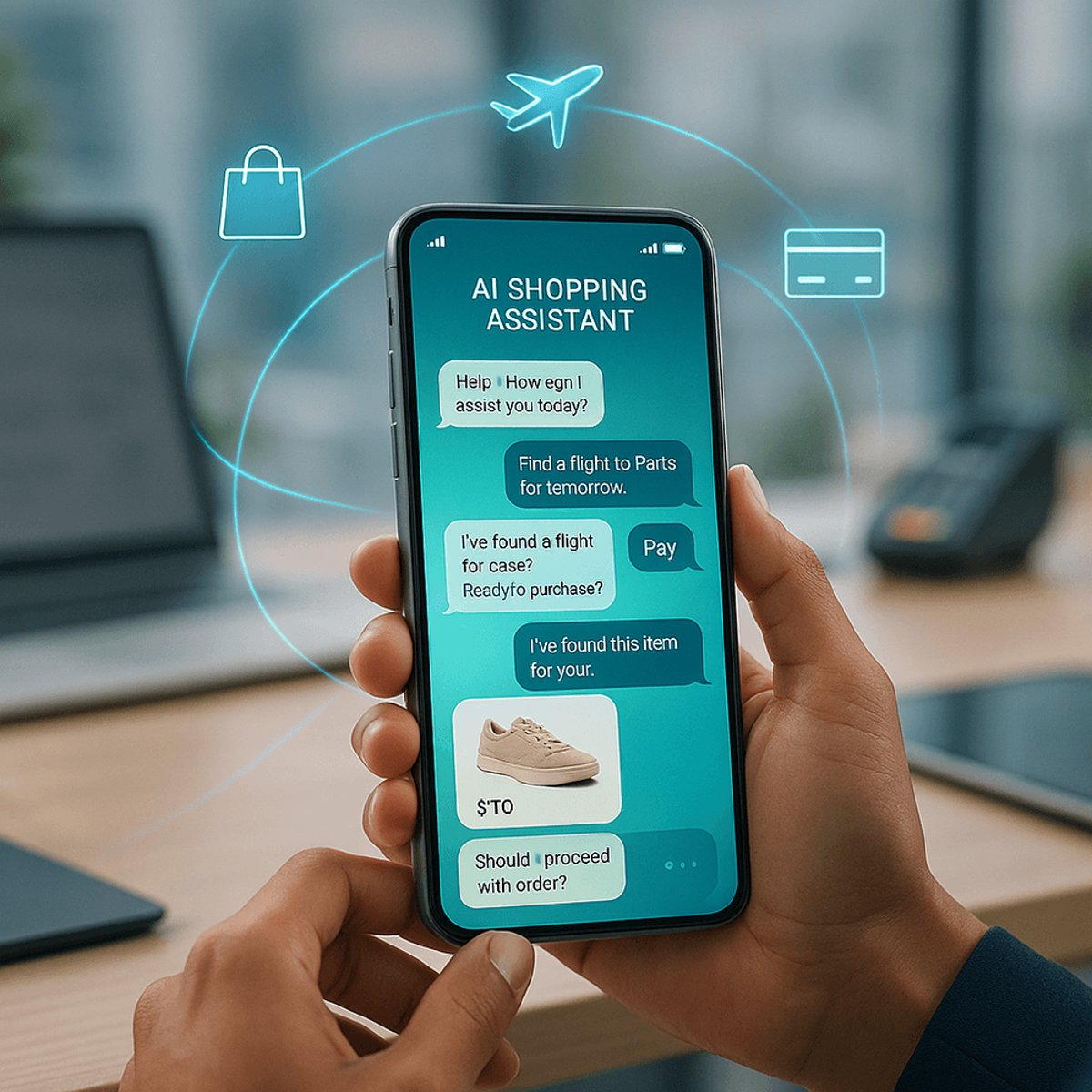
China's tech giants are charging ahead in the AI arms race with a bold new play: turning chatbots into autonomous shopping assistants. Alibaba just overhauled its Qwen AI chatbot to handle end-to-end transactions—from food orders to flight bookings to payments—all without users leaving the chat interface. ByteDance and Tencent aren't far behind. This shift to agentic AI marks the next frontier beyond basic chatbots, and it's reshaping how billions of people in China will shop online.
Alibaba just made a quiet but significant move that signals where the real AI competition is heading in China. The company rolled out an upgraded version of its Qwen AI chatbot that connects directly to its sprawling e-commerce ecosystem. Now users can do something that seemed impossible just weeks ago: complete an entire shopping journey without ever leaving the chat. Browse product recommendations from Taobao, check prices across competitors, book flights through Fliggy, and pay through Alipay—all within the chatbot interface.
This isn't just a feature update. It represents a fundamental shift in how Chinese tech giants are thinking about artificial intelligence. The move from "foundational AI models" to what's being called "agentic AI"—systems that perform complex tasks on behalf of users with minimal supervision—is reshaping the competitive landscape.
ByteDance, owner of the Chinese TikTok variant Douyin, moved at breakneck speed in December with its own version. The company upgraded Doubao, its popular AI chatbot, to autonomously handle transactions like ticket bookings through integrations with e-commerce features on Douyin. The model even appeared on a prototype smartphone from ZTE designed as a comprehensive AI assistant, though some planned features were later scaled back after privacy concerns from competitors.
Meanwhile, Tencent President Martin Lau signaled in the company's May 2025 earnings call that AI agents could become foundational to the WeChat ecosystem. That's significant when you consider WeChat boasts over 1 billion users and combines messaging, payments, e-commerce, and social services into a single app.
Shaochen Wang, a research analyst at Counterpoint Research, frames this as the "agentic transformation of commercial services." In plain language, that means maximal integration of user services that dramatically increases stickiness—the holy grail of consumer tech. "That allows companies to build a sustainable competitive advantage, often called a business moat, which helps protect profits from competitors," Wang told CNBC.
The Chinese advantage here is structural. These companies have built integrated ecosystems over years: e-commerce, payments, logistics, social networks all living under one roof. They've also accumulated massive behavioral datasets on how billions of users interact. Most importantly, their users are already accustomed to super apps that bundle everything together. This isn't a novel concept in China the way it might be in the West.
Western companies pursuing agentic commerce—OpenAI, Amazon, Perplexity, and Google among them—face real structural hurdles. Their data is fragmented across separate services. Privacy regulations like GDPR make cross-service integration thorny. Users aren't conditioned to shop through AI assistants the same way. Google is trying to position itself as a "matchmaker" between merchants, consumers, and AI agents, attempting to sidestep some of these challenges, but it's a different play than what's happening in China.
Charlie Dai, VP and principal analyst at Forrester, puts it bluntly: "AI agents will be foundational to the evolution of super apps, with success depending on deep integration across payments, logistics, and social engagement." He notes that while Chinese firms compete internally, they all share those structural advantages. "China will prioritize domestic integration and strategic expansion in selected regions, while U.S. firms focus on global scalability and governance."
The economic stakes are enormous. According to a 2025 McKinsey study, approximately half of all consumers already use AI when searching online. McKinsey estimates that AI agents could generate more than $1 trillion in economic value for U.S. businesses by 2030 by streamlining routine steps in consumer decision-making. That's a market opportunity nobody in tech can ignore.
What's unfolding in China right now isn't just incremental progress on AI chatbots. It's a fundamental restructuring of how commerce will work in the world's second-largest economy. Alibaba, Tencent, and ByteDance aren't building chatbots anymore—they're building autonomous shopping assistants that eliminate friction from every step of the transaction. The gap between Chinese and Western approaches isn't about AI capability; it's about integration depth and data advantage. For consumers, this means dramatically faster shopping. For competitors outside China, it's a reminder that AI's real power emerges when you control the entire ecosystem.