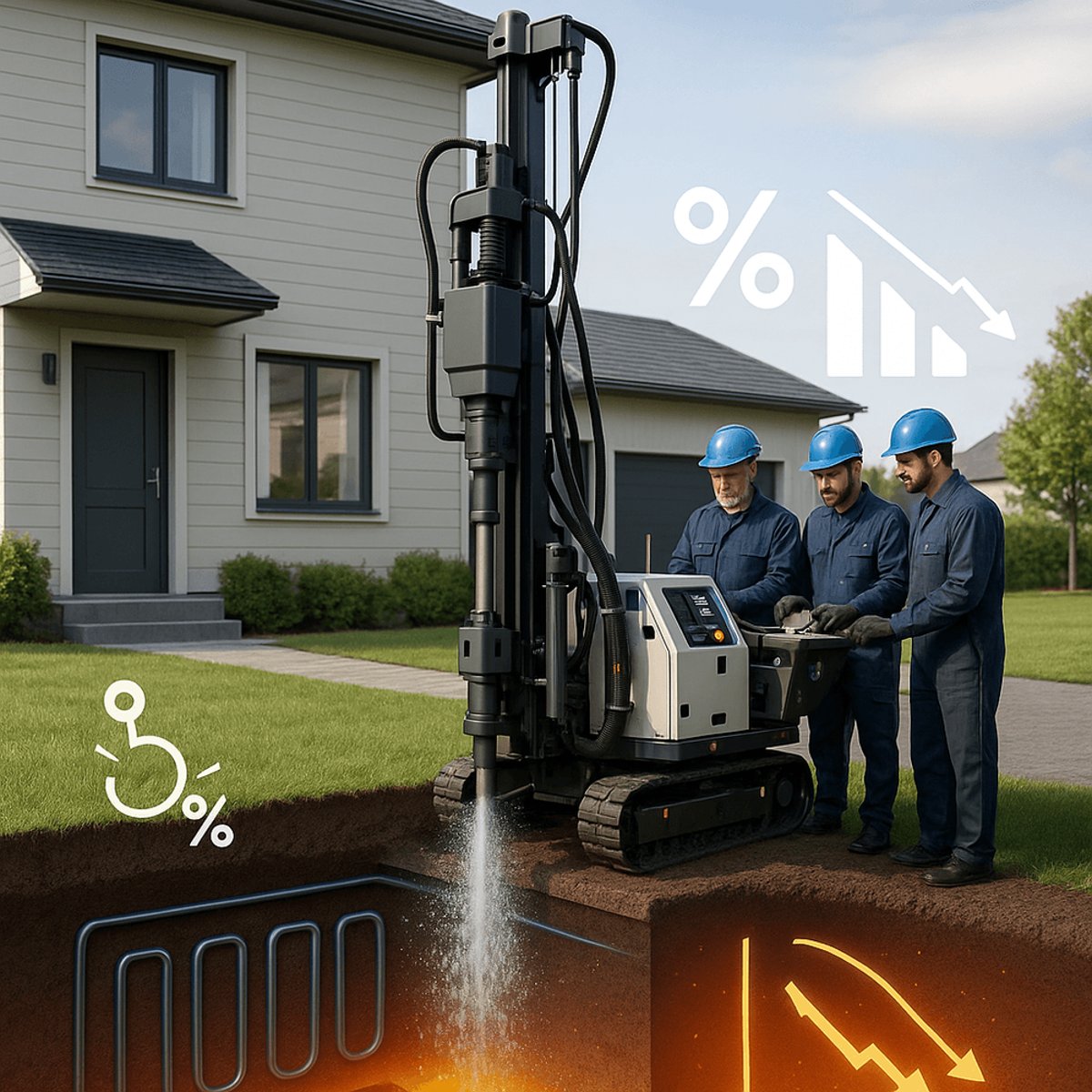
After five years in stealth, Dig Energy has emerged with a revolutionary water-jet drilling rig that could finally make geothermal heating affordable for mainstream adoption. The startup's compact technology promises to slash drilling costs by up to 80%, potentially transforming a market where geothermal represents just 1% of building installations despite superior efficiency.
Dig Energy just pulled back the curtain on technology that could finally crack the geothermal code. The New Hampshire startup emerged from five years of stealth development Tuesday with $5 million in seed funding and a water-jet drilling rig that promises to cut geothermal installation costs by up to 80%.
The round, led by Azolla Ventures and Avila VC with participation from Baukunst, Conifer Infrastructure Partners, Koa Labs, Mercator Partners, Drew Scott, and Suffolk Technologies, comes as the US faces a massive infrastructure challenge. According to Oak Ridge National Laboratory research, America needs to drill 6 million feet of geothermal borehole daily through 2050 to stabilize its electrical grid.
"In the United States, geothermal has been 1% of building installations for decades," CEO Dulcie Madden told TechCrunch in an exclusive interview. "It's really just because upfront cost is so, so, so expensive."
That cost barrier has kept geothermal heating locked out of mainstream adoption, despite the technology's ability to slash HVAC energy use - which represents a third of all US energy consumption and up to 40% in data centers. Grid operators could save up to $4 billion annually if geothermal reached scale.
Madden and co-founder Thomas Lipoma, her husband and the company's CTO, started exploring the space five years ago after winding down their previous startup, Rest Devices. They discovered decades-old research describing water-jet drilling but found the technology wasn't ready for commercial deployment.
"A lot of the drilling technology has trickled down from oil and gas," Madden explained. "It tends to be large, expensive, and overpowered for something like geothermal." Traditional geothermal drill rigs cost around $2 million and require massive double-axle trucks that can't squeeze through residential side lots or navigate crowded commercial sites.
Dig's approach targets shallow geothermal systems, which drill hundreds rather than thousands of feet to tap consistent ground temperatures perfect for heating and cooling buildings year-round. The company has spent years testing its compact rig through soil, gravel, clay, sand, and various rock types including granite, limestone, and shale near its New Hampshire offices.
The breakthrough isn't just size - it's precision. Dig's water-jet technology drills straighter holes than traditional rigs, allowing bore holes to be placed closer together. That's crucial for developers working with limited space, particularly in residential installations where ground loop installation represents 30% of total geothermal system costs.
"We shouldn't have to require people to buy a $2 million rig, it should be something that's lower cost where they can get into the business," Madden said. The company plans to sell its devices directly to drilling contractors, opening new market opportunities while giving existing players more flexibility.
Dig's timing aligns with broader climate tech momentum. Companies like Fervo Energy and Quaise are pursuing deep geothermal for electricity generation, but Dig's shallow approach targets the massive building heating market.
While the current prototype isn't commercially ready, the seed funding will help Dig launch its first commercial pilots. The production version will be slightly larger than current prototypes but still dramatically smaller than truck-mounted alternatives.
"Geothermal should be in 100% of buildings. It's in 1% of buildings. So how do we close the 99%?" Madden asked. "It's effectively an untapped market."
Dig Energy's emergence signals a potential inflection point for geothermal adoption. If their water-jet technology delivers on its cost reduction promises, it could unlock the 99% of buildings currently priced out of geothermal systems. With America needing to drill millions of feet of geothermal borehole annually through 2050, compact drilling solutions aren't just nice to have - they're essential infrastructure. The real test comes with commercial pilots, where Dig will prove whether their laboratory success translates to field conditions and market economics.