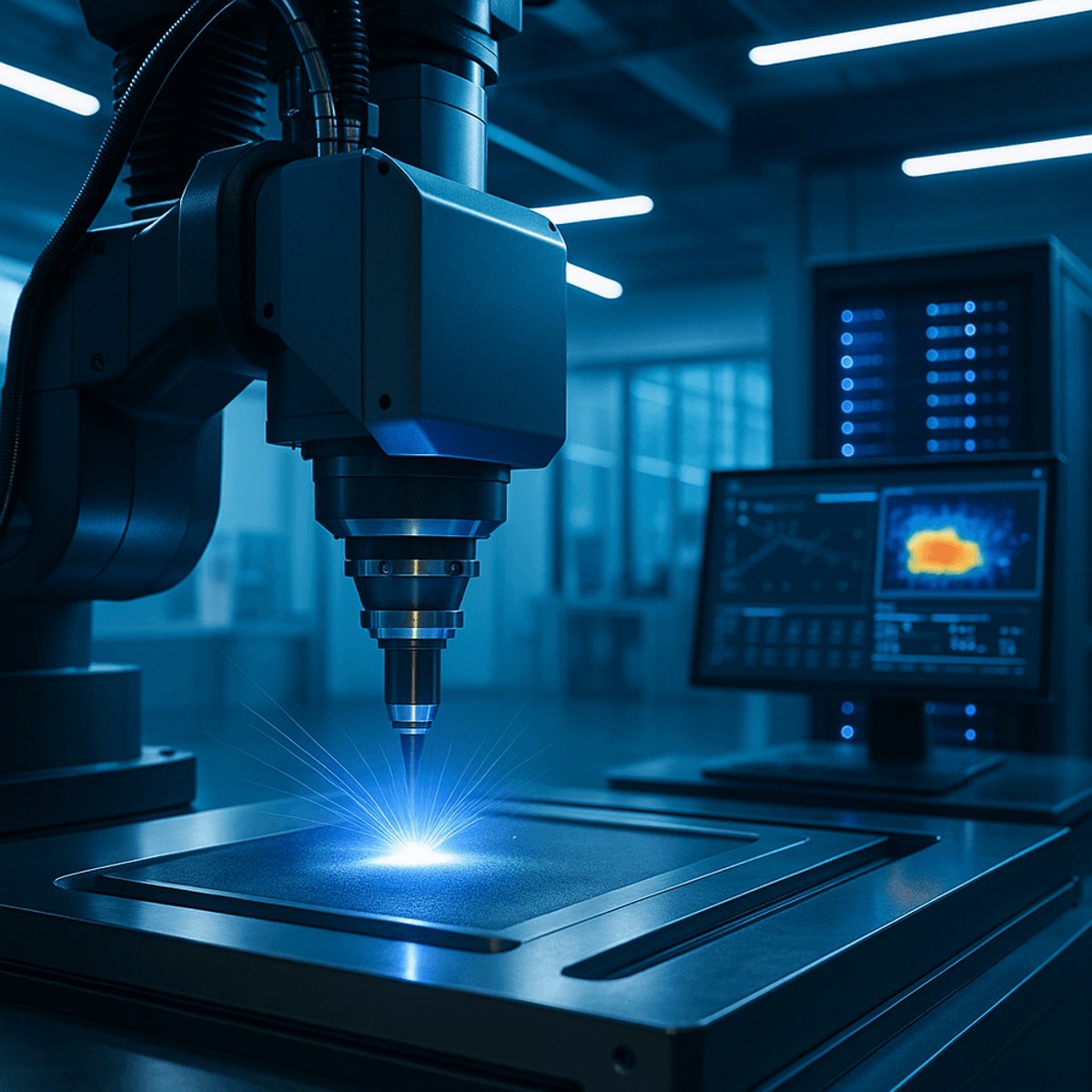
Freeform, a startup merging artificial intelligence with advanced manufacturing, just closed a $67 million Series B to scale its laser-based metal fabrication technology. The round signals growing investor confidence in AI's ability to transform traditional manufacturing - and Freeform's unusual approach of housing Nvidia H200 GPU clusters directly on the factory floor is turning heads across both Silicon Valley and industrial America.
Freeform is betting that the future of manufacturing looks less like a traditional factory floor and more like a data center that happens to melt metal. The Los Angeles-based startup just secured $67 million in Series B funding to prove it, deploying Nvidia's latest H200 GPU clusters inside its production facility to control precision laser systems that build metal parts layer by layer.
"I think we're the only quote-unquote manufacturing company out there that has H200 clusters in a data center on site," a company representative told TechCrunch in an exclusive interview. That's not just Silicon Valley swagger - it's a fundamental reimagining of how AI and physical production intersect.
The financing comes as manufacturers worldwide grapple with labor shortages, supply chain fragility, and demands for increasingly complex parts. Freeform's approach uses machine learning models running on high-performance computing infrastructure to control industrial lasers with microscopic precision, adjusting power, speed, and trajectory thousands of times per second as they fuse metal powder into finished components.
Unlike traditional 3D printing startups that focus on prototyping or small-batch production, Freeform is gunning for scale manufacturing applications where tolerances matter and downtime costs millions. The company already counts SpaceX among its customers, according to the TechCrunch report, suggesting its technology has cleared the rigorous qualification hurdles that aerospace and defense contractors demand.
The H200 deployment isn't just for show. Nvidia's H200 Tensor Core GPUs, released in late 2023, pack 141GB of HBM3e memory and deliver nearly double the inference performance of their H100 predecessors. For Freeform, that translates to real-time analysis of sensor data streaming from laser heads, thermal cameras, and quality control systems - then feeding those insights back into the manufacturing process before defects occur.
This closes a loop that's been open in manufacturing for decades. Traditional computer numerical control systems follow pre-programmed instructions blindly. Freeform's AI watches what's actually happening as metal melts and solidifies, learning patterns that human operators couldn't spot across millions of data points. When a laser pass isn't quite right, the system adapts on the fly.
The $67 million Series B follows an earlier funding round, though previous raise details weren't disclosed in the announcement. The current round's investors weren't named in the initial reporting, but the size suggests participation from both traditional venture firms and potentially strategic players in aerospace, defense, or industrial automation.
Freeform enters a crowded field of manufacturing-AI startups, but its infrastructure-heavy approach sets it apart. While competitors rent cloud compute or use off-the-shelf industrial controllers, Freeform built what amounts to a supercomputer inside a machine shop. That capital intensity explains the funding size - data center infrastructure, industrial lasers, and the facility to house both don't come cheap.
The aerospace connection through SpaceX is particularly telling. Elon Musk's rocket company has long pushed suppliers toward advanced manufacturing techniques that can produce complex geometries impossible with traditional machining. Parts like rocket engine injectors, with intricate internal cooling channels, are exactly where laser-based additive manufacturing shines. If Freeform can meet SpaceX's quality and cost requirements at volume, defense primes and commercial aerospace giants will pay attention.
But challenges loom. Scaling AI-driven manufacturing means proving reliability across thousands of production runs, not just impressive prototypes. Every H200 cluster adds operating costs. The technology needs to deliver cost savings that justify the infrastructure investment, especially when competing against established processes like casting and machining that have been optimized over decades.
Freeform's timing catches a broader wave of AI moving from digital applications into physical industries. While ChatGPT and image generators grabbed headlines, industrial AI has quietly been reshaping logistics, quality control, and now the actual making of things. The $67 million bet is that whoever cracks AI-native manufacturing first will own a massive competitive advantage as reshoring and supply chain resilience become national priorities.
Freeform's $67 million Series B isn't just another manufacturing startup funding announcement - it's a signal that AI is jumping from software into the physical world in capital-intensive, infrastructure-heavy ways. By embedding data center-grade computing inside an actual factory, the company is testing whether the next generation of American manufacturing competitiveness will be built on silicon as much as steel. If the SpaceX endorsement is any indication, and if Freeform can prove its economics at scale, we're watching the early innings of a major industrial transformation. The question now is whether investors' patience and the technology's capabilities can outlast the long, expensive road from promising prototype to production workhorse.