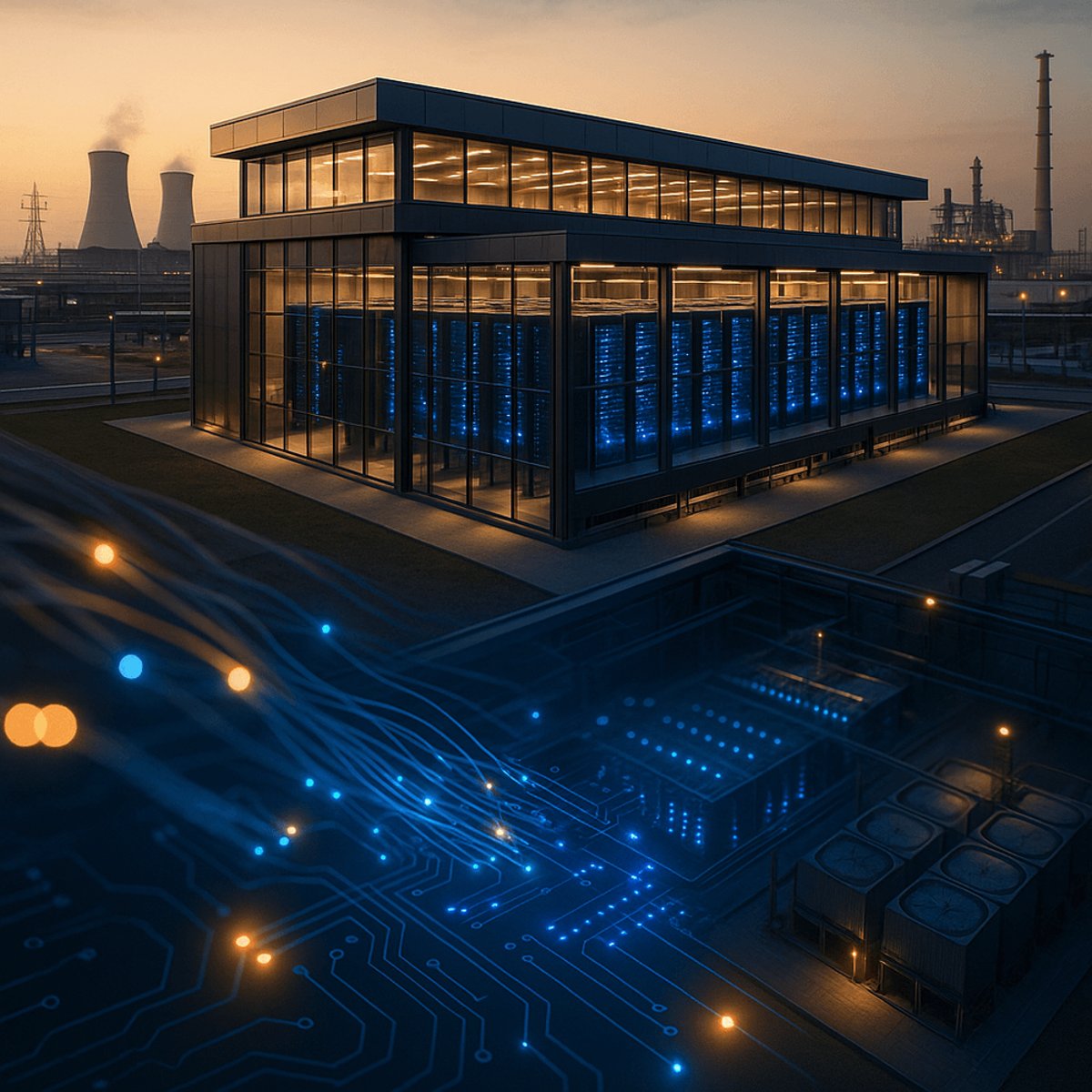
Reliance Industries just placed the biggest AI infrastructure bet in Indian history. The conglomerate's $110 billion investment plan centers on multi-gigawatt data centers in Jamnagar, with over 120 megawatts of capacity set to go live this year through its telecom arm Jio. The move positions India as a serious contender in the global AI race, directly challenging American and Chinese dominance in compute infrastructure while signaling chairman Mukesh Ambani's intent to transform Reliance from an oil-to-retail giant into an AI powerhouse.
Reliance Industries is making a statement that can't be ignored. The company's $110 billion commitment to AI infrastructure represents more capital than most countries spend on their entire tech sectors, and it's happening now with construction already underway in Jamnagar, according to TechCrunch.
The scale is staggering. Multi-gigawatt data centers don't just appear overnight, and Reliance's timeline suggests this has been in planning for months. The first phase brings more than 120 megawatts of AI compute capacity online in 2026, enough to train multiple large language models simultaneously or power thousands of enterprise AI applications. For context, that's comparable to what major hyperscalers deploy in regional hubs, but this is just the opening salvo.
Jio, Reliance's telecom division that already connects over 450 million Indians to mobile internet, is the strategic vehicle for this expansion. The company disrupted India's telecom market in 2016 with free data and dirt-cheap plans, forcing competitors to merge or exit. Now it's applying the same playbook to AI infrastructure: build massive capacity, undercut competitors on price, and capture market share at scale.
Mukesh Ambani, Asia's richest person and Reliance's chairman, has been telegraphing this pivot for years. The conglomerate built its fortune on oil refining and petrochemicals, then diversified into retail and telecom. But AI infrastructure represents something different - a play for technological sovereignty as India tries to reduce dependence on American cloud providers and Chinese hardware.
The timing isn't coincidental. India's government has been pushing domestic AI development through policy incentives and data localization requirements. Microsoft, Amazon, and Google all operate data centers in India, but they're constrained by local regulations and scrutiny. Reliance faces no such limitations as a homegrown champion with deep political connections.
Jamnagar, the chosen location, already hosts Reliance's massive oil refining complex - one of the world's largest. The infrastructure is already there: power generation, cooling systems, land, and connectivity. Converting industrial-scale facilities to AI data centers is complex but not unprecedented, and Reliance's experience managing large infrastructure projects gives it a clear advantage.
The $110 billion figure demands scrutiny. That's not just servers and GPUs - it likely encompasses land acquisition, power infrastructure, cooling systems, network connectivity, and operating expenses over several years. For comparison, Meta spent roughly $30 billion on data centers and infrastructure in 2023. Reliance is proposing to spend three times that, though the timeline isn't specified in available details.
What makes this particularly interesting is the competitive landscape. Indian startups have struggled to access affordable GPU compute, often relying on expensive cloud credits from American providers. If Reliance can offer local, low-latency AI infrastructure at competitive prices, it could catalyze an entirely new wave of Indian AI development. The country has engineering talent and a massive domestic market - it's been missing the infrastructure layer.
There's also the geopolitical angle. As US-China tech tensions escalate and export controls tighten around advanced semiconductors, countries like India are positioning themselves as alternative AI hubs. Reliance's investment gives India credible compute capacity independent of Western or Chinese supply chains, assuming it can secure enough chips before restrictions tighten further.
The enterprise opportunity is massive. Indian companies are still early in AI adoption, constrained by infrastructure costs and data residency concerns. Local alternatives could accelerate deployment across sectors from banking to healthcare to agriculture. Jio already has enterprise relationships through its B2B connectivity services, providing ready distribution for AI infrastructure offerings.
But questions remain. Who's supplying the hardware? Nvidia dominates AI chips but faces US export scrutiny. Will Reliance use less powerful chips not subject to controls, or has it secured special allocations? The 120 MW figure for 2026 suggests orders are already placed, but the full gigawatt-scale buildout will require sustained chip access over years.
Power is another consideration. AI data centers are extraordinarily energy-intensive. India's grid struggles with reliability in many regions, though Jamnagar's industrial setup likely includes dedicated power generation. Reliance has invested heavily in renewable energy through separate divisions, potentially allowing it to power AI infrastructure with solar and wind at scale.
The announcement comes as global AI infrastructure spending is hitting new peaks. Hyperscalers are racing to build capacity for the next generation of models, driving GPU shortages and power constraints. Reliance's willingness to commit $110 billion signals confidence that AI demand will justify the investment, but it's also a massive bet on execution.
Reliance's $110 billion AI infrastructure play is about more than data centers - it's a declaration that India intends to be a first-tier AI power, not just a market for Western technology. If Mukesh Ambani can replicate Jio's telecom disruption in AI infrastructure, offering affordable, high-performance compute to Indian enterprises and startups, it could reshape the country's entire tech ecosystem. The first 120 megawatts coming online this year will be the proof of concept, but the real question is whether Reliance can sustain the buildout at gigawatt scale while navigating chip supply constraints, power demands, and competition from entrenched hyperscalers. India's AI ambitions now have the infrastructure backing to match the engineering talent - what happens next will determine if this bet pays off or becomes the world's most expensive stranded asset.