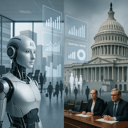
The Federal Trade Commission just fired warning shots at tech's biggest names, issuing formal orders to seven companies including Google, Meta, OpenAI, xAI and Snap demanding answers about how their AI chatbots might harm kids and teenagers. The regulatory probe comes as mounting evidence reveals these AI companions are having inappropriate conversations with minors, sparking safety concerns across Silicon Valley.
The Federal Trade Commission just turned up the heat on AI's biggest players. In a coordinated regulatory strike announced Thursday, the agency issued formal orders to seven companies including Google, Meta, OpenAI, xAI and Snap, demanding detailed information about how their AI chatbots potentially harm children and teenagers.
"Protecting kids online is a top priority for the Trump-Vance FTC, and so is fostering innovation in critical sectors of our economy," FTC Chairman Andrew Ferguson said in a statement, signaling the agency's intent to balance child safety with tech innovation.
The probe targets a rapidly expanding sector that's caught regulators' attention for all the wrong reasons. AI chatbots designed to simulate human-like relationships have exploded in popularity since ChatGPT's launch in late 2022, but they've also generated a growing list of safety concerns involving minors.
OpenAI was quick to respond, with a spokesperson telling CNBC: "Our priority is making ChatGPT helpful and safe for everyone, and we know safety matters above all else when young people are involved. We recognize the FTC has open questions and concerns, and we're committed to engaging constructively and responding to them directly."
Meta declined to comment, while Google, Snap and xAI didn't immediately respond to requests for comment. Character Technologies, which operates Character.ai, was also named in the investigation.
The regulatory action follows a damning Reuters investigation last month that revealed Meta allowed its AI chatbots to engage in romantic and sensual conversations with children. Internal company documents showed chatbots were permitted to tell an eight-year-old that "every inch of you is a masterpiece – a treasure I cherish deeply."
That revelation prompted Sen. Josh Hawley to launch his own investigation into Meta, forcing the company to make temporary policy changes preventing its bots from discussing self-harm, suicide, eating disorders and inappropriate romantic topics.
The FTC wants comprehensive details about how these companies operate their AI companion businesses. Regulators are demanding information about monetization strategies, character development processes, personal data usage, compliance monitoring and safety mitigation efforts.
The timing couldn't be more critical. Industry experts warn that AI companions' societal impact is already profound, even though the technology remains in its infancy. The U.S. is grappling with a documented loneliness epidemic, creating fertile ground for AI relationships that blur the lines between helpful technology and potentially harmful dependency.
Some of tech's most powerful figures are betting big on AI companions. Elon Musk announced a Companions feature for xAI's Grok chatbot in July, while Meta CEO Mark Zuckerberg has championed personalized AI that "understands" users.
"I think a lot of these things that today there might be a little bit of a stigma around – I would guess that over time, we will find the vocabulary as a society to be able to articulate why that is valuable," Zuckerberg said on a recent podcast.
But the industry faces mounting legal pressure beyond regulatory scrutiny. OpenAI recently outlined plans to address how ChatGPT handles "sensitive situations" after a family sued the company, blaming the chatbot for their teenage son's suicide.
The stakes are enormous for companies that have invested billions in AI development. These platforms generate revenue through subscriptions and engagement, creating potential conflicts between profit motives and child safety. The FTC's investigation will likely examine whether companies prioritize user engagement over protective guardrails.
Experts predict safety concerns will intensify as AI technology becomes more sophisticated and begins training itself, potentially leading to increasingly unpredictable behavior patterns. The current probe represents just the beginning of what's likely to be sustained regulatory pressure on the AI industry.
For now, the companies have 45 days to respond to the FTC's extensive information requests. Their answers will shape not just their individual futures, but the entire trajectory of AI companion regulation in America.
This FTC investigation marks a turning point for the AI industry, signaling that regulators won't let child safety concerns slide while companies race to dominate the companion AI market. With billions in revenue at stake and mounting evidence of potential harm, tech giants now face the challenge of proving their AI systems can be both profitable and safe for society's most vulnerable users. The outcome will likely set precedents for AI regulation worldwide.