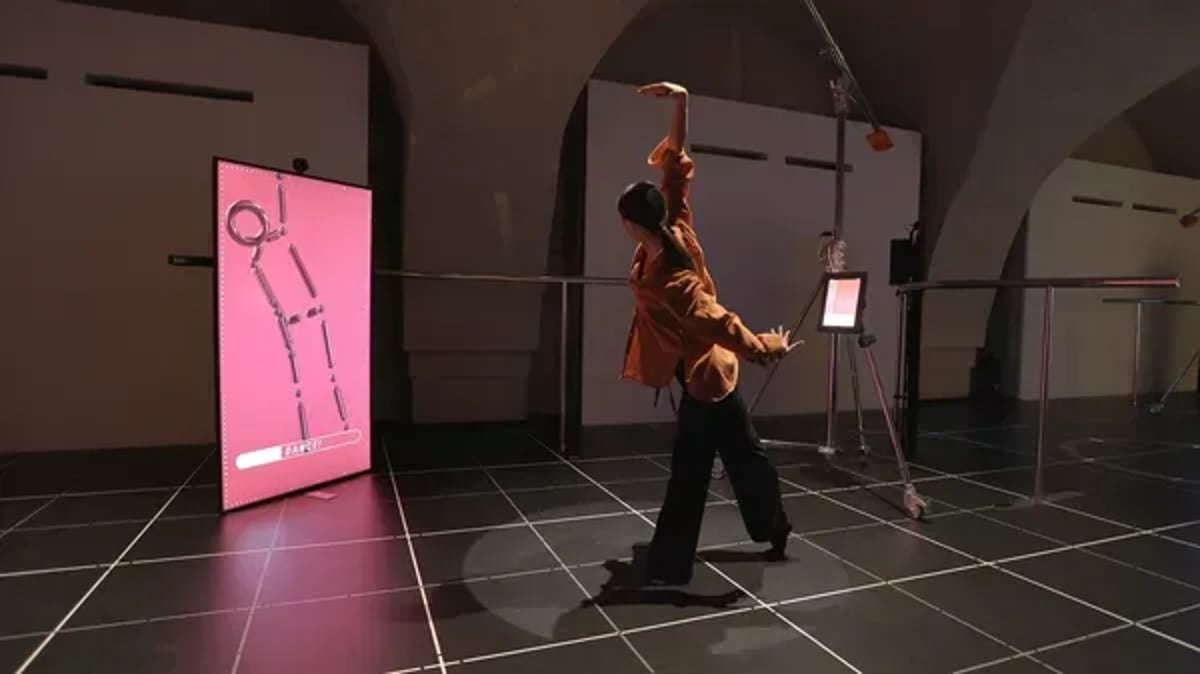
Google just launched AISOMA, an AI-powered choreography tool that learned to dance from analyzing four million poses across Sir Wayne McGregor's 25-year archive. The interactive platform lets anyone perform movements that AI extends with original choreographic phrases rooted in McGregor's signature style, marking a breakthrough in how artificial intelligence can preserve and expand artistic legacy.
Google is turning dance archives into living, breathing creative tools. The tech giant just unveiled AISOMA, an AI choreography platform that learned to dance by studying four million poses from renowned British choreographer Sir Wayne McGregor's 25-year body of work.
The tool represents a fascinating leap in creative AI applications. Users perform a short dance sequence, and AISOMA's custom AI analyzes their movements before suggesting original choreographic phrases that feel authentically rooted in McGregor's distinctive movement vocabulary. It's like having one of the world's most celebrated choreographers as a creative partner, available to anyone with internet access.
"My life's work as a choreographer and director is an endless inquiry into how we think with and through the body," McGregor explained in Google's announcement. "This questioning has transformed my studio into a laboratory — a space for relentless experimentation."
The collaboration between McGregor and Google Arts & Culture Lab began in 2019, evolving from initial experiments into this sophisticated AI system. What makes AISOMA particularly impressive is its technical foundation: the team developed a bespoke model using TensorFlow 2 and MediaPipe pose technology that analyzes human movement in three-dimensional space.
This 3D capability marks a significant upgrade from earlier versions that were limited to 2D analysis. The AI can now "map and comprehend the intricate, architectural grammar of a body in motion," as McGregor puts it, understanding not just what dancers do but how they occupy and move through space.
The training process involved extracting poses from hundreds of videos spanning McGregor's career, creating what might be the most comprehensive digital understanding of a single choreographer's artistic DNA ever assembled. The AI learned patterns, transitions, and the subtle architectural logic that makes McGregor's work instantly recognizable to dance aficionados worldwide.
"It's a privilege to continue our collaboration with internationally acclaimed choreographer, Sir Wayne McGregor," said Amit Sood from Google Arts & Culture. "AISOMA uses AI to bring Wayne's seminal and transformative body of work through a new lens, giving everyone an invitation to play, explore, and push the boundaries of their own creativity."
For McGregor, AISOMA isn't meant to replace human creativity but to amplify it. He initially used the tool in his own studio to "expand, challenge, and interrogate existing movement sequences" before deciding to make it publicly available. The choreographer views it as a starting point rather than a final answer - an invitation for people to become active participants in the creative process.
The public launch coincides perfectly with McGregor's major exhibition "Infinite Bodies" at Somerset House, running from October 30, 2025 through February 22, 2026. Visitors can experience AISOMA both online and in person, creating a bridge between digital innovation and physical art spaces.
This project sits at the intersection of several major tech trends: AI's expanding role in creative industries, the digitization of cultural archives, and the democratization of artistic tools. While other companies focus on text and image generation, Google is exploring how AI can understand and extend human movement - a challenge that requires processing complex spatial and temporal relationships.
The implications extend beyond dance. AISOMA's approach to learning from archived human movement could influence applications in sports training, physical therapy, and motion capture for entertainment. The technology demonstrates how AI can serve not just as a tool for efficiency but as a genuine creative collaborator that helps artists push beyond their existing boundaries.
AISOMA represents more than just another AI tool - it's a glimpse into how technology can preserve and extend artistic legacy while democratizing access to world-class creative guidance. By training AI on decades of McGregor's work, Google has created something that feels both deeply respectful of artistic tradition and boldly innovative. The real test will be whether everyday users find genuine creative value in collaborating with an AI that's learned to think like one of dance's most visionary artists. For now, AISOMA stands as proof that the most interesting AI applications might not be replacing human creativity, but amplifying it in ways we're only beginning to understand.