Google just unleashed its biggest AI upgrade yet, transforming Chrome into an intelligent browsing assistant while supercharging Search with visual capabilities and expanding Gemini's reach across six new languages. The September updates signal Google's aggressive push to embed AI deeper into daily workflows, from automated grocery ordering to real-time visual help.
Google just dropped what might be its most comprehensive AI update ever, fundamentally reshaping how users interact with the web. The September rollout touches nearly every major Google product, from Chrome's new intelligent assistant to Search's expanded visual capabilities.
The crown jewel is Chrome's integration with Gemini, which now acts as an AI browsing assistant that can answer questions across all open tabs. Users can ask complex, multi-part questions directly in the omnibox, while future updates promise agentic capabilities for automating tasks like grocery ordering. The browser also gains proactive scam protection, using AI to identify and block new types of malicious content before they reach users.
"We've been working to make AI as useful as possible, whether through visible features or essential behind-the-scenes improvements," according to Google's official announcement. The company's 20-year investment in machine learning research is now paying dividends across its entire ecosystem.
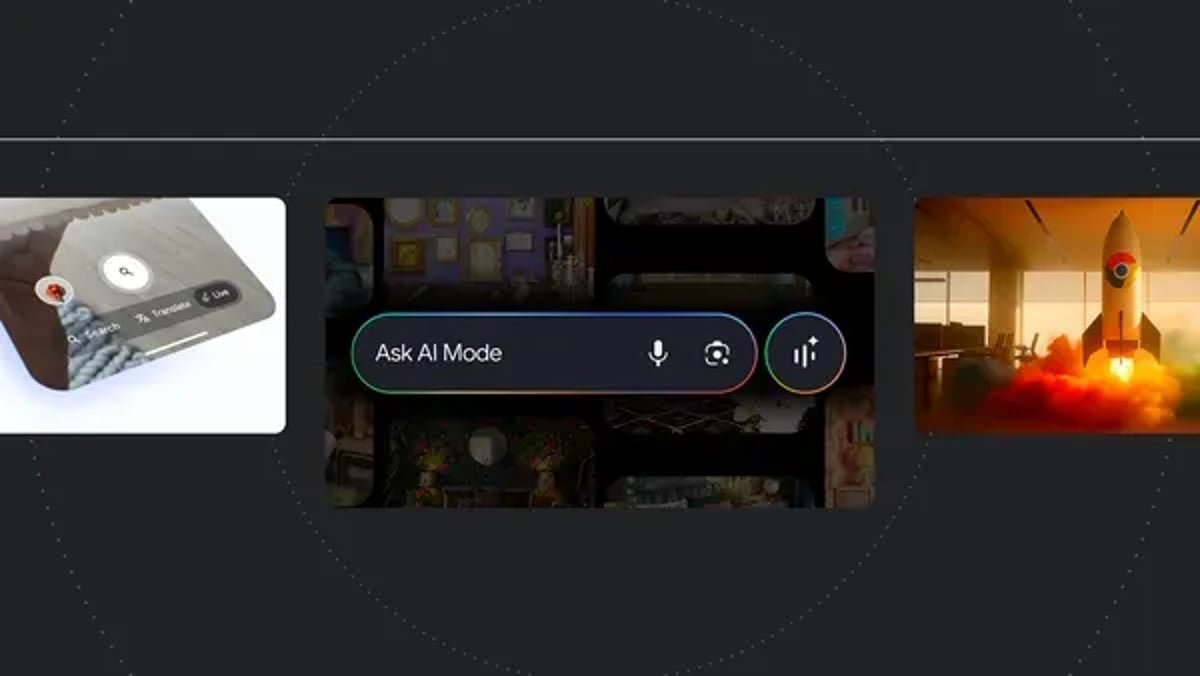
Search received equally dramatic upgrades through AI Mode, which combines Gemini 2.5 with a new "visual search fan-out" technique for deeper understanding of images and natural language queries. The result is what Google calls "stunningly precise visual search results" that make shopping and design exploration more intuitive.
But the real game-changer might be Search Live, which integrates interactive voice conversations with camera feed sharing for real-time multimodal help. Users can literally point their camera at objects and get instant, hands-free assistance with everything from travel planning to complex troubleshooting.
The AI Mode expansion to six new languages - Hindi, Indonesian, Japanese, Korean, Brazilian Portuguese, and Spanish - represents Google's biggest international AI push yet. Each implementation focuses on nuanced understanding of local information, allowing users to explore the web more deeply in their preferred language.
Meanwhile, the Gemini app evolved into what Google calls "a hub for AI" with the viral Nano Banana image generation tool leading the charge. Since launching in August, the model has gained massive popularity for tasks ranging from outfit swapping to complex imaginative scenarios. The September update added shareable custom Gems, allowing users to distribute personalized AI tools through a Google Drive-like interface.
Google DeepMind simultaneously launched Gemini Robotics 1.5 and Gemini Robotics-ER 1.5, marking what the company calls "the era of physical agents." These models enable robots to see, plan, think, and use tools for multi-step tasks while transferring learnings between different robot types. Gemini Robotics-ER 1.5 handles big-picture reasoning and even web searches, while Gemini Robotics 1.5 converts visual information into motor commands.
Education received significant attention through NotebookLM's transformation into a comprehensive AI study partner. The platform now creates flashcards and quizzes from user notes, generates reports in multiple formats, and offers personalized tutoring through its Learning Guide feature. Audio Overviews gained new perspectives like Critique and Debate modes for enhanced learning experiences.
Google's education push extends beyond individual tools. CEO Sundar Pichai's appearance at the White House AI Education Taskforce highlighted the company's $1 billion commitment to AI education, including offering Gemini for Education to every American high school and training over 650,000 educators.
The September updates culminated with Gemini 2.5 Deep Think achieving gold-medal performance at the International Collegiate Programming Contest World Finals, building on previous success at the International Mathematical Olympiad. This breakthrough in abstract problem-solving demonstrates Gemini's advancing coding and reasoning capabilities.
Android users aren't left out, with new AI writing tools in Gboard for tone revision and automatic spelling/grammar fixes, plus enhanced audio sharing capabilities and redesigned Quick Share for better file transfer experiences.
These updates represent more than incremental improvements - they signal Google's vision of AI as infrastructure rather than novelty. By embedding intelligence across its core products, Google is positioning itself as the gateway for AI-powered daily workflows, from browsing and searching to learning and creating.
Google's September AI blitz isn't just about adding features - it's about reimagining how we interact with information entirely. From Chrome's tab-spanning intelligence to Search's real-time visual assistance, these updates position AI as essential infrastructure rather than optional enhancement. With robotics entering the physical world and education tools becoming truly personalized, Google is betting that the future belongs to those who can seamlessly blend human intent with artificial intelligence. The question isn't whether competitors can match these capabilities, but how quickly they can respond to Google's comprehensive AI ecosystem play.