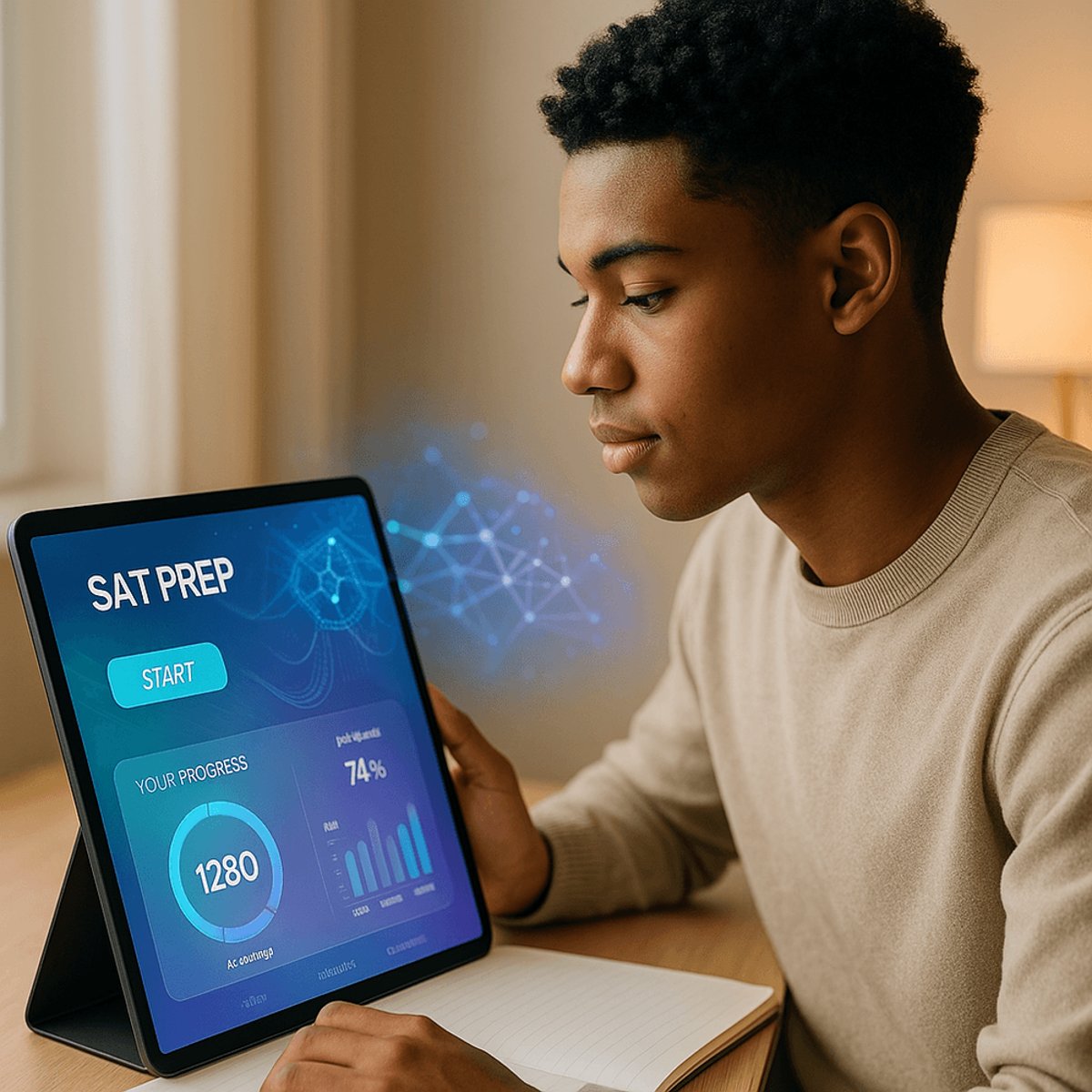
Google just threw a curveball at the $1 billion SAT prep industry. The company announced it's now offering free, AI-powered practice exams through Gemini, complete with personalized feedback and detailed explanations for wrong answers. The move positions Google as a disruptor in standardized test preparation while raising fresh questions about AI's expanding role in education and the future of human tutors.
Google is making a serious play for the education market, and the traditional SAT tutoring industry just felt the ground shift beneath it. The company announced it's now offering free SAT practice exams through Gemini, its AI assistant, in a move that could democratize test prep access while simultaneously threatening thousands of tutoring jobs.
The mechanics are straightforward. Students simply prompt Gemini with "I want to take a practice SAT test," and the AI serves up a full exam. After completion, Gemini analyzes the results, pinpointing strengths and flagging weak spots that need work. It doesn't stop there - the AI provides detailed breakdowns of why answers were wrong, essentially functioning as a round-the-clock tutor that never charges by the hour.
Google didn't go it alone. The company partnered with The Princeton Review, a heavyweight in test prep, to ensure the practice questions mirror actual SAT content. That partnership matters - it's the difference between generic practice and exam-realistic preparation that could actually move scores.
The timing is strategic. SAT prep has long been a dividing line between students who can afford $100-per-hour private tutors and those who can't. By offering this for free, Google is positioning itself as the great equalizer in college admissions prep. But the announcement is already sparking debate about whether we're solving one problem while creating another.
Teachers and education researchers aren't entirely sold on the AI-everywhere approach. The concern isn't that Gemini can't help students prepare - it's that students might lean so heavily on AI tools that they never develop their own problem-solving muscles. Academic research is backing up these worries, with recent studies suggesting that over-reliance on AI assistance can actually weaken critical thinking abilities over time.
Then there's the human cost. The private tutoring industry, which has thrived on personalized SAT coaching for decades, now faces serious competition from a free alternative backed by one of the world's largest tech companies. For independent tutors charging $75 to $200 per session, competing with free AI-powered prep is a nearly impossible proposition.
This isn't Google's first rodeo in the education space. The company recently launched a Gemini-powered feature that transforms lessons into podcast-style audio content, targeting Gen Z students who consume information differently than previous generations. Google has been steadily building out its education toolkit, with Gemini features helping teachers brainstorm lesson ideas, construct curriculum plans, and customize materials for different learning styles.
The SAT prep launch represents Google's most direct challenge yet to established education businesses. Unlike lesson planning tools that complement teacher work, this directly replaces a service people have traditionally paid for. It's a pattern we've seen before - tech giants offering free versions of paid services, reshaping entire markets in the process.
What makes this particular move interesting is the AI angle. Traditional test prep companies have offered free or low-cost materials for years, but they couldn't provide personalized feedback at scale. Gemini can analyze individual performance patterns and tailor explanations to specific mistakes, mimicking what human tutors do best, just without the hourly rate.
The test prep market was already evolving. Khan Academy partnered with the College Board years ago to offer free SAT prep, proving there was demand for accessible options. But Google's entry brings significantly more AI horsepower and integration with tools students already use daily.
For Google, this is about more than just being helpful. It's about embedding Gemini deeper into students' daily routines, making the AI assistant indispensable before these students enter college and the workforce. If Gemini becomes the go-to study companion for millions of high schoolers, that's a powerful competitive moat against rivals like ChatGPT and Claude.
The education AI arms race is heating up fast. OpenAI has been pushing ChatGPT into schools, while Microsoft's Copilot is getting woven into classroom tools. Google's SAT move is a direct shot across the bow - a high-visibility feature that showcases what Gemini can do in a context that matters deeply to students and parents.
Still, questions linger about accuracy and reliability. AI models can hallucinate incorrect information, and when you're preparing for a test that significantly impacts college admissions, accuracy isn't optional. Google's partnership with The Princeton Review helps address this, but the AI is still generating and analyzing content on the fly.
Google's free SAT prep through Gemini is a genuine game-changer for access, potentially leveling the playing field for students who couldn't afford expensive tutoring. But it's also a warning shot to an entire industry and a test case for how much we're willing to let AI shape critical thinking development. As Gemini embeds itself deeper into students' academic lives, we're watching in real-time how tech giants are reshaping not just how we learn, but who profits from education itself. The question isn't whether AI tutoring works - it's whether the tradeoffs are worth it.