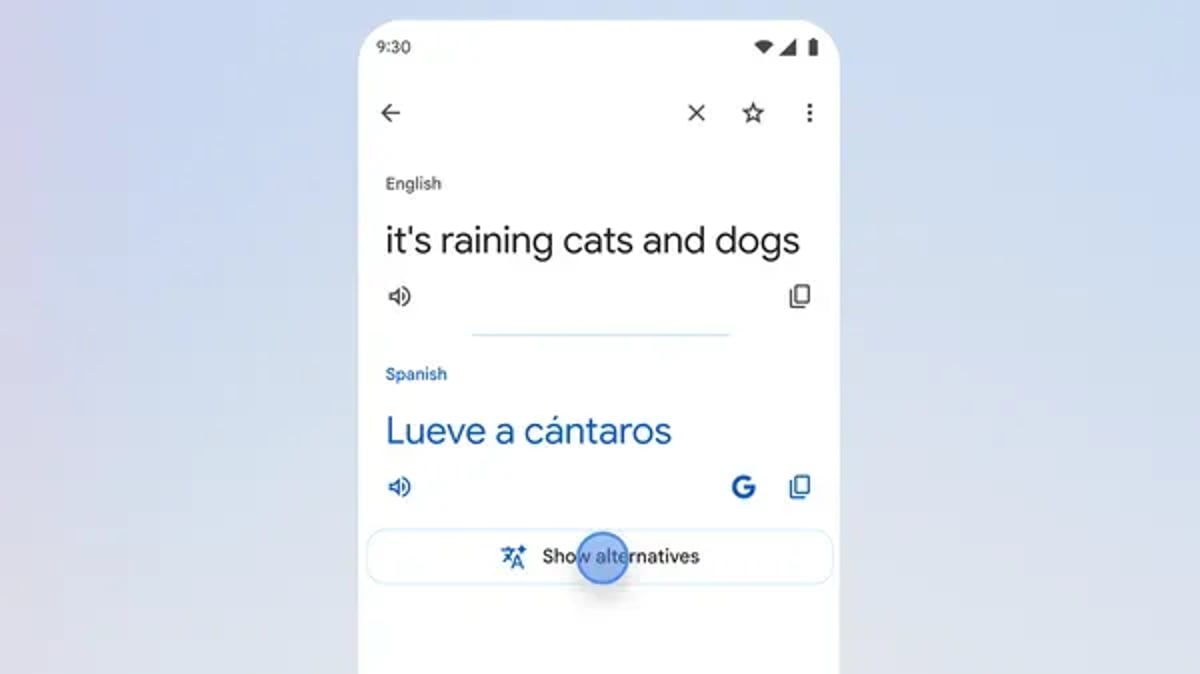
Google just made translation a lot smarter. The company rolled out new AI-powered features to Google Translate that go beyond simple word-for-word conversion, adding 'understand' and 'ask' buttons that help users navigate the messy reality of natural language. Product Manager Matt Sheets announced the update in a company blog post, marking Google's latest push to embed AI deeper into its consumer products. For the 500 million daily users who rely on Translate, this means fewer awkward misunderstandings and more nuanced communication.
Google is betting that context is king in translation. The company just shipped a handful of AI-powered updates to Google Translate that tackle one of language's trickiest problems - words that mean different things depending on who's saying them and why.
The headline feature is a pair of new buttons that appear alongside translations. Hit 'understand' and you get AI-generated explanations of why a phrase was translated a certain way, complete with cultural context and usage notes. The 'ask' button lets you pose follow-up questions about the translation, turning Translate into something closer to a language tutor than a dictionary.
Product Manager Matt Sheets framed the update as a response to user feedback in the official announcement. Turns out people don't just want translations - they want to understand what makes a phrase formal versus casual, or why a word has three different English equivalents.
Google's also rolling out an 'alternatives' feature that surfaces multiple translation options upfront. If you're translating a word with several meanings, you'll see them all laid out with context clues about when to use each one. It's a direct answer to one of translation's most common failure modes - the word that technically translates but completely misses the speaker's intent.
The timing matters. Google has been racing to inject AI across its product lineup as OpenAI, Microsoft, and others make translation feel like table stakes. DeepL has been eating away at Google's dominance with more natural-sounding output, while Microsoft Translator gets tighter integration with Office and Teams.
These updates lean on the same large language models powering Gemini, Google's AI assistant. The company's been building context awareness into its models for years, but this is one of the first times that capability is surfacing in a consumer product as a distinct feature rather than just better output.
For Google's 500 million daily Translate users, the changes are most visible in situations where literal translation falls apart - idioms, slang, formal business language, or technical jargon. A translator working on a contract can now ask why 'shall' was chosen instead of 'will' and get an explanation about legal convention. A tourist can understand that 'por favor' isn't just 'please' but carries different weight depending on context.
The competitive stakes are higher than they look. Translation apps have become a commodity, with decent quality available for free from multiple providers. Google is trying to differentiate by making Translate smarter about the messy reality of how humans actually use language - a move that could help it maintain dominance as AI makes basic translation trivial.
The features are rolling out now across Google Translate's web interface and mobile apps, covering all of the service's 133 supported languages. Google says the AI models have been trained on billions of real-world translation queries, which should mean they understand common confusion points and can explain them clearly.
What we don't know yet is how well the AI handles edge cases or whether the explanations will sometimes be wrong in subtle ways. Language is notoriously tricky for AI - models can sound confident while completely missing cultural nuance. Google's track record with Gemini suggests the technology is solid, but translation is one of those domains where small errors can have big consequences.
Google's turning Translate from a lookup tool into an AI-powered language coach, and that shift matters for anyone who works across languages. The new context features won't replace human translators for high-stakes work, but they do make the service dramatically more useful for everyday communication. As AI models get better at understanding cultural nuance and intent, expect translation to become less about converting words and more about bridging the gap between what someone says and what they actually mean. Google's betting that whoever builds the best context layer wins the next era of translation - and with 500 million daily users already on the platform, they've got a solid head start.