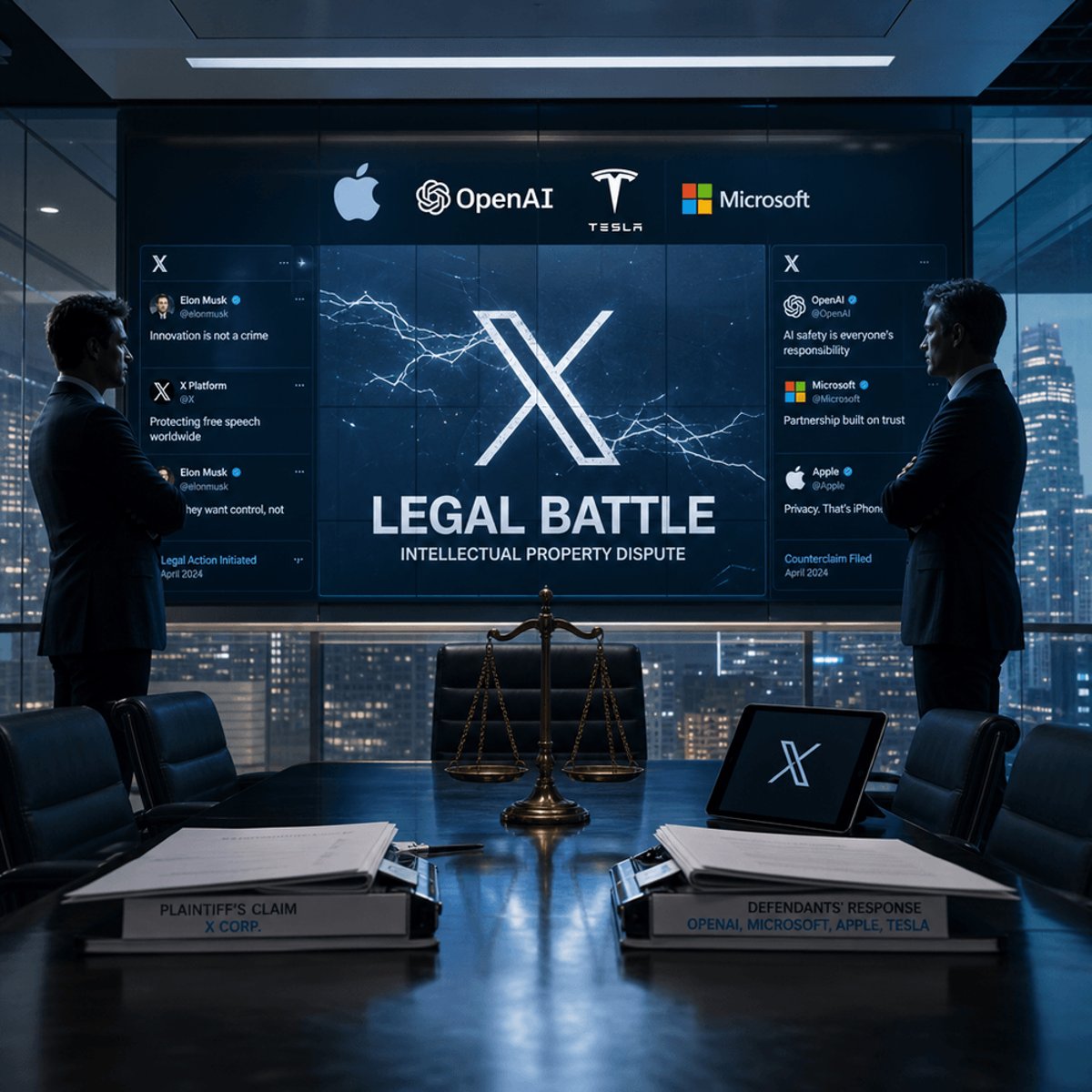
The AI industry's most combustible rivalry just exploded back into public view. OpenAI CEO Sam Altman and Tesla chief Elon Musk traded sharp words on X Sunday, hours after Apple filed a surprise lawsuit against the AI startup. The clash comes on the heels of OpenAI's latest model release earlier this week, which Altman says triggered Musk's latest obsession with him. The public spat adds another volatile chapter to the increasingly messy intersection of big tech, AI development, and personal rivalries that's reshaping the industry.
Apple just threw a legal grenade into the AI wars, and the fallout is getting personal fast. The iPhone maker filed a lawsuit against OpenAI on Sunday, triggering an immediate public clash between the AI company's CEO Sam Altman and his former co-founder Elon Musk on the platform formerly known as Twitter.
Altman fired the first public salvo, posting on X that Musk was "again obsessed" with him following OpenAI's model release earlier this week. The comment suggests this isn't the first time the two tech luminaries have clashed over OpenAI's product announcements. Musk, who co-founded OpenAI in 2015 before departing the board in 2018, has become increasingly critical of the company's direction under Altman's leadership.
The timing couldn't be more combustible. OpenAI reportedly unveiled a new AI model just days ago, the kind of technical milestone that typically generates industry buzz and competitive anxiety. Instead, it seems to have reignited one of tech's most watched personal feuds. Musk, who now runs competing AI venture xAI, has repeatedly accused OpenAI of abandoning its original nonprofit mission in favor of commercial interests.
But the real earthquake is Apple's lawsuit. While details remain scarce, the legal action marks a dramatic escalation in the relationship between two companies that have been dancing around partnership and competition for months. Apple has been notably cautious about AI integration compared to rivals like Google and Microsoft, making any legal action against a leading AI developer particularly significant.
The lawsuit comes as OpenAI navigates an increasingly complex corporate landscape. The company has transformed from a research nonprofit into a capped-profit entity valued at over $80 billion, backed by a $10 billion investment from Microsoft. That evolution has drawn criticism from Musk and others who argue the company betrayed its founding principles.
Musk's public comments about Altman and OpenAI have grown sharper over the past year. The Tesla and SpaceX CEO has suggested in various interviews and posts that OpenAI's partnership with Microsoft represents a departure from the open-source, safety-focused mission he helped establish. Altman, for his part, has mostly avoided direct engagement until now, making Sunday's accusation of obsession a notable shift in strategy.
The personal dynamics matter because they're playing out against existential questions about AI development. Who controls these powerful models? How should they be monetized? What obligations do AI companies have to openness and safety? The Musk-Altman feud has become a proxy battle for these larger industry tensions.
Apple's entrance into this drama adds another dimension entirely. The company has been quietly building its AI capabilities while publicly expressing concerns about privacy and safety in generative AI. A lawsuit suggests those concerns may have crystallized into specific grievances against OpenAI's practices or technology. Whether it involves intellectual property, data usage, or partnership terms remains unclear.
For OpenAI, the dual challenge of managing both legal pressure from Apple and renewed public attacks from Musk creates a precarious moment. The company is already facing scrutiny from regulators, questions about its corporate structure, and intense competition from well-funded rivals. Adding personal drama and major litigation to that mix could distract from the technical and business execution that's kept OpenAI at the forefront of the AI race.
The fact that this played out on X is its own kind of irony. Musk's platform has become the preferred arena for tech executives to air grievances, announce products, and shape narratives. That Altman chose to engage there, accusing Musk of obsession on his own turf, signals just how heated things have gotten.
Industry observers will be watching whether this public spat affects OpenAI's partnerships or Musk's xAI venture. Both companies are competing for talent, compute resources, and the attention of enterprise customers trying to figure out which AI platform to bet on. Personal feuds between founders can create uncertainty that benefits competitors like Google and Anthropic who can position themselves as more stable alternatives.
What started as a dispute over AI safety and corporate structure has morphed into a multi-front battle involving personal attacks, major litigation, and competing visions for the industry's future. The Musk-Altman feud might make for entertaining tech drama, but it's unfolding against serious questions about AI governance, corporate accountability, and the concentration of power in a technology that could reshape society. Apple's lawsuit adds legal stakes to what was already a philosophical and commercial fight. For OpenAI, managing this turbulence while maintaining technical leadership and partner relationships may prove to be Altman's biggest test yet. The AI industry watches not just for the entertainment value, but because how these conflicts resolve could determine who controls the technology that defines the next decade.