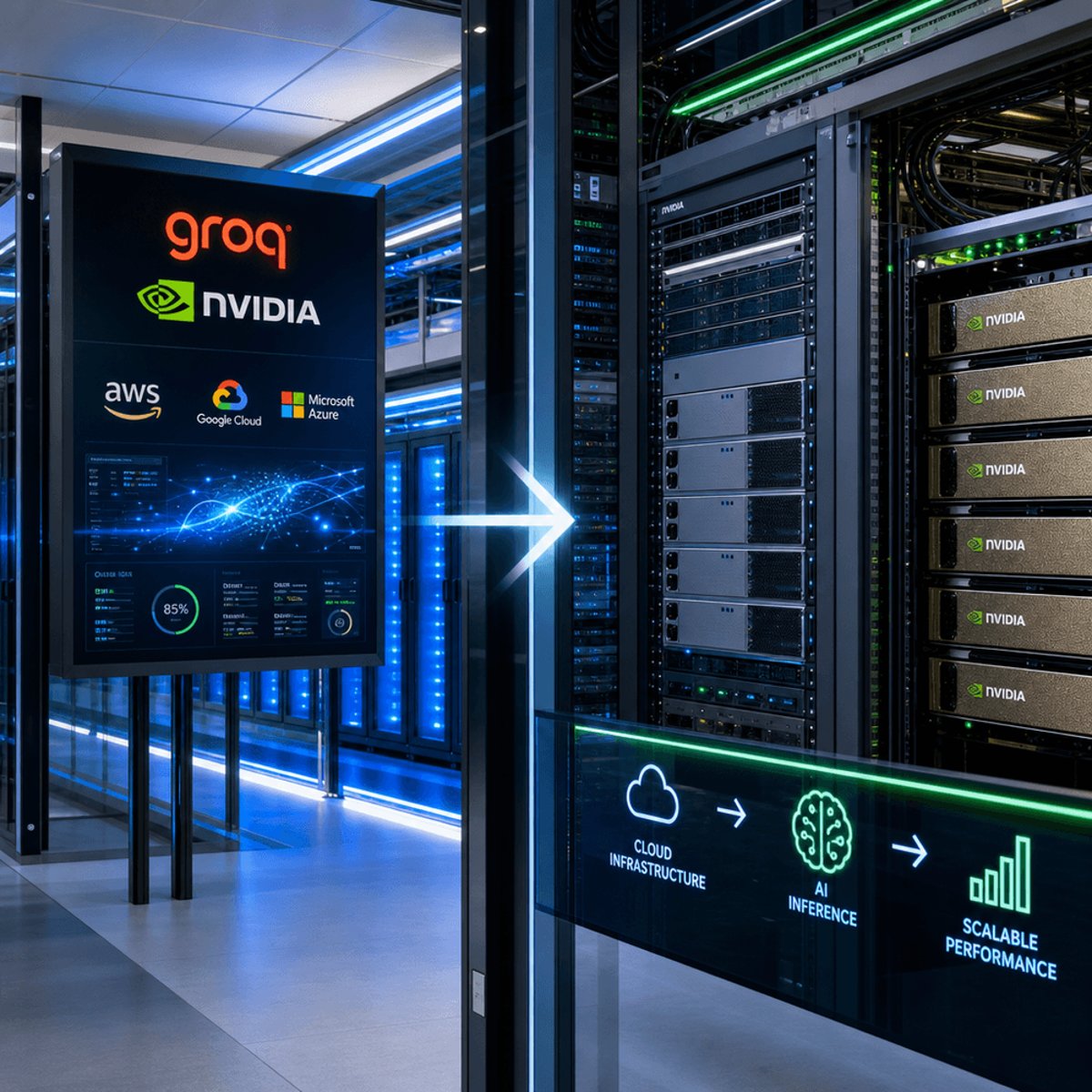
Groq just pulled off one of the year's most dramatic pivots in AI infrastructure. The company raised $350 million at a $3.5 billion valuation, but here's the kicker - it's no longer betting on its own chips. Instead, the former AI chipmaker is going all-in on becoming a neocloud provider powered by rival Nvidia's hardware, a move that signals how brutally competitive the AI infrastructure wars have become.
Groq just made a bet that surprised plenty of Valley insiders. The company raised $350 million at a $3.5 billion valuation, but the real story isn't the numbers - it's what they're building with the cash.
Groq is walking away from its original vision of competing head-to-head with Nvidia in the AI chip market. Instead, it's pivoting to become a neocloud provider, and ironically, it'll be powered by Nvidia's own GPUs. Think of it as joining the ecosystem rather than fighting it.
The move reflects a harsh reality in AI infrastructure: building competitive chips requires billions in capital and years of iteration. Even well-funded startups struggle to match the R&D budgets and manufacturing scale of giants like Nvidia, which has spent decades perfecting its CUDA software ecosystem and chip architectures.
Groq originally gained attention for its Language Processing Unit (LPU) chips, designed specifically for inference workloads. The technology promised faster token generation and lower latency than traditional GPUs. But promising technology doesn't always translate to market dominance, especially when you're competing against Nvidia's stranglehold on AI training and inference.
The neocloud strategy puts Groq in a different game entirely. Rather than selling chips, it'll offer cloud infrastructure optimized for AI workloads - compute, storage, and networking bundled into a developer-friendly platform. It's a crowded space with players like CoreWeave and Lambda Labs already staking claims, but there's clearly investor appetite for alternatives to the hyperscalers.
What makes this pivot particularly interesting is the timing. AI infrastructure spending is exploding as companies rush to deploy large language models and other AI applications. AWS, Google Cloud, and Microsoft Azure dominate, but they're often expensive and inflexible for specialized AI workloads.
Neoclouds promise something different: infrastructure purpose-built for AI, with better price-performance ratios and more flexibility than the big three. They're betting that enterprises will pay a premium for specialized infrastructure that just works for their AI applications, without the overhead of configuring general-purpose cloud services.
Groq's $350 million war chest will fund an aggressive data center buildout. The company plans to expand its Nvidia-powered infrastructure footprint, though specific locations and capacity details haven't been disclosed. Data center construction burns cash fast - a single AI-optimized facility can cost hundreds of millions once you factor in real estate, power infrastructure, cooling systems, and GPU inventory.
The $3.5 billion valuation suggests investors see significant potential in Groq's repositioning. That's a healthy number for a company essentially rebooting its business model, though it's worth noting that valuations in private markets have been all over the map lately. Some AI infrastructure companies are raising at sky-high multiples while others struggle to maintain their previous rounds' valuations.
For Nvidia, Groq's pivot represents both vindication and opportunity. It validates Nvidia's dominance in AI chips while creating another customer for its H100 and next-generation GPUs. As more would-be chip competitors pivot to cloud services, Nvidia's moat only deepens.
The broader trend here is consolidation in the AI infrastructure stack. Companies are realizing that competing at every layer - chips, systems, cloud, and applications - requires resources that only a handful of tech giants possess. Specialization is becoming the name of the game.
Groq's challenge now is execution. Building a competitive neocloud means solving hard problems around GPU availability, power infrastructure, networking performance, and developer experience. The company will need to differentiate on more than just price, offering unique capabilities that justify choosing them over established players.
Groq's $350 million raise marks a pragmatic shift in the AI infrastructure landscape. Rather than burning capital fighting Nvidia's chip dominance, the company is carving out a different position as a specialized cloud provider. Whether this pivot pays off depends on execution - can Groq build infrastructure compelling enough to pull customers away from hyperscalers and beat out other neoclouds? The funding gives them runway to find out, but in a market where AWS, Google, and Microsoft control the high ground, being the scrappy alternative takes more than capital. It takes a genuinely better product. The next 18 months will reveal whether Groq can deliver on that promise or if this pivot becomes another cautionary tale about the brutal economics of AI infrastructure.