CES 2026: Jensen Huang Lays Out NVIDIA’s Plan for the Physical AI Era
At CES 2026, NVIDIA focused its keynote on how AI infrastructure is scaling across the global economy. CEO Jensen Huang spoke about data centers, robots, autonomous vehicles, and healthcare, with a clear emphasis on systems already moving into production.
There were no announcements about new GeForce GPUs during this keynote. Gaming updates were placed outside the main event. The stage was used to explain how AI is being deployed into real industries and how NVIDIA is building the systems that support it.
Vera Rubin Enters Production
Vera Rubin is now in full production.
Vera Rubin is a rack-scale AI computing system designed by NVIDIA. It combines the Vera CPU, Rubin GPU, NVLink 6, ConnectX-9, BlueField-4, and Spectrum-X Ethernet into a single platform for large-scale training, inference, and reasoning.
This system is designed for companies operating large AI clusters, sometimes called AI factories. These systems handle model training, real-time inference, and reasoning workloads that require high bandwidth, large memory pools, and efficient power use.
System-Level Design for AI Workloads
AI workloads are changing. Models are larger, and reasoning models generate more tokens per task. This places pressure on compute, networking, and memory.
NVIDIA is addressing this by designing chips, networking, security, and cooling as a single system. This improves throughput and efficiency across an entire rack instead of optimizing one component at a time.
For customers, this approach reduces training time, improves inference efficiency, and lowers the cost per token at the data center level.
Large Open Model Release
Alongside the keynote, NVIDIA released new open models, datasets, and tools covering multiple AI categories.
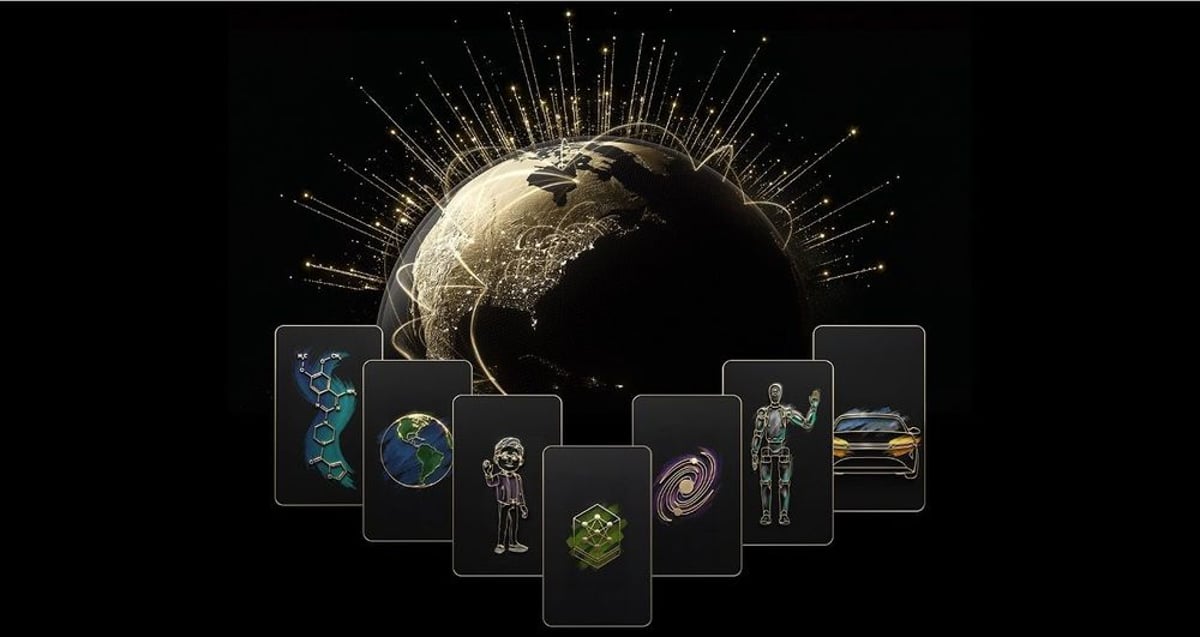
The released model families include:
-
NVIDIA Nemotron for agentic AI
-
NVIDIA Cosmos for physical AI
-
NVIDIA Alpamayo for autonomous vehicles
-
NVIDIA Isaac GR00T for robotics
-
NVIDIA Clara for healthcare and life sciences
To support these models, NVIDIA published open data at large scale:
-
10T language training tokens
-
500,000 robotics trajectories
-
455,000 protein structures
-
100TB of vehicle sensor data
This data is available to developers through platforms like GitHub and Hugging Face.
Nemotron and AI Agents
Nemotron focuses on building AI agents that can handle real tasks in enterprise software.
Recent Nemotron releases cover:
-
Speech recognition for real-time use
-
Retrieval and document understanding
-
Safety models for content filtering and sensitive data detection
Companies adopting Nemotron models include Bosch, CrowdStrike, Cohesity, Fortinet, Palantir, Salesforce, ServiceNow, Hitachi, and Uber.
These systems are often used to power AI assistants inside business software.
Cosmos and Physical AI
Physical AI systems require experience in real-world environments. Collecting that data is slow and expensive.
NVIDIA Cosmos provides simulation and world modeling tools that generate realistic training data. Robots and vehicles can learn inside simulated environments that follow physical rules. Actions create reactions, allowing safe testing of rare or dangerous situations.
This approach helps AI systems improve faster than real-world data collection alone.
Alpamayo for Autonomous Vehicles
Autonomous driving received a major update with NVIDIA Alpamayo.
Alpamayo 1 is a 10B-parameter vision language action model designed for autonomous vehicles. It allows a vehicle to analyze its surroundings, reason through complex traffic situations, and explain its decisions.
Supporting tools include:
-
AlpaSim, an open-source driving simulator
-
1,700+ hours of real-world driving data across many regions and conditions
These tools help developers train systems to handle rare and unpredictable road scenarios.
Healthcare AI with Clara
NVIDIA Clara expands AI use in medicine and life sciences.
New Clara models include:
-
La-Proteina for protein design
-
ReaSyn v2 for drug manufacturing planning
-
KERMT for early safety prediction
-
RNAPro for RNA structure modeling
An open dataset of 455,000 synthetic protein structures supports research and model development.
The CES 2026 Takeaway
CES 2026 showed how NVIDIA is aligning infrastructure, open models, and simulation tools into a single strategy.
AI systems are moving into factories, vehicles, robots, and hospitals. NVIDIA is building the computing platforms that support this shift at scale.
This keynote focused on deployment, production, and long-term infrastructure rather than short-term product cycles.