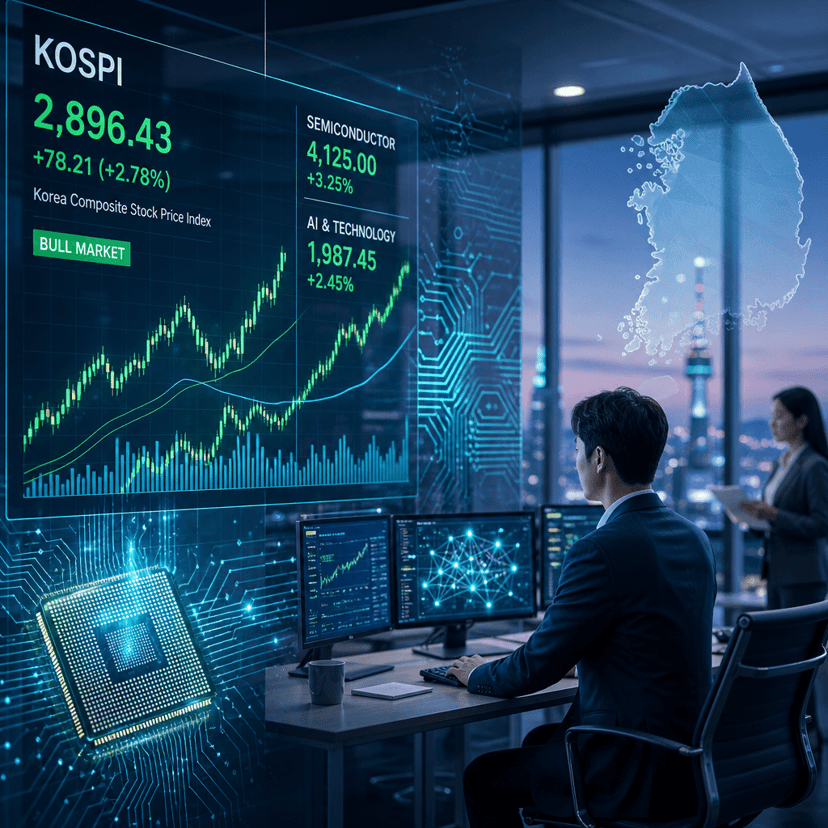
South Korea's stock market just pulled off one of the fastest bear-to-bull reversals in recent memory. The benchmark Kospi index surged into technical bull market territory Thursday, climbing more than 20% from its recent lows in just over a month. The dramatic turnaround comes as Samsung and SK Hynix ride a massive wave of AI chip demand, proving that the semiconductor supercycle everyone predicted is finally here.
The Kospi's rally Thursday pushed the index decisively past the 20% threshold that marks a technical bull market, capping a stunning reversal that began in early July when the benchmark sat deep in bear territory. It's the kind of violent swing that either signals a major inflection point or sets up investors for disappointment, and right now the smart money is betting on the former.
SK Hynix has emerged as the poster child for this rally, with shares climbing relentlessly as the company cements its position as the go-to supplier for high-bandwidth memory chips that power AI accelerators. The stock has become a pure-play bet on AI infrastructure spending, and institutional investors can't seem to get enough. Meanwhile, Samsung is clawing back market share in the same HBM category after a slow start, and the market is rewarding the progress.
The timing isn't coincidental. Global demand for AI chips has shifted from theoretical to absolutely critical as companies race to build out data center capacity. Nvidia can't make GPUs fast enough, and that bottleneck is creating a ripple effect throughout the supply chain. Korean chipmakers are the primary beneficiaries because they control the vast majority of advanced memory production, the exact components needed to feed AI's insatiable appetite for processing power.
Memory chip prices have turned sharply higher after a brutal two-year downturn that nearly pushed the industry into crisis. DRAM spot prices are up double digits from their lows, and analysts expect the momentum to continue as AI server deployments accelerate through 2027. For context, SK Hynix's HBM production is reportedly sold out through next year, with customers willing to pay premium prices to secure supply.
But the rally isn't just about chips. Korea's market has been chronically undervalued compared to global peers, trading at a discount that investors call the "Korea discount" - a combination of corporate governance concerns, geopolitical tensions, and structural issues that have kept foreign capital on the sidelines. The AI boom is powerful enough to override those worries, at least for now.
Foreign institutional investors have been net buyers of Korean stocks for four consecutive weeks, reversing a pattern of steady outflows that defined most of 2025. The influx of capital suggests global fund managers are willing to look past the risks in exchange for exposure to what could be a multi-year AI infrastructure buildout. Korea offers that exposure at a fraction of the valuation multiples commanded by U.S. semiconductor names.
Still, the speed of this reversal is raising eyebrows. Moving from bear to bull in five weeks is unusual for a major index, and it typically signals either a major bottom or a bear market rally that will eventually fizzle. Technical analysts are split on which scenario is playing out, though momentum clearly favors the bulls right now.
The geopolitical backdrop adds another layer of complexity. Trade tensions, semiconductor export controls, and the ongoing chip war between the U.S. and China create constant uncertainty for Korean manufacturers who sell globally. Any escalation could derail the rally quickly, particularly if China retaliates against Korean chipmakers or if Washington tightens restrictions on advanced chip exports.
What happens next depends largely on whether AI spending lives up to the hype. If hyperscalers like Microsoft, Google, and Amazon continue pouring billions into AI infrastructure, Korean chipmakers will print money. If the buildout slows or efficiency improvements reduce memory requirements, the rally could reverse just as quickly as it began.
For now, traders are betting on the former. Options activity shows heavy positioning for further upside in both Samsung and SK Hynix, with call volumes spiking over the past two weeks. Retail investors in Korea have also jumped in, a sign that FOMO is starting to build after weeks of watching the market climb.
The Kospi's performance also highlights a broader shift in global markets, where AI has become the dominant investment theme capable of overriding traditional concerns about valuations, rates, or economic growth. Investors are willing to pay up for exposure to the AI supply chain, and Korea's chipmakers offer that exposure with less competition than U.S. names that have already run hard.
Korea's whipsaw market move captures the broader story playing out across global tech - AI isn't just a theme, it's a force powerful enough to override structural concerns and rewrite market narratives in weeks rather than quarters. Whether the Kospi can hold these gains depends on AI spending staying robust and geopolitical risks staying contained, two variables that could shift quickly. But for Korean chipmakers sitting at the center of the AI supply chain, the opportunity is real and the market is finally paying attention. Investors who sat out the rally are now facing an uncomfortable question: chase momentum or wait for a pullback that may never come.