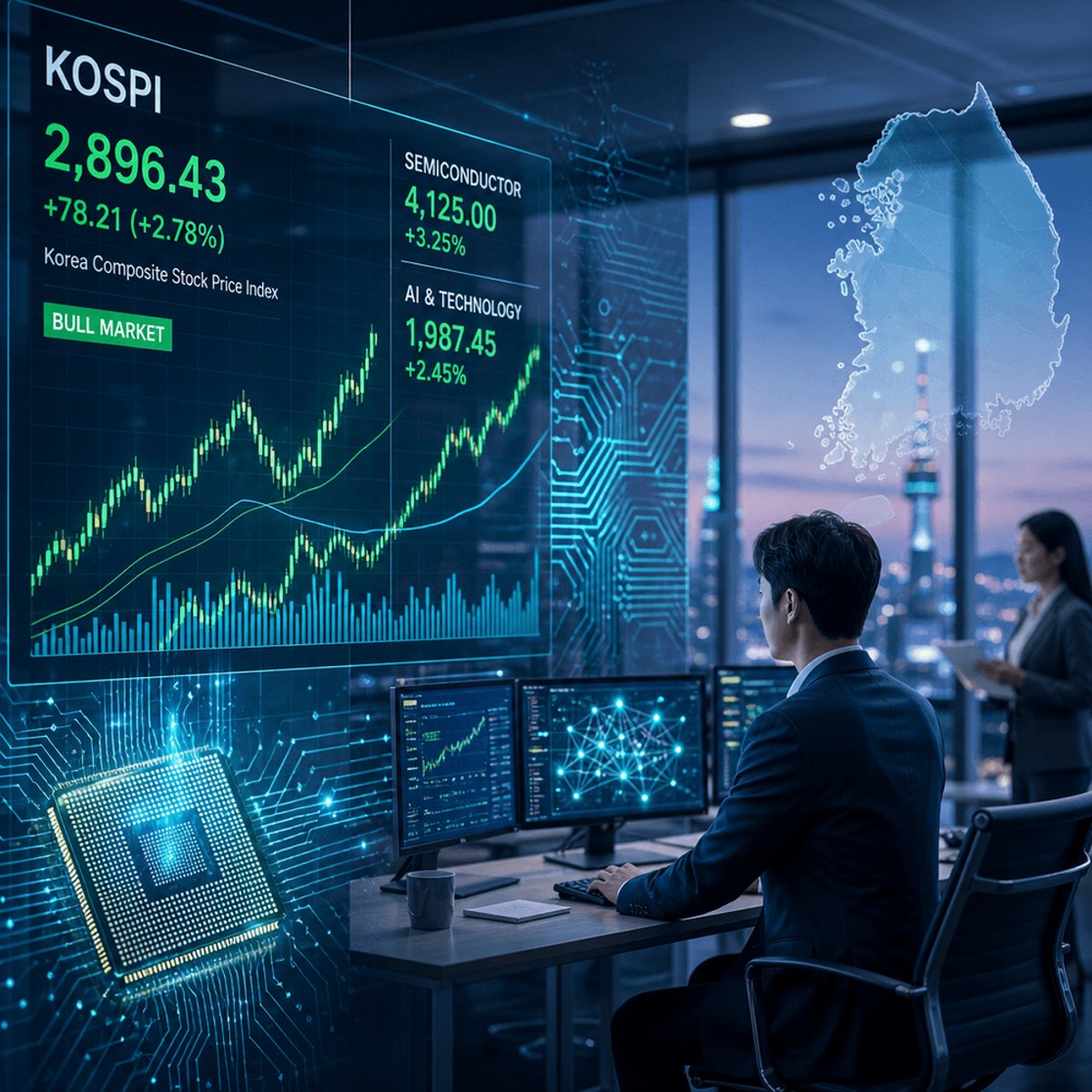
South Korea's benchmark Kospi index just roared back into bull market territory, fueled by a dramatic resurgence in semiconductor stocks that dominate the exchange. The rally marks a stunning reversal for Samsung and SK Hynix, whose combined weight drives nearly 30% of the index's movements. Investors are piling back into Korean chip makers as AI infrastructure spending shows no signs of slowing, despite earlier fears of a sector correction.
The Kospi's dramatic comeback is rewriting the narrative around Asian semiconductor stocks. After tumbling through early summer on fears of AI spending fatigue and weakening consumer demand, South Korea's main stock index has clawed back more than 20% from its recent lows, officially entering bull market territory according to CNBC.
Samsung and SK Hynix are powering the surge, with both companies benefiting from what analysts are calling a 'second wave' of AI infrastructure investment. The timing couldn't be better for Seoul's chip giants. After months of inventory corrections and pricing pressure in the DRAM market, memory chip prices have stabilized while demand for high-bandwidth memory (HBM) used in AI accelerators continues to outpace supply.
SK Hynix has emerged as a particular standout, positioning itself as the go-to supplier for Nvidia's latest generation of AI chips. The company's HBM3E products are shipping to hyperscalers at premium prices, reversing earlier concerns about margin compression. Samsung, meanwhile, is racing to catch up in the HBM market while maintaining its dominance in conventional memory and logic chips.
The rally extends beyond just the two semiconductor behemoths. The broader Korean tech ecosystem is riding the wave, with equipment makers, materials suppliers, and even packaging specialists seeing renewed investor interest. Foreign institutional money is flowing back into Korean equities after months of net outflows, a shift that's providing crucial support to valuations.
But skeptics aren't hard to find. The semiconductor industry remains notoriously cyclical, and some market watchers argue the current rally is built more on momentum than fundamentals. Memory chip prices, while stabilized, haven't returned to the peak levels seen during the pandemic-era boom. And geopolitical tensions, particularly around Taiwan and U.S.-China tech restrictions, continue to create uncertainty for supply chains heavily dependent on cross-border cooperation.
The sustainability question looms large. Korean chip stocks have rallied hard before, only to give back gains when quarterly earnings failed to meet elevated expectations. The difference this time, bulls argue, is the structural shift toward AI workloads that require vastly more memory and processing power than traditional computing. If that thesis holds, the current rally could have legs.
Timing matters too. The Kospi's recovery comes as other major Asian markets struggle to find direction. Japan's Nikkei has been choppy, Chinese tech stocks remain under regulatory pressure, and Taiwan's market faces its own valuation concerns despite TSMC's strength. Korean equities are suddenly looking like a relative value play for investors seeking semiconductor exposure without some of the political baggage attached to Chinese alternatives.
What happens next likely depends on earnings season. Both Samsung and SK Hynix will need to deliver results that justify current valuations, particularly as memory pricing remains under pressure in segments outside AI. The companies are betting big on HBM capacity expansion, but that capacity won't come online overnight. In the meantime, investors are essentially pricing in a sustained recovery in both volumes and margins.
The index's heavy concentration in semiconductors cuts both ways. When chip stocks rally, the Kospi soars. But that same concentration means the index is vulnerable to any stumble in the sector. With tech earnings volatility picking up globally and questions swirling about the pace of AI monetization, the bull market's durability remains an open question.
South Korea's chip-driven rally is a reminder that semiconductor stocks remain the ultimate volatility play in tech investing. The Kospi's bull market status reflects genuine optimism about AI's insatiable appetite for memory and processing power, but it also embeds significant risk if that demand falters or geopolitical tensions escalate. For now, investors are betting that Samsung and SK Hynix can execute on their HBM ambitions while navigating a market that's proven brutally cyclical. The next few quarters will reveal whether this rally has staying power or if it's just another chapter in the boom-bust cycle that's defined the chip sector for decades.