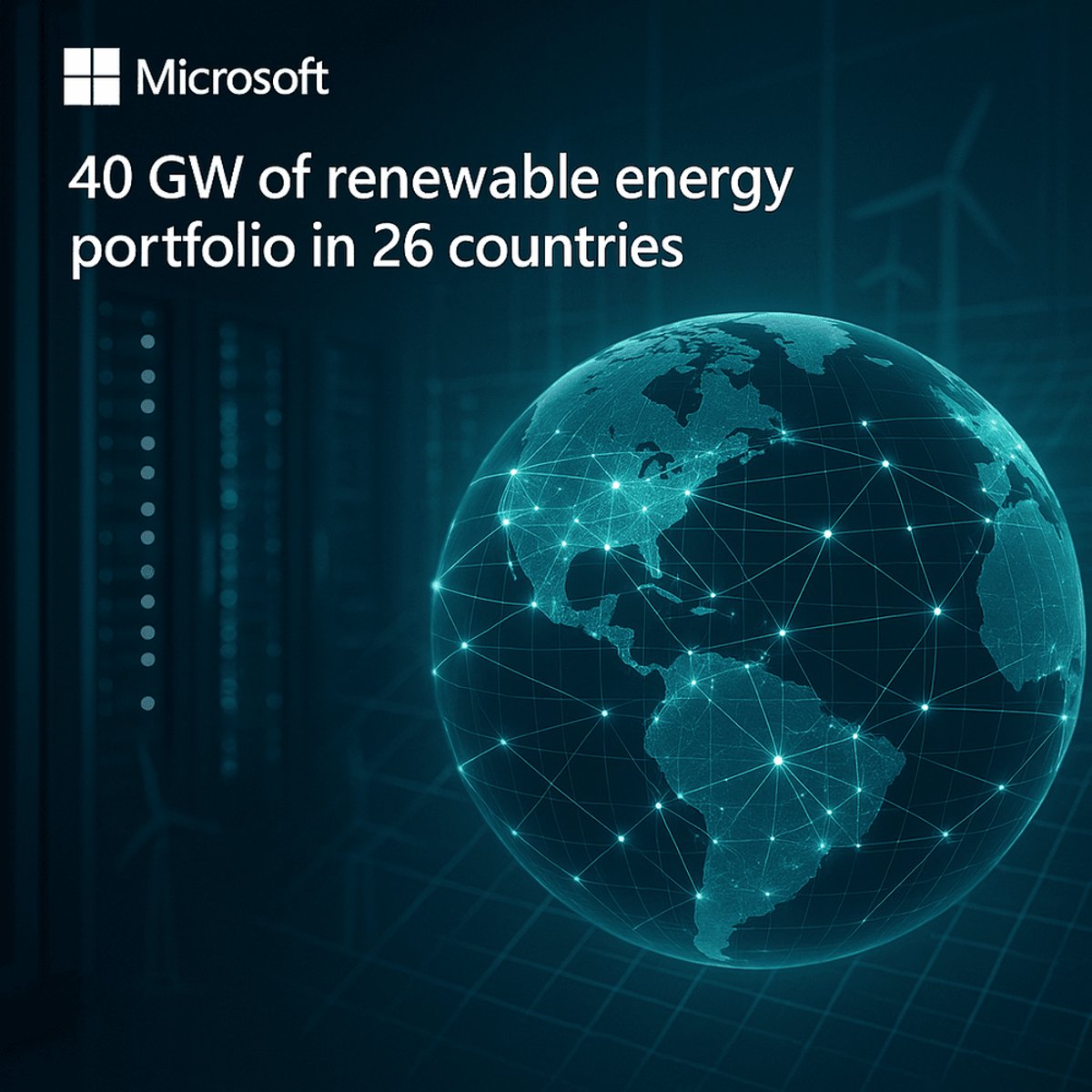
Microsoft just declared victory on a promise it made five years ago. The company announced it's hit 100% renewable energy matching for all global operations, backed by what it calls one of the world's largest clean energy portfolios - 40 gigawatts of contracted renewable capacity spanning 26 countries. What started as a single 110-megawatt Texas wind farm deal in 2013 has mushroomed into 400-plus contracts with 95 utilities and developers, slashing the company's reported Scope 2 emissions by an estimated 25 million tons since 2020. But as Microsoft's AI-driven cloud infrastructure continues its explosive growth, the real test lies ahead: transitioning from renewable energy credits to round-the-clock carbon-free power.
Microsoft is rewriting the playbook on corporate clean energy procurement, and the numbers tell a story of scale that few companies can match. The tech giant announced Tuesday it's achieved 100% renewable energy matching for its global operations - a milestone it set back in 2020 as part of its moonshot pledge to go carbon negative by 2030. Behind that achievement sits a sprawling portfolio of 40 gigawatts of contracted renewable capacity, spread across 26 countries through more than 400 separate deals.
It's a remarkable acceleration from humble beginnings. Back in 2013, Microsoft signed its first power purchase agreement - a modest 110-megawatt wind project in Texas that was more proof-of-concept than game-changer. "What began as a small first step to demonstrate how corporate procurement could scale clean energy has evolved into one of the largest clean energy portfolios in the world," Chief Sustainability Officer Melanie Nakagawa and Cloud Operations President Noelle Walsh wrote in the official announcement.
The scale is hard to wrap your head around. Of the 40 gigawatts contracted since Microsoft's carbon negative announcement in 2020, 19 gigawatts are already pumping electrons into power grids worldwide. That's enough juice to power roughly 10 million US homes, according to EPA calculations. The remaining 21 gigawatts are slated to come online over the next five years as projects move from planning to construction to operation.
But Microsoft isn't just signing checks and collecting renewable energy credits. The company's approach has helped reshape how corporations buy clean power, pioneering contract structures that other buyers have since adopted. Working with 95 utilities and developers, Microsoft has evaluated over 5,000 carbon-free energy projects globally, using everything from traditional power purchase agreements to innovative virtual PPAs and clean energy tariffs tailored to different market structures.
The environmental impact is substantial. Microsoft reports cutting its Scope 2 carbon dioxide emissions by an estimated 25 million tons between fiscal year 2020 and 2025 - a reduction achieved by replacing grid electricity with contracted renewables rather than buying what the company calls "spot market" renewable energy credits from existing projects. That distinction matters in sustainability accounting circles, where there's growing scrutiny on whether corporate green power claims actually drive new clean energy development or simply shuffle existing clean electrons on paper.
Microsoft's procurement strategy has also unlocked billions in private infrastructure investment. The company's landmark 10.5-gigawatt framework agreement with Brookfield alone sends a long-term demand signal through 2030 that helps developers secure financing, build supply chains and hire engineers. Six energy partners now have over 1 gigawatt each contracted with Microsoft, while more than 20 partners have at least five separate renewable projects with the company.
The deals span the globe and showcase Microsoft's market-opening role. In Japan, Microsoft signed one of the country's first corporate PPAs - a 25-megawatt, 20-year agreement with Shizen Energy that helped pave the way for over 2 gigawatts of corporate renewable procurement since 2024, according to Bloomberg New Energy Finance. In India, Microsoft purchased a 437-megawatt solar-wind hybrid from Renew to support rural electrification. Back home in Washington state, the company's Douglas County datacenters run on 100% carbon-free energy through a creative blend of new wind power and hydropower storage.
Community benefits are woven into many deals. Microsoft's 500-megawatt PPA with Sol Systems and its 250-megawatt agreement with Volt Energy Utility include provisions for local training, jobs, grants to nonprofit organizations and habitat restoration. The company has signed over 1.5 gigawatts of distributed solar projects that bring clean energy directly into hundreds of communities worldwide.
But hitting 100% renewable matching is just one chapter in Microsoft's climate story. The company is increasingly focused on what comes next: moving beyond annual renewable energy matching to 24/7 carbon-free energy that eliminates emissions in real-time rather than balancing them over a year. That requires a broader technology toolkit than wind and solar alone can provide.
Microsoft is already placing early bets on advanced energy technologies that remain largely unproven at commercial scale. The company partnered with Helion on a 50-megawatt fusion energy project in Washington state and is working with Constellation Energy to restart the 835-megawatt Crane Clean Energy Center nuclear facility in Pennsylvania. Through its Climate Innovation Fund, Microsoft has allocated $806 million across 67 investments, with 38% directed toward energy systems including carbon-free power, storage and grid management solutions.
The company is also leaning into AI-driven tools to accelerate clean energy deployment. Recent collaborations with Idaho National Laboratory and the Midcontinent Independent System Operator showcase how Microsoft is applying machine learning to streamline nuclear licensing, optimize grid operations and speed up permitting for new power infrastructure.
The timing is critical. The International Energy Agency describes the current moment as the dawn of a new "Age of Electricity" - with surging demand from electric vehicles, heat pumps, air conditioners and datacenters pushing global electricity consumption to unprecedented levels. Corporate buyers like Microsoft have collectively purchased nearly 200 gigawatts of clean energy since 2008, according to Bloomberg New Energy Finance, helping drive renewable energy generation to expand nearly four-fold since 2000 based on IEA data.
For Microsoft, the stakes are especially high. The company's cloud infrastructure growth - fueled by enterprise AI adoption and expanding Azure services - is driving electricity demand skyward. Meeting its 2030 carbon negative commitment while simultaneously scaling AI infrastructure will require not just more renewable energy contracts, but fundamentally new approaches to clean power procurement, grid integration and energy innovation.
The 100% renewable matching milestone represents what's possible when corporate demand meets market innovation. But it's also a checkpoint on a longer journey toward truly carbon-free operations that don't rely on annual accounting tricks. Whether Microsoft's bets on fusion, nuclear restarts and AI-optimized grids pay off will determine if the company can deliver on its bigger climate promises while powering the AI revolution.
Microsoft's achievement of 100% renewable energy matching through 40 gigawatts of contracted capacity marks a significant milestone in corporate sustainability, but it's really just table stakes for what's coming. The harder challenge - and the one that will define whether Microsoft meets its 2030 carbon negative goal - is transitioning from annual renewable matching to 24/7 carbon-free power that eliminates emissions in real-time. With AI workloads exploding and datacenters multiplying, the company's bets on fusion energy, nuclear restarts, and AI-optimized grid management represent a recognition that wind and solar alone won't cut it. The renewable portfolio proves Microsoft can mobilize capital and reshape markets. Now comes the test of whether it can do the same for technologies that haven't been proven at commercial scale.