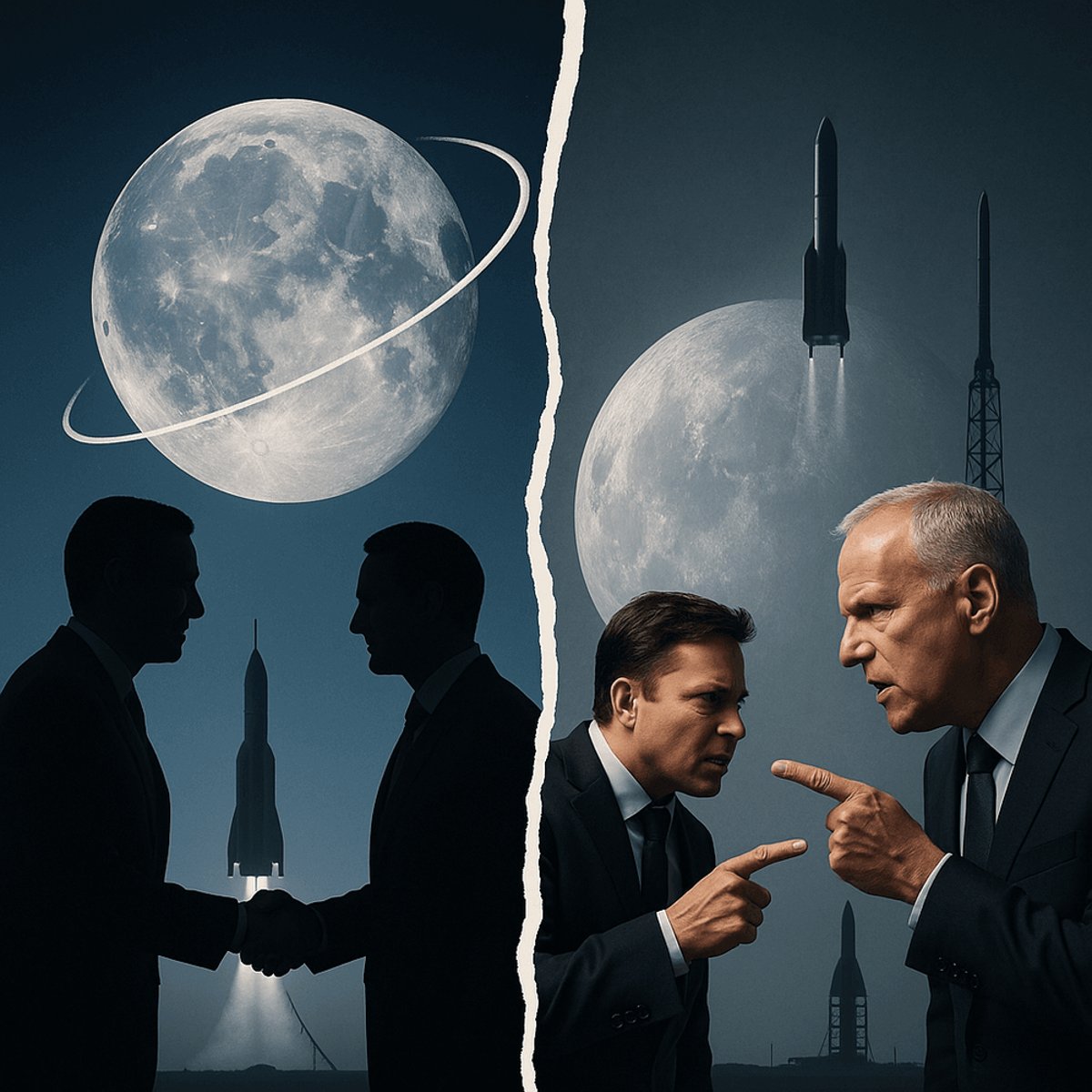
Elon Musk unleashed a blistering attack on acting NASA Administrator Sean Duffy Tuesday, calling him incompetent and accusing him of sabotaging America's moon program. The feud erupted after Duffy publicly criticized SpaceX for falling behind on its $2.9 billion lunar lander contract and threatened to consider rival bids from competitors like Blue Origin.
The gloves came off in America's space program Tuesday as SpaceX CEO Elon Musk launched a withering personal attack on acting NASA Administrator Sean Duffy, escalating a contract dispute that could reshape the nation's return to the moon. Musk didn't hold back on X, writing that 'the person responsible for America's space program can't have a 2 digit IQ' and dubbing Duffy '*Sean Dummy.' The billionaire even mocked Duffy's background as a competitive speed climber, asking followers if 'someone whose biggest claim to fame is climbing trees' should run NASA.
The explosive confrontation stems from Duffy's Monday interview with CNBC, where he publicly criticized SpaceX for lagging 'behind' schedule on its crucial lunar landing system for the Artemis III mission. More damaging still, Duffy floated the possibility of awarding contracts to competitors like Jeff Bezos' Blue Origin - a direct challenge to Musk's space dominance. 'We would consider other contracts with competitors such as Jeff Bezos' Blue Origin,' Duffy told reporters, setting a October 29 deadline for SpaceX and other contractors to propose acceleration plans.
The timing couldn't be worse for NASA's already troubled moon program. The agency has been hemorrhaging talent under sweeping workforce reductions tied to Musk's previous role heading the Department of Government Efficiency (DOGE). Nearly 4,000 NASA employees - roughly one-fifth of the workforce - accepted buyout packages since Trump took office, leaving critical programs understaffed. The cuts, implemented through what NASA called 'deferred resignation programs,' have particularly hit diversity and inclusion initiatives that Musk had targeted during his DOGE tenure.
SpaceX won its $2.9 billion Artemis contract back in 2021, beating out established aerospace giants like Boeing and Lockheed Martin. But the program has stumbled repeatedly since then. NASA's first Artemis mission launched in November 2022, but last December brought another round of delays. The first crewed moon flight is now scheduled for April 2026, with the actual lunar landing pushed to 2027 - a timeline that has China breathing down America's neck in the new space race.
Duffy's appointment itself reflects the political chaos surrounding NASA leadership. Trump initially nominated Musk ally Jared Isaacman for the top job, only to withdraw the nomination after calling Isaacman a 'blue blooded Democrat.' The position sat vacant for months before Trump tapped Duffy, the former transportation secretary, to lead an agency racing against time and geopolitical rivals. Sources tell CNBC that Trump has quietly reopened discussions with Isaacman about reconsidering the role.
The current government shutdown adds another layer of uncertainty to an already fragile situation. While NASA carved out exceptions for Artemis contractors to keep working during the shutdown, the broader funding freeze threatens to derail any plans to reopen bidding or accelerate timelines. The agency is essentially operating on life support while Musk and Duffy wage their public war of words.
'We need to increase the cadence of Moon missions,' a NASA official told CNBC, but that goal seems increasingly distant as political infighting consumes the program. Blue Origin, which lost the original contract to SpaceX, has been quietly preparing its own lunar lander proposals, seeing an opening in the current chaos. Lockheed Martin and Boeing continue working on other Artemis components, but the lunar lander remains the critical bottleneck.
The stakes extend far beyond corporate contracts or political posturing. China has accelerated its own lunar ambitions, targeting a crewed moon landing before 2030. Every delay in Artemis hands Beijing more time to claim the ultimate prize in space exploration. NASA's goal of establishing a 'long-term presence' on the moon for scientific research now hangs in the balance as America's space leaders tear each other apart on social media.
This public feud between Musk and Duffy exposes deeper cracks in America's space ambitions at the worst possible moment. With China advancing rapidly on its own lunar program and NASA facing severe staffing shortages, the last thing the space agency needs is its biggest contractor and top administrator engaged in Twitter warfare. The October 29 deadline looms as a critical test - not just for SpaceX's technical plans, but for whether American space leadership can overcome its own political dysfunction to reach the moon before its rivals do.