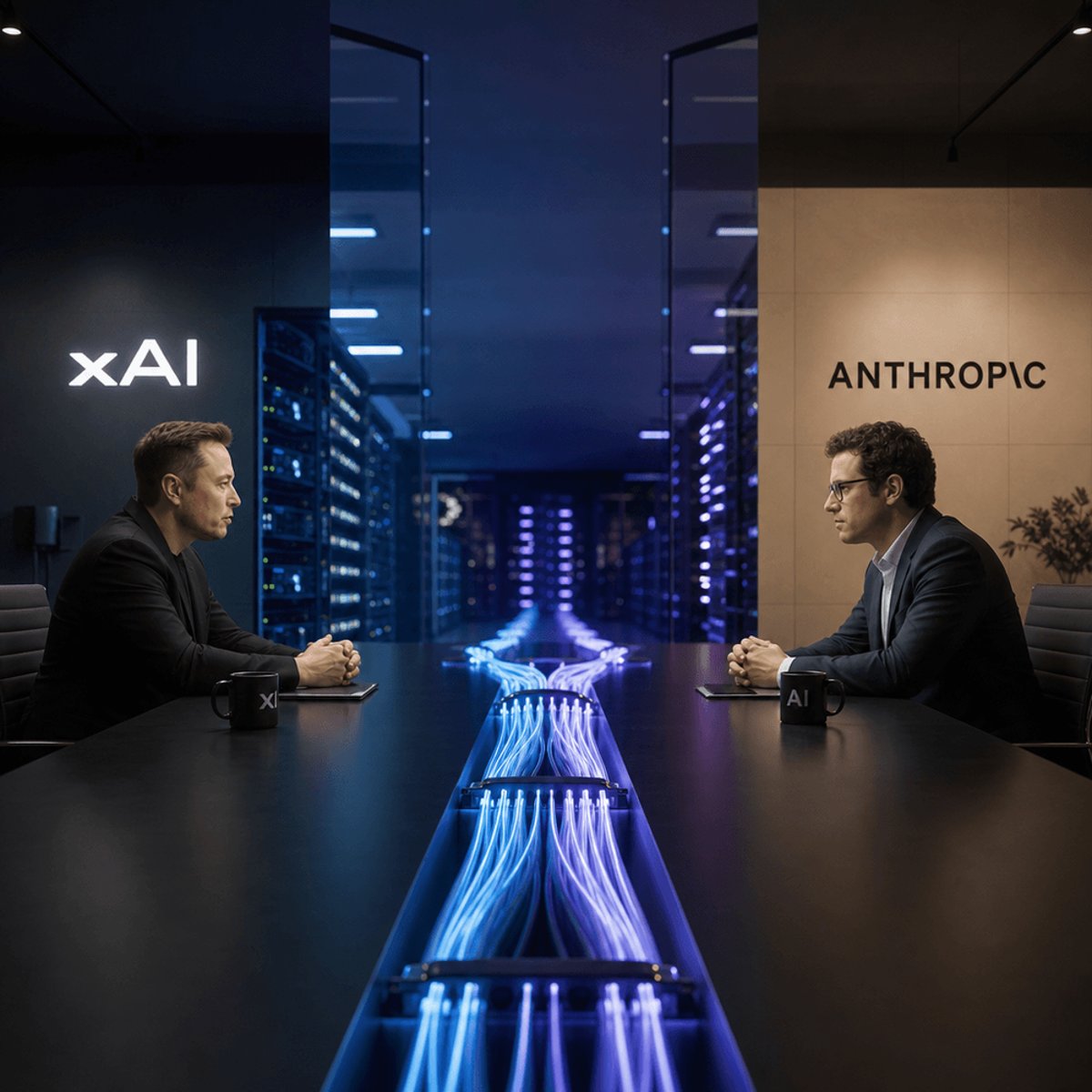
Elon Musk just made a high-stakes promise to one of his biggest AI rivals. The xAI founder publicly committed not to cut off Anthropic's access to critical infrastructure, even as competition intensifies between the two companies. With roughly $40 billion in revenue hanging in the balance, the pledge highlights the uncomfortable dependencies shaping the AI industry - where competitors must sometimes trust each other to keep the lights on.
Elon Musk is making promises to Anthropic, and the AI industry is watching closely to see if they'll hold. The Tesla and SpaceX CEO publicly committed not to shut down Anthropic's access to infrastructure his companies control, even as his own xAI venture competes directly with Anthropic's Claude models.
The stakes couldn't be higher. Anthropic is staring down roughly $40 billion in potential revenue that depends on reliable infrastructure access. That's not just a number - it represents the company's ability to serve enterprise customers, scale its models, and compete with OpenAI, Google, and other AI giants racing to dominate the market.
But here's the uncomfortable reality that Anthropic and other AI companies face: the infrastructure landscape is increasingly concentrated. Building massive GPU clusters costs billions, and only a handful of players have the capital and expertise to do it at scale. That creates situations where competitors must rely on each other's infrastructure, breeding the kind of trust issues now playing out publicly between Musk and Anthropic.
Musk's pledge came alongside praise for Mythos and Fable, gaming-focused AI projects that signal his broader infrastructure ambitions. The timing isn't coincidental. As xAI builds out its own compute capabilities - reportedly constructing one of the world's largest supercomputers - Musk is positioning himself as both competitor and potential infrastructure provider to the AI industry.
Anthropic's dependency highlights a broader vulnerability in the AI ecosystem. Unlike traditional software companies that can distribute workloads across multiple cloud providers, AI model hosting requires specialized hardware configurations, tight integration, and massive scale. Switching providers isn't as simple as migrating a database - it means potentially rebuilding infrastructure relationships from scratch.
The competitive dynamics get messier when you consider the relationships. Anthropic was founded by former OpenAI executives who left over safety concerns. Musk co-founded OpenAI before departing and later suing the organization. Now his xAI is racing to catch up with models like Claude and ChatGPT, while simultaneously controlling infrastructure that rivals might need.
Industry insiders are questioning whether verbal promises are enough. Contracts and service-level agreements typically govern these relationships, but Musk's public statement suggests the arrangement might be more informal - or that Anthropic needed public reassurance. Either scenario raises questions about the stability of AI infrastructure dependencies.
The situation also exposes how infrastructure control translates to industry power. Amazon Web Services, Microsoft Azure, and Google Cloud have built empires by becoming indispensable to other companies' operations. Musk appears to be attempting something similar in AI-specific infrastructure, using SpaceX's resources and Tesla's manufacturing expertise to build compute capabilities.
For Anthropic, the calculus is brutal. The company has raised billions from investors expecting explosive growth, but that growth requires infrastructure reliability. Diversifying providers means splitting attention and potentially degrading performance. Trusting Musk means accepting that a competitor controls critical resources.
The $40 billion figure reportedly represents Anthropic's revenue projections tied to infrastructure availability. If access got cut or degraded, the company couldn't serve existing customers, let alone scale to new ones. It's the kind of existential dependency that keeps executives awake at night.
Musk's Mythos and Fable praise adds another layer. These gaming AI projects need infrastructure too, and by publicly supporting them while promising not to cut off Anthropic, Musk is signaling he wants to be seen as a neutral infrastructure provider - even while competing at the application layer. It's a delicate balance that Amazon has walked for years, hosting competitors' services on AWS while competing with them in retail and other markets.
But Musk isn't Amazon, and his track record on keeping promises to competitors is mixed. He's cut off API access, changed terms unilaterally, and made strategic pivots that left partners scrambling. Whether Anthropic can truly trust this commitment remains the industry's biggest question.
Musk's public promise not to cut Anthropic's infrastructure access exposes the precarious dependencies shaping the AI industry's future. With $40 billion at stake, Anthropic finds itself in the uncomfortable position of trusting a direct competitor for critical resources - a situation that's becoming increasingly common as infrastructure consolidates among a few powerful players. Whether verbal commitments can sustain multi-billion dollar businesses remains an open question, one that will likely define competitive dynamics as AI companies scale. For now, Anthropic is betting that Musk's infrastructure ambitions outweigh his competitive instincts, but the industry knows that calculation could change overnight.