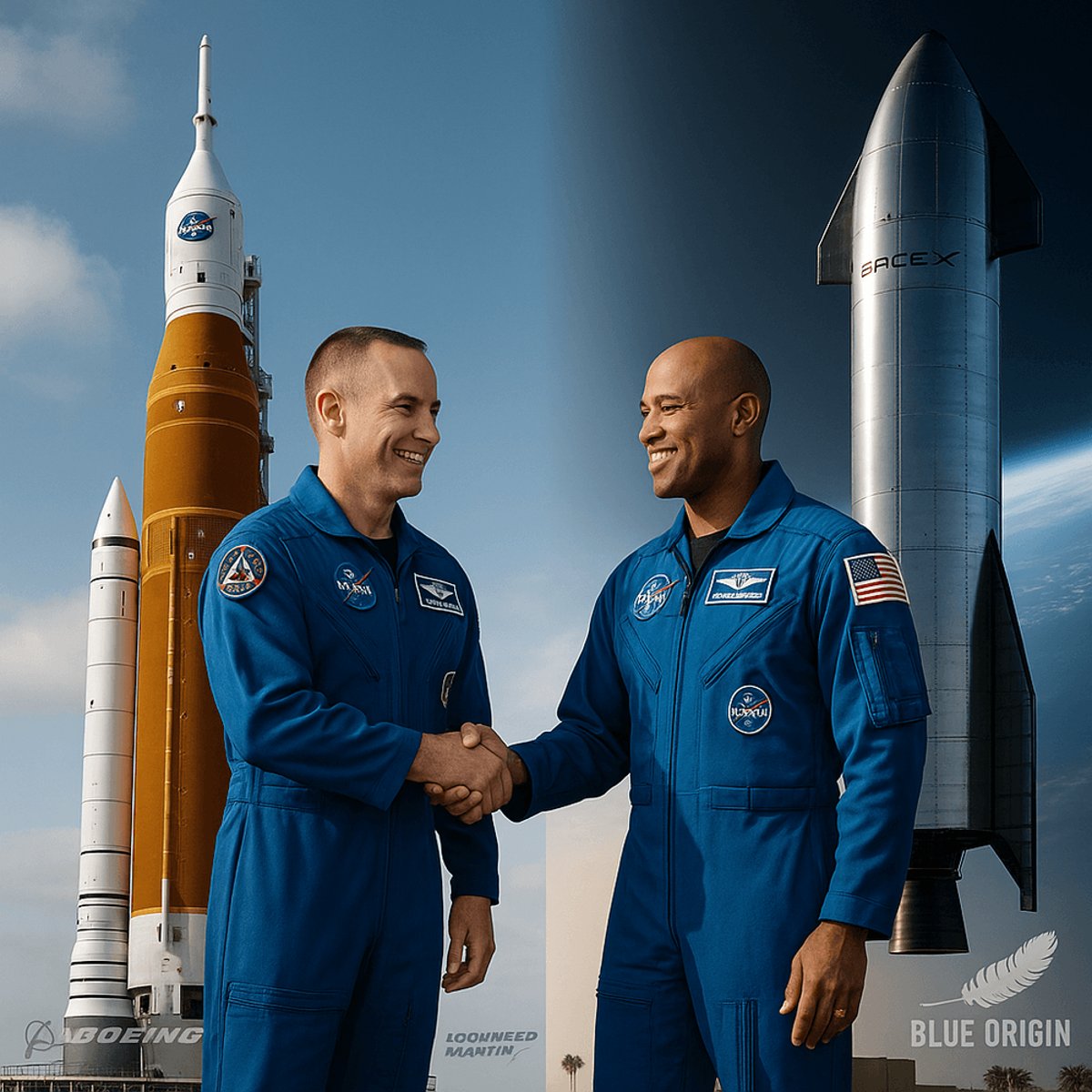
NASA's Artemis II mission represents a historic turning point in space exploration - it's the last time the agency will go to the moon without relying on Silicon Valley's commercial space giants. When the crew splashes down, the next lunar missions will depend entirely on SpaceX and Blue Origin to deliver both the landing systems and key infrastructure. It's a fundamental shift from government-led space programs to a public-private model that could reshape humanity's return to the lunar surface.
NASA is about to complete its last solo act at the moon. Artemis II, scheduled to fly four astronauts around the lunar surface, relies entirely on hardware developed through traditional government contracts - the Space Launch System rocket, Orion capsule, and ground systems built by legacy aerospace contractors like Boeing and Lockheed Martin. But when those astronauts return to Earth, they'll be closing a chapter that began with Apollo.
Starting with Artemis III, NASA can't touch the lunar surface without SpaceX. The agency awarded Elon Musk's company a $2.9 billion contract to develop a modified Starship as the Human Landing System - the vehicle that will actually ferry astronauts from lunar orbit down to the surface. Without it, NASA's rockets can get close, but they can't land. The entire architecture of America's moon return depends on a spacecraft that's still in development and has yet to complete a successful orbital refueling demonstration.
That's not the only commercial dependency. Blue Origin, Jeff Bezos's space venture, won a separate contract worth $3.4 billion to develop a competing lunar lander for missions after Artemis III. The company is also building cargo delivery systems essential for establishing any permanent presence on the moon. These aren't auxiliary systems - they're mission-critical hardware that didn't exist in government blueprints until private companies proposed them.
The transition reflects a fundamental bet by NASA leadership that commercial space companies can move faster and cheaper than traditional aerospace. The Space Launch System, NASA's government-designed rocket, has been in development since 2011 and costs roughly $4.1 billion per launch according to NASA's Inspector General. SpaceX's Starship, by contrast, is designed for full reusability with a target cost per launch in the tens of millions once operational.
But speed comes with risk. SpaceX's Starship has completed several test flights, but the vehicle still needs to demonstrate on-orbit refueling - transferring cryogenic propellant between spacecraft in zero gravity - before it can reach the moon. That technology has never been done at the scale required. Blue Origin's lunar lander, meanwhile, exists primarily in renderings and engineering studies. The company's New Glenn rocket, which would launch lander components, hasn't flown yet.
NASA Administrator Bill Nelson has publicly expressed confidence in both companies, but the agency has also built flexibility into the timeline precisely because of these unknowns. Artemis III, originally targeted for 2025, has slipped to no earlier than 2027. Some industry analysts think 2028 or 2029 is more realistic given the technical challenges facing both SpaceX and Blue Origin.
The commercial pivot also changes the economics of space exploration. Rather than owning the vehicles, NASA is essentially buying rides - a model the agency pioneered with Commercial Crew contracts that now ferry astronauts to the International Space Station via SpaceX's Dragon capsule. The approach allows companies to sell unused capacity to other customers, whether that's foreign space agencies, research institutions, or eventually space tourists willing to pay tens of millions for a lunar flyby.
This creates a fundamentally different ecosystem than Apollo. During the 1960s moon race, NASA and its contractors built single-purpose vehicles optimized solely for government missions. The new model assumes a broader market for lunar access will emerge, justifying private investment in reusable systems. Whether that market materializes remains an open question.
For SpaceX and Blue Origin, the stakes extend beyond NASA contracts. Both companies have positioned lunar capabilities as stepping stones toward Mars for SpaceX and permanent space settlements for Blue Origin. Success with Artemis validates their broader visions and could unlock additional commercial and international partnerships. Failure would set back not just NASA's timeline but the entire commercial space industry's credibility.
The Artemis II crew - flying in a capsule that resembles Apollo but carries 21st century life support and computers - represents the bridge between these two eras. They'll test systems needed for longer lunar missions while proving that NASA can still execute complex human spaceflight even as the agency prepares to hand off key capabilities to contractors who operate more like tech startups than traditional aerospace giants.
What happens after splashdown will determine whether NASA's commercial gamble pays off or whether the agency finds itself dependent on systems that aren't ready when needed. Unlike Apollo, where NASA controlled every bolt and circuit, the next chapter of lunar exploration succeeds or fails based on companies that answer to shareholders and private owners as much as government program managers.
Artemis II's significance extends beyond the mission itself - it's the final dress rehearsal before NASA entrusts America's lunar ambitions entirely to commercial partners. SpaceX and Blue Origin now carry responsibility that once belonged exclusively to government engineers, and their success or struggles will ripple through space policy for decades. The shift promises faster innovation and lower costs, but it also means the timeline for returning humans to the moon depends on technologies still being invented in California and Texas rather than government labs. When Artemis II's crew waves from the recovery ship, they'll be closing one chapter while Silicon Valley prepares to write the next.