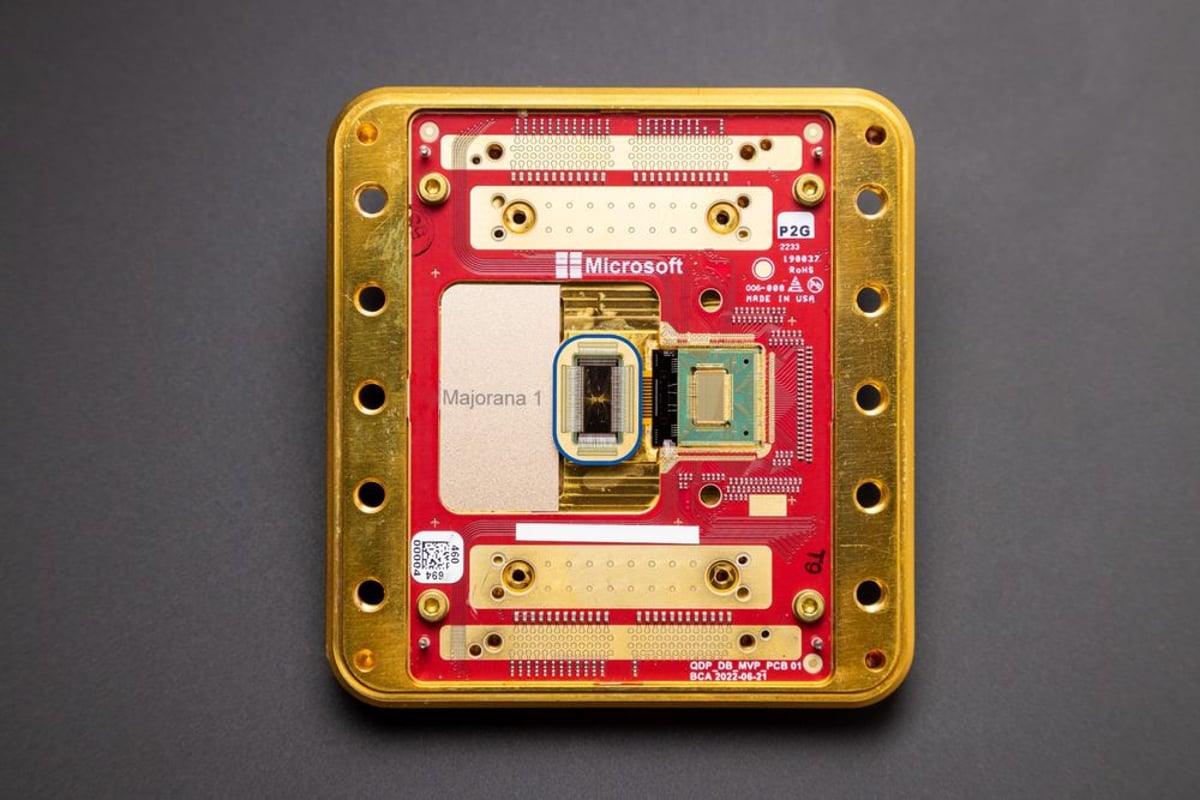
Microsoft is facing serious scientific scrutiny over its headline-grabbing quantum computing breakthrough. A peer-reviewed paper published Wednesday in Nature challenges the fundamental claims behind the company's Majorana 1 chip, which Microsoft unveiled in February 2025 as a quantum computing game-changer. The timing couldn't be worse - the company just announced the next-gen Majorana 2 at Build earlier this month, doubling down on a technology that physicist Henry Legg now argues lacks proper scientific backing.
Microsoft just got called out by one of the world's top scientific journals, and the stakes are massive. Henry Legg, a physicist at the University of St. Andrews, published a peer-reviewed analysis in Nature Wednesday that re-examines the data behind Microsoft's Majorana 1 processor. His conclusion? The company's researchers didn't conclusively demonstrate they'd created the topological qubits they claimed.
This isn't just academic nitpicking. Microsoft positioned the Majorana 1 as a fundamental breakthrough when it launched in February 2025, calling topological qubits the "building blocks" of their future quantum computer. The tech is supposed to be dramatically more stable than the qubits used by competitors like Google and IBM, potentially solving one of quantum computing's biggest headaches - keeping qubits coherent long enough to actually compute something useful.
But Legg's analysis suggests the experimental signatures Microsoft pointed to as evidence of topological qubits could be explained by more conventional physics. According to the Nature paper, alternative interpretations of the data weren't adequately ruled out. That's a polite way of saying Microsoft may have announced a breakthrough before the science was actually there.
The company already went through this once. Back in 2018, Microsoft researchers published a Nature paper claiming they'd observed Majorana particles - the exotic quantum entities that give topological qubits their special properties. That paper was retracted in 2021 after other scientists couldn't reproduce the results and found flaws in the data analysis. It was a black eye for Microsoft's quantum program, which has lagged behind competitors in delivering working quantum systems.
Now here's where it gets awkward. Microsoft announced the Majorana 2 chip at its Build conference earlier in June, positioning it as the next evolution of the supposedly breakthrough Majorana 1 technology. The company's quantum computing roadmap depends entirely on topological qubits panning out. If Legg's critique holds up under scientific scrutiny, Microsoft's entire quantum strategy could be built on shaky ground.
The quantum computing race has turned into a high-stakes game of leapfrog, with Google, IBM, and startups like Rigetti all claiming various forms of "quantum advantage" or "quantum supremacy." But these claims are notoriously hard to verify - the whole point of quantum computers is that classical computers can't easily check their work. That creates an environment where hype can run ahead of reality.
Microsoft hasn't publicly responded to Legg's paper yet, but the company has historically been defensive about its quantum research. After the 2018 retraction, Microsoft maintained its overall approach was sound even while acknowledging specific errors. The question now is whether the company will engage with this latest critique or stick to its narrative that topological qubits are the future.
For the broader quantum computing industry, this controversy highlights an uncomfortable truth - we're still in the very early days of the technology, and distinguishing genuine breakthroughs from measurement artifacts remains incredibly difficult. The physics is operating at the edge of what we can reliably observe and control.
What makes this particularly significant is Microsoft's massive investment in quantum infrastructure. The company has been building out Azure Quantum as a cloud platform for quantum computing, banking on eventually having hardware that outperforms competitors. If the foundational technology is in doubt, that's a problem not just for Microsoft's research credibility but for its business strategy.
The scientific community will now dig into Legg's critique and Microsoft's response, if it comes. This isn't the first time Microsoft's quantum claims have faced serious challenges, but the timing is particularly awkward given the Majorana 2 announcement. For an industry already plagued by hype and hard-to-verify claims, this latest controversy underscores how far we still have to go before quantum computing delivers on its massive promises. Microsoft's quantum future - and its credibility in the field - may depend on how convincingly it can address these fundamental questions about its core technology.