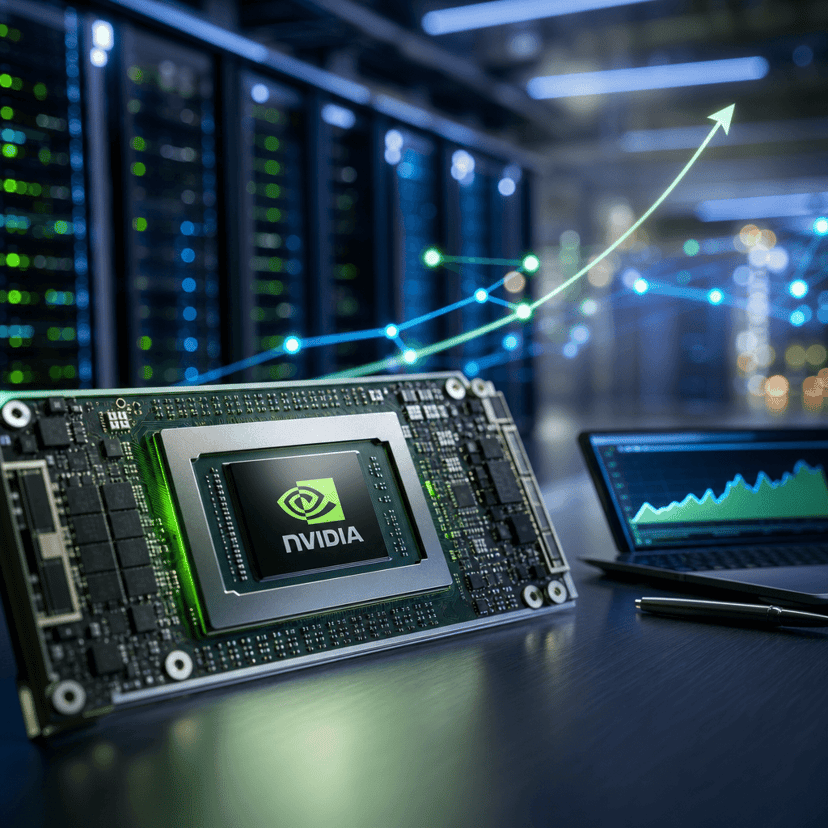
Nvidia is backing AI data infrastructure company Vast Data at a staggering $30 billion valuation, marking one of the chip giant's most significant venture bets as it expands beyond hardware into the broader AI ecosystem. The investment underscores how Nvidia is leveraging its AI gold rush dominance to build strategic stakes across the technology stack, from silicon to storage solutions powering enterprise AI deployments.
Nvidia just made one of its boldest venture plays yet, backing AI data infrastructure startup Vast Data at a $30 billion valuation according to CNBC. The deal positions the chip giant as both supplier and investor across the AI technology stack, a dual role that's becoming increasingly central to its strategy.
Vast Data, which provides AI-optimized storage and data management platforms, has emerged as a critical infrastructure player as enterprises struggle to handle massive datasets required for training and deploying large language models. The company's technology addresses a growing bottleneck - while Nvidia's GPUs deliver unprecedented compute power, many organizations find their AI initiatives constrained by data storage and retrieval speeds.
This isn't Nvidia's first rodeo as an investor. The company has quietly assembled a portfolio of AI startups over the past 18 months, but the Vast Data valuation dwarfs previous bets. The chip maker has backed companies ranging from AI drug discovery platforms to autonomous vehicle startups, creating an ecosystem of customers that are also strategically dependent on Nvidia's hardware roadmap.
The timing is revealing. As Nvidia faces mounting competition from custom AI chips developed by Amazon, Google, and Microsoft, the company is hedging by building deeper relationships across the AI infrastructure layer. By investing in companies like Vast Data, Nvidia ensures its GPUs remain the de facto standard even as cloud providers develop alternatives.
Vast Data's appeal lies in its unified storage architecture designed specifically for AI workloads. Traditional storage systems weren't built for the read-write patterns of model training, where thousands of GPUs simultaneously access petabytes of data. The company claims its platform can reduce training times by up to 40% compared to legacy storage solutions - a compelling pitch when GPU time costs thousands of dollars per hour.
The $30 billion valuation, while eye-popping, reflects the market's appetite for AI infrastructure plays. Investors are betting that whoever controls the data layer will capture significant value as AI moves from experimentation to production. Vast Data competes with legacy players like NetApp and emerging startups, but Nvidia's backing provides both validation and strategic advantage through deeper hardware integration.
For Nvidia, the investment represents a calculated expansion of its moat. The company already dominates AI chip sales with an estimated 80% market share, generating quarterly revenues that have tripled year-over-year. But CEO Jensen Huang has repeatedly emphasized that Nvidia sees itself as a full-stack AI company, not just a chip maker. The Vast Data deal puts capital behind that vision.
The investment also raises questions about conflicts of interest. Nvidia supplies GPUs to nearly every major tech company and AI startup, many of whom compete with each other. As it builds its venture portfolio, the company must navigate relationships where it's simultaneously supplier, investor, and potential competitor. So far, Nvidia has maintained that its investments are strategic rather than controlling, but the distinction may blur as valuations grow.
What's clear is that Nvidia is using its war chest - the company sits on over $30 billion in cash - to shape the AI landscape beyond silicon. Every dollar invested in companies like Vast Data reinforces the broader ecosystem built around Nvidia's CUDA platform and GPU architecture. It's a flywheel effect: more infrastructure optimized for Nvidia chips means more customers locked into Nvidia's roadmap.
The deal also signals where bottlenecks are emerging in AI development. While much attention focuses on chip shortages and model capabilities, data infrastructure is quietly becoming the limiting factor for many enterprises. Companies are discovering that even with access to cutting-edge GPUs, poorly optimized data pipelines can cripple AI initiatives. Vast Data's valuation suggests investors see massive opportunity in solving that problem.
Nvidia's $30 billion bet on Vast Data is about more than one company - it's a blueprint for how the chip giant plans to extend its AI dominance beyond silicon into every layer of the stack. As enterprises race to deploy AI at scale, the winners will be those who control the infrastructure chokepoints. Nvidia is making sure it has a stake in as many of those as possible, transforming from chip supplier to ecosystem architect. For competitors and customers alike, the message is clear: Nvidia isn't just powering the AI revolution, it's investing in who gets to participate.