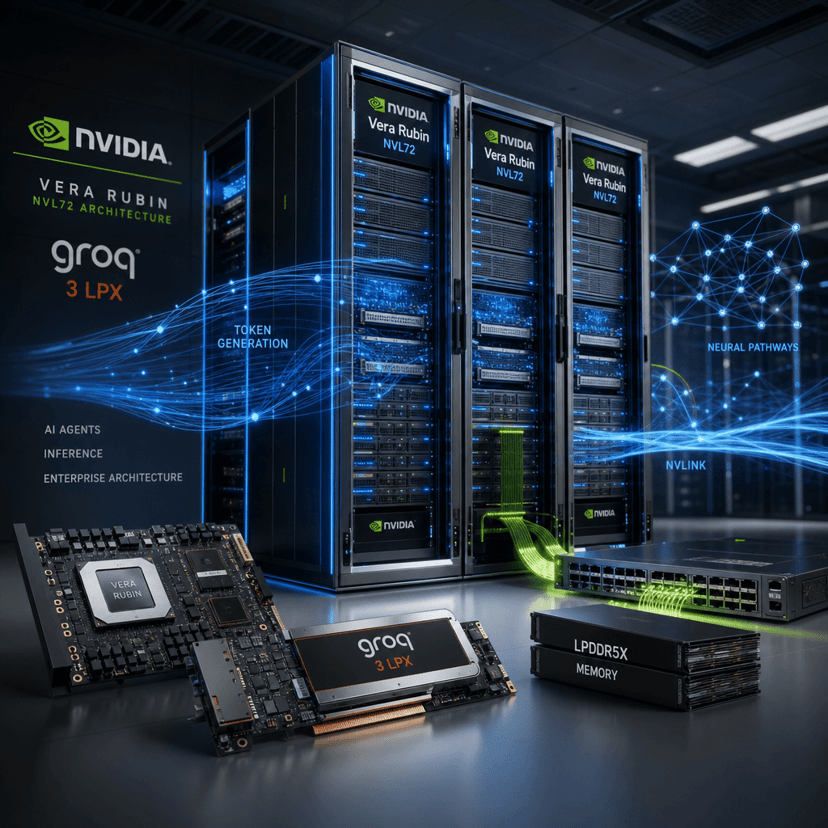
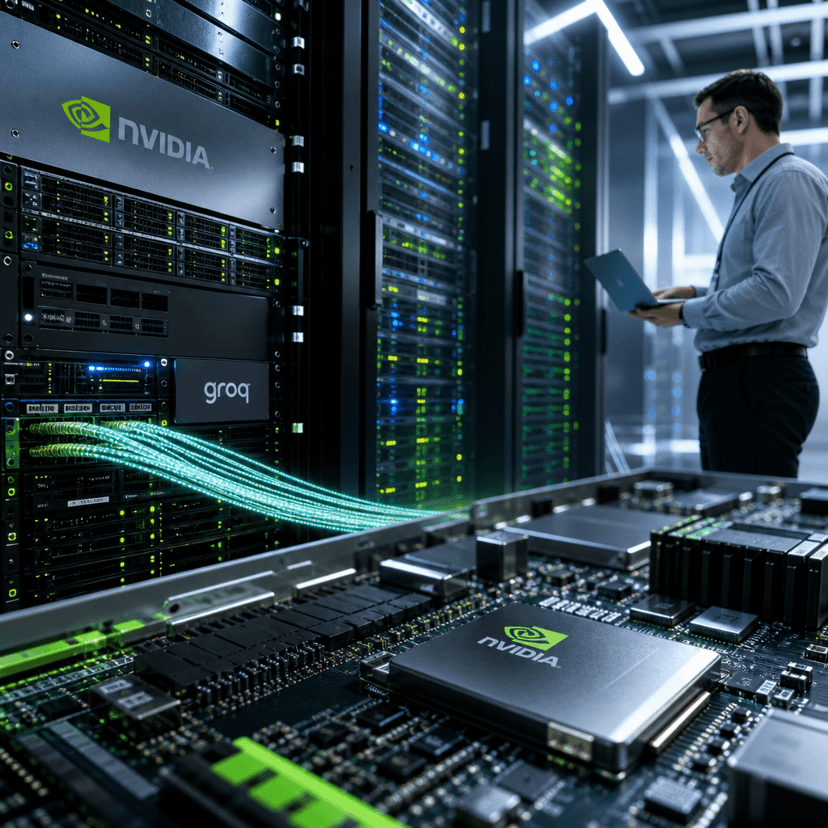
NVIDIA just flipped the switch on Groq 3 LPX, its latest inference accelerator built to supercharge agentic AI systems with blazing-fast token generation. The chip, now in full production as part of the Vera Rubin platform, marks NVIDIA's latest play to dominate the AI inference market as enterprises race to deploy responsive AI agents. With competitors like AMD and custom silicon from hyperscalers nipping at its heels, NVIDIA's betting that speed wins the agentic AI arms race.
NVIDIA just made its next move in the AI infrastructure chess match. The company announced today that its Groq 3 LPX inference accelerator is shipping to customers, bringing what it calls "world-class speed" to agentic AI workloads that demand split-second responsiveness.
The timing couldn't be more critical. As enterprises move from experimenting with large language models to deploying production AI agents that handle customer service, coding assistance, and complex decision-making, the bottleneck has shifted from training to inference. Companies need chips that can spit out tokens fast enough to make AI feel conversational, not clunky.
Groq 3 LPX extends NVIDIA's Vera Rubin platform, which the company has been positioning as its answer to the inference challenge. According to NVIDIA's announcement, the accelerator delivers a "major boost in AI inference by enabling ultrafast token generation for highly responsive agentic systems." Translation: your AI chatbot won't pause awkwardly mid-sentence anymore.
But NVIDIA's facing heat from multiple directions. AMD has been pushing its MI300 series hard, claiming superior memory bandwidth for inference workloads. Meanwhile, Google, Amazon, and Microsoft are all building custom inference chips to reduce their dependence on NVIDIA's ecosystem. The hyperscalers spent billions on H100s for training, but they're less willing to pay NVIDIA's premium for inference when they can design specialized silicon themselves.
The agentic AI angle is smart positioning. Unlike traditional AI models that respond to single prompts, agentic systems chain together multiple reasoning steps, make tool calls, and iterate on solutions. That means more tokens generated per interaction and higher sensitivity to latency. If your AI agent pauses for two seconds between each step in a 10-step workflow, users will notice.
NVIDIA hasn't disclosed pricing or detailed performance benchmarks yet, which matters because inference economics work differently than training. Training happens once per model; inference happens millions of times per day. A chip that costs twice as much but runs three times faster could still win on total cost of ownership. The company's track record with CUDA software integration gives it an edge, but only if the price-performance ratio holds up against hungrier competitors.
The Vera Rubin platform integration is worth noting. NVIDIA's been building complete systems rather than just selling chips, bundling networking, software, and support into turnkey AI infrastructure. That makes deployment easier for enterprises but also locks them deeper into NVIDIA's ecosystem. It's the same playbook that worked for training infrastructure, now applied to inference.
Industry watchers are already speculating about what this means for OpenAI and Microsoft's deployment costs. Both companies are racing to make AI assistants more responsive and capable, which means they're burning through inference compute. If Groq 3 LPX delivers meaningful speed improvements without proportional cost increases, it could change the economics of running services like ChatGPT or GitHub Copilot at scale.
The competitive pressure isn't just about raw speed anymore. Meta open-sourced Llama with optimizations for diverse hardware, making it easier to run inference on non-NVIDIA chips. Startups like Groq (the company, confusingly similar to NVIDIA's product name) have built specialized inference chips from scratch. Even Intel is making noise about its Gaudi accelerators gaining traction.
What NVIDIA has that others don't is the installed base and software moat. Thousands of companies already run NVIDIA infrastructure and have engineers trained on CUDA. Switching costs are real, especially when production workloads are at stake. But inference is also where those switching costs matter least - you can run different chips for training versus deployment without breaking your workflow.
The full production announcement suggests NVIDIA's confident in yields and supply, which hasn't always been a given with new chip launches. If they can ship volume immediately, it puts pressure on AMD and others who are still ramping their competing products. Availability matters as much as specs when enterprises are making deployment decisions right now.
One thing's certain: the inference market is about to get a lot more interesting. With agentic AI moving from research demos to production systems, the demand for fast, cost-effective inference is exploding. NVIDIA's made the first move with Groq 3 LPX, but every other chip company is watching closely and planning their counterpunch.
NVIDIA's Groq 3 LPX launch is less about technological breakthrough and more about market positioning at a critical inflection point. As AI workloads shift from training to inference and from simple chatbots to complex agentic systems, the company that owns inference infrastructure owns the next decade of AI deployment. NVIDIA's betting its CUDA moat and system integration advantages will fend off custom silicon from hyperscalers and aggressive pricing from AMD. But with inference economics favoring specialization over generalization, the door's open for challengers in ways it never was during the training gold rush. The next six months of pricing announcements and performance benchmarks will reveal whether NVIDIA can defend its dominance or whether the inference market fragments across multiple winners.