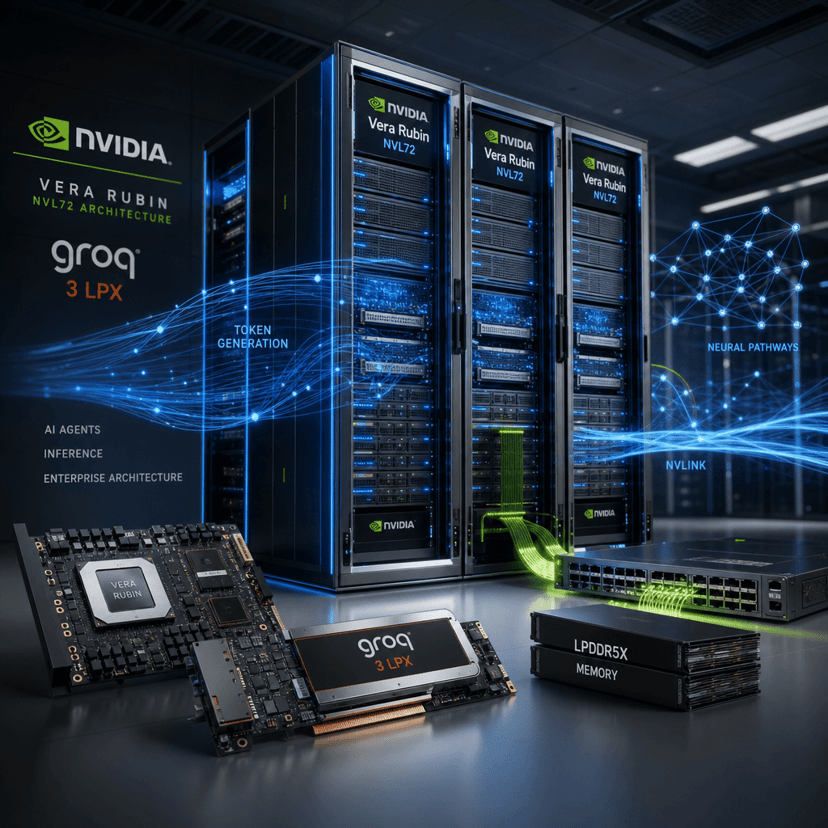
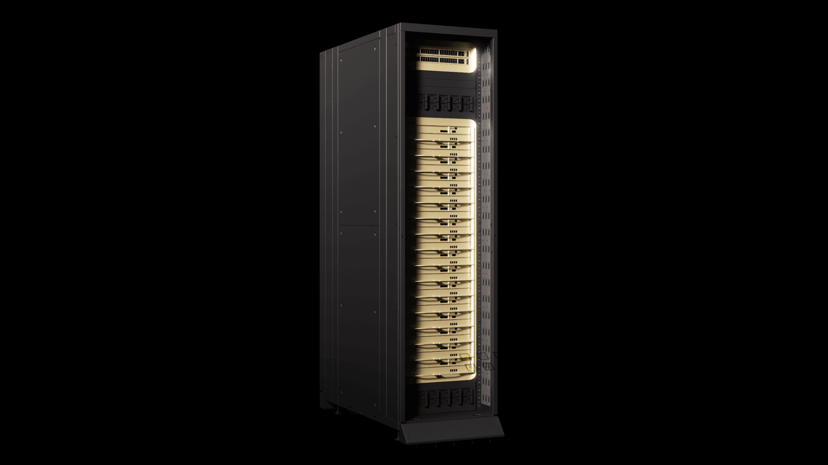
NVIDIA just dropped a bombshell for the enterprise AI market. The company's new Vera Rubin NVL72 GPU architecture promises up to 30x more work per watt specifically engineered for agentic AI workloads, which OpenRouter data reveals consume 15x more tokens than simple chatbot requests. The timing couldn't be more critical as enterprises race to deploy AI agents that don't just chat but actually perform complex multi-step tasks, from financial analysis to supply chain optimization.
NVIDIA is rewriting the economics of AI agents with hardware built for how these systems actually work. The Vera Rubin NVL72 represents the company's first GPU architecture explicitly optimized for agentic workflows, and the efficiency gains are staggering - up to 30 times more computational work per watt compared to previous generations.
The breakthrough comes at a pivotal moment. According to OpenRouter data cited in NVIDIA's announcement, agentic AI workloads devour 15x more tokens than a straightforward chat interaction. That's not just a marginal difference - it's the gap between answering a question and actually doing work. When an AI agent researches a company for investment decisions, it's querying financial databases, scraping news and regulatory filings, spawning sub-agents to run peer comparisons and valuation models, then synthesizing everything into actionable intelligence.
Every one of those steps burns tokens and compute cycles. Multiply that across thousands of enterprise deployments, and you've got an infrastructure crisis brewing. Microsoft, Google, and Amazon have all signaled that power consumption, not raw compute, is becoming the primary constraint on AI scaling. NVIDIA's answer is purpose-built silicon.
The Vera Rubin NVL72 architecture tackles this through what NVIDIA describes as optimized memory bandwidth and inference acceleration tailored to the stop-start pattern of agent workflows. Unlike training runs that hammer GPUs continuously, agents alternate between bursts of intense computation and idle periods waiting for database queries or API calls. Traditional GPUs waste energy during those transitions. Vera Rubin's design minimizes that waste.
The 30x efficiency claim represents best-case performance on specific agent benchmarks, likely involving long context windows and tool-use patterns. Real-world deployments will vary, but even a 10x improvement would slash operational costs for companies running agent fleets at scale. OpenAI has been vocal about inference costs limiting wider GPT deployment. Competitors racing to build agent frameworks - from Anthropic's Claude to Google's Gemini - face the same math.
NVIDIA isn't just selling chips here. The company's positioning Vera Rubin as the foundation for what it calls "the agentic era" of enterprise AI. That means software partnerships, reference architectures, and tight integration with frameworks like LangChain and AutoGPT that developers actually use to build agents. It's the same playbook that made NVIDIA's A100 and H100 the default choice for AI training - create an ecosystem, not just a product.
The naming choice is telling too. Vera Rubin was the astronomer who confirmed dark matter's existence, revealing the universe's hidden structure. NVIDIA's metaphor: AI agents are the invisible infrastructure that'll power the next generation of enterprise software, and you need specialized hardware to make them practical.
Timing matters. This announcement comes as major cloud providers finalize their 2027 capex budgets and enterprises move from experimenting with chatbots to deploying agents that handle customer service, financial analysis, and operational workflows. If NVIDIA can convince CTOs that Vera Rubin pays for itself through lower power bills, the company extends its AI infrastructure dominance into a new category.
Competitors aren't standing still. AMD has been gaining ground in inference workloads with its MI300 series. Custom chips from Google's TPU team and Amazon's Trainium target similar efficiency goals. But NVIDIA's got software momentum - CUDA, cuDNN, and TensorRT remain the paths of least resistance for developers. Switching costs are real.
The enterprise calculation is straightforward. If your AI agent deployment is consuming millions of dollars in cloud compute monthly, and Vera Rubin cuts that by even 20%, the ROI timeline shrinks from years to quarters. Data centers running at capacity get more work from the same power envelope. Startups burning through Series B funding on inference costs suddenly have more runway.
What's not clear yet is availability and pricing. NVIDIA's high-end AI chips have been chronically supply-constrained since ChatGPT sparked the generative AI boom. The company's working through that backlog, but adding a new SKU optimized for agents could mean enterprises face another waiting list. Cloud providers will likely get first access through strategic partnerships, leaving smaller players scrambling for allocation.
The broader signal: agentic AI isn't hype anymore, it's infrastructure planning. When NVIDIA designs chips specifically for agent workflows and talks about 15x token consumption as a baseline assumption, that's the market telling you where enterprise AI is headed. Simple chat interfaces were the appetizer. Agents that actually accomplish multi-step tasks are the main course, and they're hungry for compute.
NVIDIA's Vera Rubin NVL72 isn't just another GPU refresh - it's a bet that the next wave of enterprise AI runs on agents, not chatbots. The 30x efficiency gains target the specific problem holding back agent deployment at scale: the exponential token consumption that makes these systems expensive to operate. If the company delivers on those performance claims and can manufacture at volume, it's positioned to own the infrastructure layer of agentic AI the same way it dominated training and early inference. For enterprises evaluating AI strategies, the calculus just shifted. The question isn't whether to deploy agents anymore - it's whether your infrastructure can handle them efficiently. NVIDIA's making sure the answer involves their silicon.