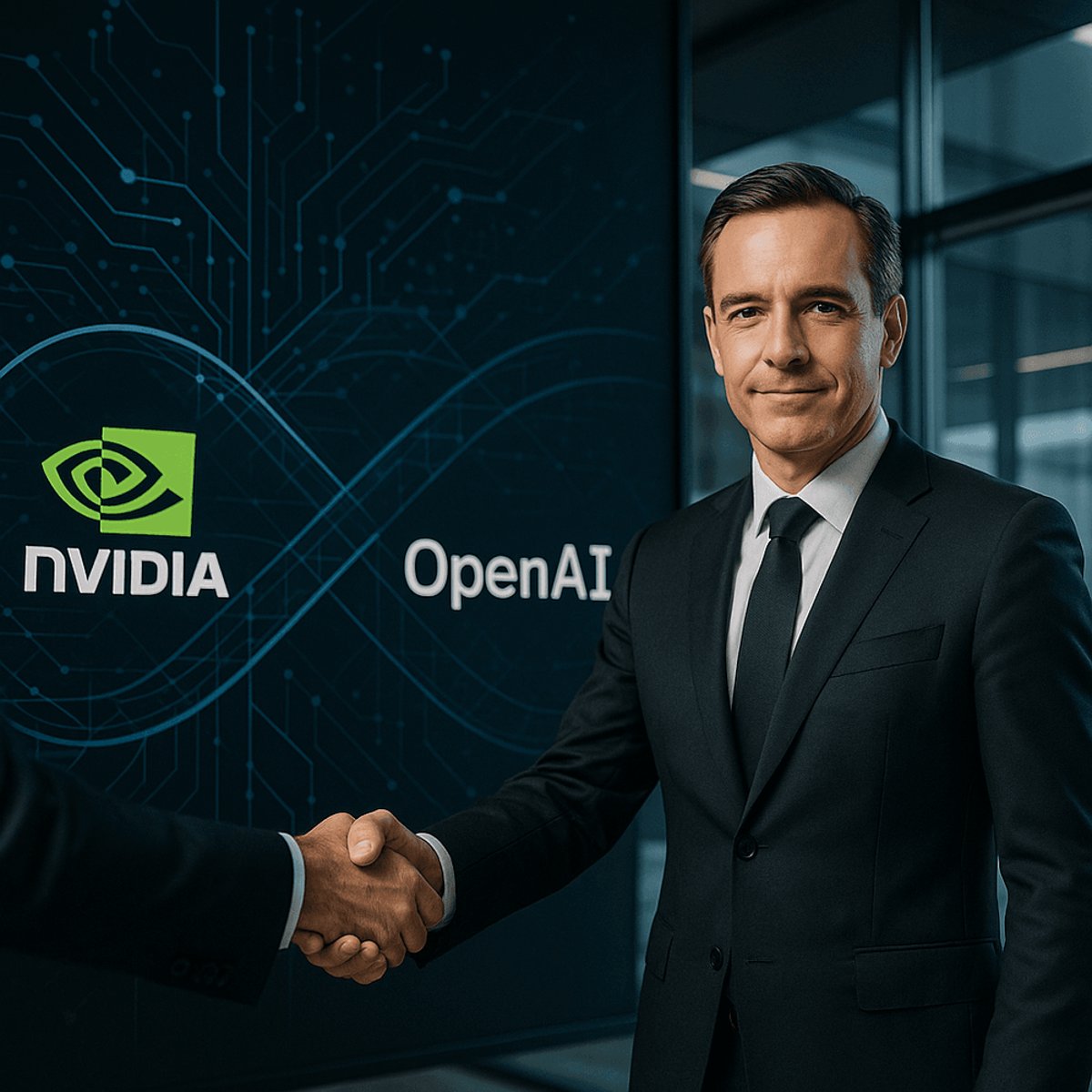
Nvidia CEO Jensen Huang just torched a report suggesting the chipmaker's massive OpenAI investment has gone sideways. Speaking to reporters in Taipei on Saturday, Huang dismissed The Wall Street Journal's Friday bombshell about scaling back the $100 billion partnership as "nonsense" and doubled down on his commitment to Sam Altman's AI giant. The pushback comes as OpenAI gears up for what could be one of the biggest funding rounds in tech history, with Amazon, Microsoft, and SoftBank also circling.
Nvidia CEO Jensen Huang isn't letting speculation about his company's OpenAI partnership fester. During a visit to Taipei on Saturday, he shot down a Wall Street Journal report claiming the chipmaker was getting cold feet about its massive AI investment, calling the story "nonsense" and reaffirming Nvidia's commitment to the partnership.
The drama started late Friday when the WSJ published claims that Huang was looking to scale back Nvidia's involvement in what was supposed to be a landmark deal. The original September announcement had Nvidia planning to invest up to $100 billion in OpenAI while also building 10 gigawatts of computing infrastructure for the AI company. But according to the WSJ, Huang has been privately emphasizing the deal's nonbinding nature, criticizing OpenAI's business strategy, and expressing concerns about competitors like Anthropic and Google.
The report also suggested recent discussions between the two companies were focusing on a significantly smaller equity investment, measured in tens of billions rather than the eye-popping $100 billion figure that made headlines last fall. That's a massive difference that would reshape the AI investment landscape if true.
But Huang's response leaves little room for interpretation. When reporters in Taipei asked about the WSJ story, he told Bloomberg that Nvidia will "definitely participate" in OpenAI's latest funding round "because it's such a good investment." He went further, saying "We will invest a great deal of money. I believe in OpenAI. The work that they do is incredible. They're one of the most consequential companies of our time."
The timing of Huang's pushback matters. OpenAI is currently working on what could become one of the largest funding rounds in tech history. TechCrunch reported in December that the company is looking to raise $100 billion, while The New York Times said this week that Nvidia, Amazon, Microsoft, and SoftBank are all discussing potential investments.
An OpenAI spokesperson told the WSJ that the companies are "actively working through the details of our partnership," adding that Nvidia "has underpinned our breakthroughs from the start, powers our systems today, and will remain central as we scale what comes next." That carefully worded statement suggests the relationship remains intact even as the specifics get hammered out.
Huang declined to specify exactly how much Nvidia plans to invest, deferring to OpenAI CEO Sam Altman to announce the total raise amount. "Let Sam Altman announce how much he's going to raise - it's for him to decide," Huang said. That suggests the funding round is still being finalized and that multiple investors are likely negotiating their stakes.
The relationship between Nvidia and OpenAI has been foundational to the current AI boom. Nvidia's chips power the training and inference for OpenAI's models, including ChatGPT and the recent o1 reasoning models. Any real friction between the two companies would send ripples through the entire AI industry, affecting everything from chip supply chains to competitive dynamics among AI labs.
The September announcement of Nvidia's potential $100 billion investment was seen as a statement about where AI infrastructure is headed. Building 10 gigawatts of computing capacity represents a massive bet on continued scaling of AI models. If that deal were truly collapsing, it could signal concerns about the economic viability of ever-larger training runs.
But Huang's forceful denial suggests the partnership is alive and well, even if the final numbers might look different from initial reports. The AI investment landscape remains incredibly fluid, with major players like Microsoft already deeply invested in OpenAI through previous rounds and cloud computing agreements.
What happens next will likely shape how the AI industry finances its next phase of growth. OpenAI's valuation has soared to an estimated $830 billion according to reports, making it one of the most valuable private companies in the world. Securing a $100 billion funding round at that valuation would be unprecedented and would provide OpenAI with resources to continue pushing the boundaries of AI capabilities.
Huang's rapid-fire response to the WSJ report shows how sensitive the stakes have become in AI partnerships. With OpenAI pursuing a funding round that could hit $100 billion and reshape tech investment records, every signal from major players like Nvidia matters. The fact that Huang personally addressed the speculation within hours, calling it nonsense and reaffirming his belief in OpenAI's work, suggests the partnership remains solid even as details get finalized. For now, the AI infrastructure buildout continues, and Nvidia clearly plans to be part of whatever comes next for Sam Altman's operation.