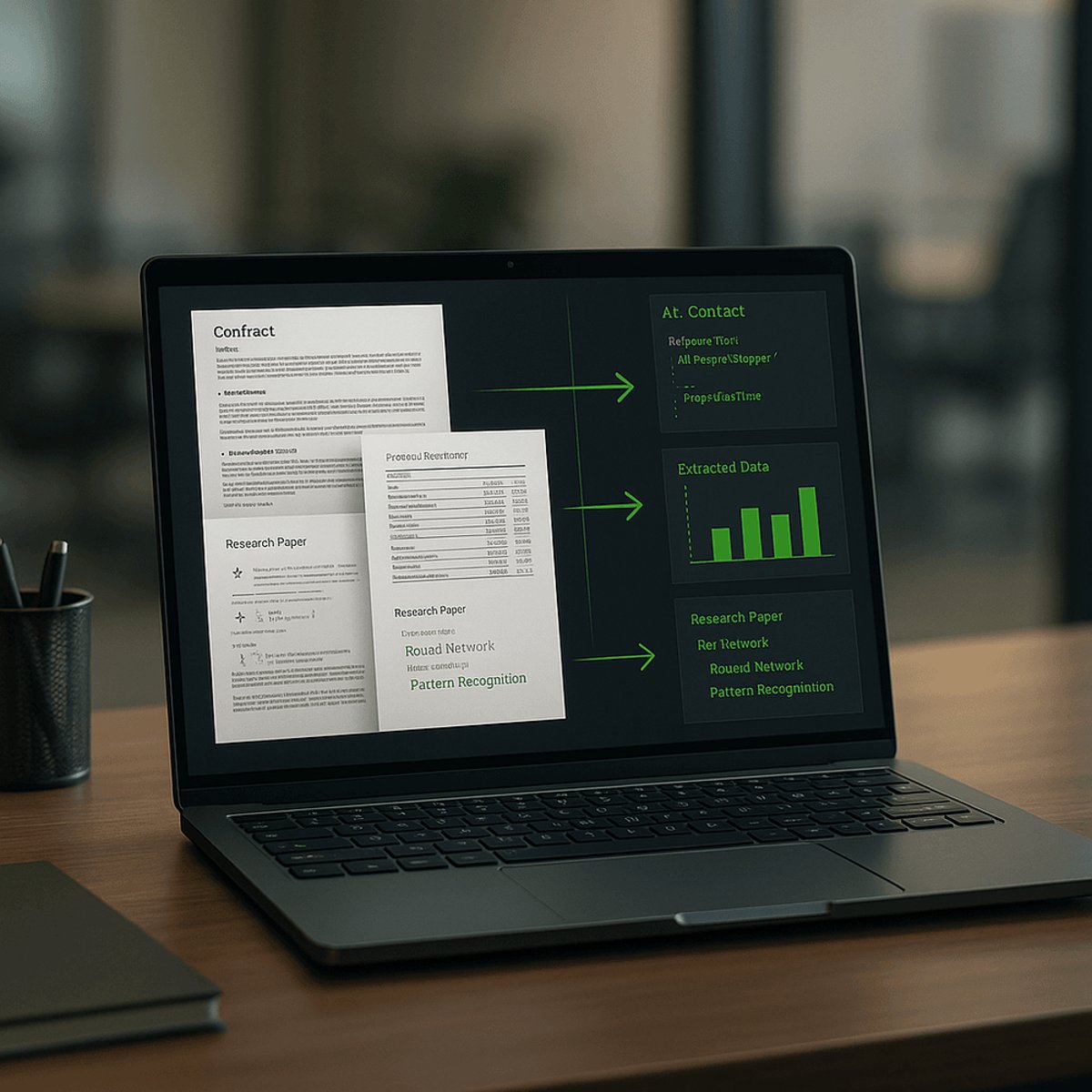
Nvidia just pulled the curtain back on how its Nemotron Labs is reshaping enterprise document processing. The company's new AI-powered parsing models are already live in production at Docusign, Justt and Edison Scientific, automatically extracting structured data from millions of contracts, financial disputes and research papers. Unlike traditional OCR tools that stumble on complex layouts, Nemotron Parse interprets tables, charts and mixed-media documents the way a human analyst would - with context, spatial awareness and semantic understanding.
Nvidia is making a aggressive push into enterprise AI with Nemotron Labs, a suite of open models designed to turn static document archives into queryable business intelligence systems. The announcement, detailed in a blog post by Moon Chung, showcases how three companies are already using the technology to automate workflows that traditionally required armies of analysts.
The core innovation centers on Nemotron Parse, a model that goes far beyond standard optical character recognition. While legacy OCR tools extract text linearly and often butcher tables or charts, Nemotron Parse reconstructs document semantics - understanding reading flow, spatial relationships between elements, and the contextual meaning of data nested in complex layouts. It's the difference between copying text from a PDF and actually comprehending what that quarterly earnings table means in relation to the executive summary three pages earlier.
Docusign, which processes agreements for 1.8 million customers and over a billion users, is evaluating Nemotron Parse to extract obligations, risks and key terms from contracts at scale. The company needs high-fidelity parsing of tables, clauses and metadata so organizations can search agreements semantically rather than keyword-hunting through PDFs. Running on Nvidia GPUs, the system reliably interprets complex contract tables and preserves the structural relationships that make or break legal interpretation. The goal is transforming Docusign's massive agreement repositories into structured data that powers AI-driven workflows - turning contracts into queryable assets instead of static files buried in SharePoint.
In financial services, Justt is using Nemotron Parse to automate chargeback dispute management. Payment disputes cost merchants billions annually, but the evidence needed to fight them - transaction logs, customer communications, policy documents - lives in fragmented, unstructured formats. Justt's platform ingests data from payment processors and merchant systems, then automatically assembles dispute-specific evidence packages aligned with card network requirements. The AI determines which chargebacks to contest, which to accept, and how to optimize each response for maximum recovery. Hospitality operators like HEI Hotels & Resorts are using it to recapture revenue lost to illegitimate chargebacks while cutting manual review work.
Edison Scientific is deploying Nemotron Parse inside its Kosmos AI Scientist platform, which helps researchers navigate scientific literature. Traditional parsing methods choke on research papers loaded with equations, complex tables and figure annotations. By integrating Nemotron Parse into its PaperQA2 pipeline, Edison can decompose papers, index key concepts and ground AI responses in specific passages with proper citations. That turns sprawling research corpuses into interactive knowledge engines that accelerate hypothesis generation and literature review. The efficiency gains make it cost-effective to run multimodal pipelines at scale across entire fields of study.
The Nemotron document intelligence stack includes four key components. Nemotron extraction and OCR models ingest multimodal PDFs while preserving layout and semantics. Nemotron embedding models convert passages and visual elements into vector representations optimized for semantic search. Nemotron reranking models evaluate candidate passages to surface the most relevant context for large language models, cutting hallucinations. And Nemotron Parse deciphers document structure to extract text and tables with precise spatial grounding.
These models posted strong results on industry benchmarks. Nvidia highlighted top rankings on MTEB, MMTEB and ViDoRe V3, which evaluate multilingual and multimodal retrieval accuracy. That matters because enterprises need models that work across languages, document types and visual formats without constant fine-tuning.
The tech is packaged as Nvidia NIM microservices and foundation models that run on Nvidia GPUs, letting teams scale from proof-of-concept to production while keeping sensitive data on-premises or in their chosen cloud environment. That addresses a major enterprise concern - companies don't want proprietary contracts, financial records or research data leaving their security perimeter.
Nvidia is positioning this as part of a broader agentic AI strategy. The most effective systems use a mix of frontier models and open source models like Nemotron, with an LLM router analyzing each task and selecting the best model for it. That approach balances performance against computing costs and improves overall efficiency.
The Nemotron Labs series is Nvidia's ongoing effort to demonstrate practical production use cases for its open models and training techniques. Previous posts covered research copilots and specialized AI agents. By spotlighting real customer deployments at Docusign, Justt and Edison Scientific, Nvidia is signaling that this isn't vaporware - enterprises are already running Nemotron-powered workflows at scale.
Developers can access Nemotron RAG models and the NeMo Retriever library on GitHub and Hugging Face, with Nemotron Parse available on Hugging Face. The Nvidia Blueprint for Enterprise RAG is live on build.nvidia.com, GitHub and the NGC catalog, backed by a dozen AI data platform providers.
The timing is notable. As enterprises rush to deploy generative AI, document intelligence has emerged as a killer use case - it delivers immediate ROI by automating workflows that were previously bottlenecked by human review. Law firms, banks, research institutions and healthcare providers all sit on massive document archives that could power AI agents if the data were structured and queryable. Nvidia is betting that open models optimized for its GPU stack will become the default infrastructure for that transformation.
Nvidia's Nemotron Parse represents a shift from document extraction as a backend chore to document intelligence as a strategic capability. By open-sourcing the models and packaging them as GPU-optimized microservices, Nvidia is making a play to own the enterprise AI infrastructure stack. The early customer traction at Docusign, Justt and Edison Scientific suggests the market is ready - organizations are tired of wrestling with unstructured data and willing to bet on AI agents that can actually understand what's in their documents. Watch whether this becomes the default approach for enterprise RAG deployments, and how quickly competitors like OpenAI and Anthropic respond with their own document intelligence offerings.