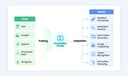
OpenAI just dropped Frontier, a new enterprise platform that promises to wrangle AI agents the same way companies manage human employees. Available now to early customers including Intuit, State Farm, and Uber, the platform tackles what's becoming a critical enterprise headache - how do you actually deploy, monitor, and control fleets of AI agents when they're scattered across different tools and vendors? It's OpenAI's direct challenge to Microsoft's Agent 365 in the race to become the default operating system for AI workers.
OpenAI is making a calculated bet that the future of enterprise AI isn't about having the smartest models - it's about managing the chaos when dozens or hundreds of AI agents start doing actual work. That's the thinking behind Frontier, the company's new platform that launches today for select enterprise customers.
The pitch sounds almost mundane until you think about what's actually happening inside large organizations right now. Companies are spinning up AI agents for customer service, data analysis, code generation, and dozens of other tasks. But those agents live in disconnected silos, can't share context, and often duplicate work or contradict each other. "Right now, many companies simply run AI agents on top of whatever they're using, which often means fragmented tools, disconnected workflows, and siloed data," Barret Zoph, OpenAI's general manager for business-to-business, told The Verge.
Frontier sits on top of that mess and creates what OpenAI calls a "shared business context" - think of it as the digital equivalent of the company intranet, employee handbook, and org chart rolled into one, but designed for AI agents instead of humans. "Frontier gives agents the same skills people need to succeed at work: shared context, onboarding, hands-on learning with feedback, and clear permissions and boundaries," the company wrote in its blog post announcing the platform.
The HR metaphor isn't accidental. OpenAI CEO of Applications Fidji Simo said the product was inspired "by looking at how enterprises already scale people." Just like new employees need access credentials, training, and defined roles, AI agents need the same scaffolding to be useful rather than dangerous. Frontier lets companies set boundaries and permissions, which OpenAI says makes it "possible to use them confidently in sensitive and regulated environments" - critical for industries like finance and healthcare where compliance isn't optional.
What's notable here is OpenAI's willingness to play nice with competitors. Frontier uses open standards and can manage agents built by OpenAI, the enterprise customer itself, or rival AI companies. "A recognition that we're not going to build everything ourselves," Simo acknowledged. That's a pragmatic stance in a market where Microsoft, Google, and Anthropic are all racing to deploy their own agent ecosystems.
The competitive context matters. Microsoft already launched Agent 365 last year as its answer to this exact problem, leveraging its dominance in enterprise software to bundle agent management with Office and Azure. Anthropic has been gaining serious traction with Claude Cowork and Claude Code, which let agents collaborate and write code with minimal human oversight.
OpenAI is coming to this party with some strong early validation. Intuit, State Farm, Thermo Fisher, and Uber are already using Frontier, with "dozens of existing customers" having piloted it. Chief revenue officer Denise Dresser declined to disclose pricing during a press briefing, which suggests OpenAI might be customizing deals to land marquee accounts.
The platform promises agents will "build memories" and improve through feedback from human colleagues - essentially creating a learning loop where agents get better at their jobs over time, just like human employees ideally do. Companies can use Frontier to quickly "hire AI coworkers" for specific tasks like running code or analyzing data, without needing to build custom infrastructure from scratch.
Simo laid out an ambitious vision during the launch: "By the end of the year, most digital work in leading enterprises will be directed by people and executed by fleets of agents." That's a big claim, but it aligns with where enterprise tech spending is heading. Companies have dumped billions into AI infrastructure, and CFOs are starting to ask hard questions about return on investment. Platforms like Frontier represent the bridge between experimental AI projects and actual business value.
The timing is deliberate. As Anthropic's Claude agents generate buzz and Microsoft leverages its enterprise relationships, OpenAI needs to prove it can deliver not just cutting-edge models but practical infrastructure for companies that want to move beyond pilots. Frontier won't be evaluated on technical elegance - it'll succeed or fail based on whether it makes AI agents reliable and manageable enough for risk-averse enterprise IT departments to actually deploy at scale.
Broader availability is coming "over the next few months," according to OpenAI, which means the real test starts soon. Can Frontier deliver on its promise to be the single pane of glass for managing AI agents across an enterprise? Or will companies end up needing yet another management layer on top of their agent management platform? The answer will shape how quickly - and how chaotically - AI agents move from tech demos to doing actual work alongside humans.
Frontier represents OpenAI's recognition that winning the enterprise AI race isn't just about building the smartest models - it's about solving the messy operational reality of deploying AI at scale. By positioning itself as the universal control plane for AI agents regardless of who built them, OpenAI is making a strategic bet that interoperability and management tooling matter more than vendor lock-in. But with Microsoft already entrenched in enterprise IT and Anthropic building momentum with developer-friendly tools, the real question is whether companies will consolidate around a single agent management platform or end up with the same fragmented chaos Frontier promises to solve. The next few months will show whether early customers like Intuit and Uber see measurable ROI, or if agent management turns into yet another layer of enterprise complexity.