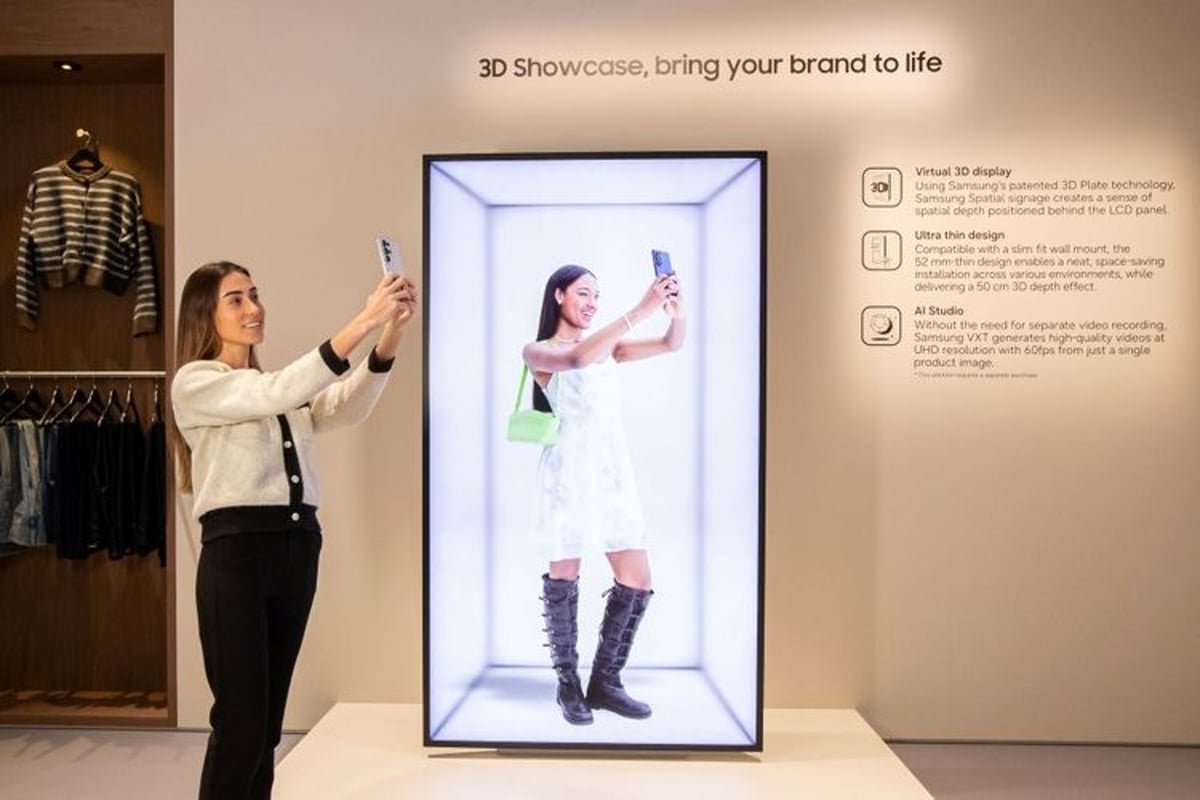
Samsung Electronics is rolling out its glasses-free 3D digital signage worldwide, starting with an 85-inch Spatial Signage display that went live today at Integrated Systems Europe 2026 in Barcelona. The launch marks a significant push into immersive commercial displays, combining patented 3D Plate technology with a new AI-powered content creation app called AI Studio within Samsung VXT. The move positions Samsung to capture high-value retail, luxury, and enterprise environments where visual impact drives customer engagement.
Samsung Electronics just made glasses-free 3D displays a reality for commercial environments. The company's Spatial Signage launched globally today at ISE 2026 in Barcelona, bringing what Samsung calls its "industry-leading" 3D digital signage to retail stores, luxury boutiques, museums, and corporate lobbies worldwide.
The 85-inch display uses Samsung's patented 3D Plate technology to create spatial depth behind the LCD panel without requiring viewers to wear 3D glasses. Content maintains 2D sharpness while adding what Samsung describes as "natural-looking 3D depth." The 4K UHD resolution (2,160 x 3,840) comes in a 9:16 portrait format, letting brands show 360-degree rotating product views.
"For commercial environments, bringing displays and content solutions together is becoming increasingly important," SW Yong, President and Head of the Visual Display Business at Samsung Electronics, told attendees at the Barcelona trade show. The company's betting that the glasses-free approach will lower the barrier to adoption compared to traditional 3D showcase displays that require bulky enclosures.
But the hardware is only half the story. Samsung showcased AI Studio at ISE 2026, a new AI-powered content app baked into its Samsung VXT cloud platform. The tool converts static images into signage-ready video without external editing software. It automatically optimizes shadow details, adjusts margins, and applies background treatments specifically for Spatial Signage displays.
Samsung VXT itself is a cloud-based digital signage platform combining content creation, management, and remote device control in a single system accessible via desktop and mobile. AI Studio will roll out globally in the first half of 2026, though Samsung notes it may come with additional usage-based costs. For businesses already managing fleets of Samsung displays, the AI content generation could significantly cut production time and costs.
The Spatial Signage display earned recognition as a CES 2026 Innovation Award Honoree in the newly launched Enterprise Tech category, making Samsung one of the first companies recognized in that category. Last year, it also received an IFA 2025 Innovation Award Honoree designation in the Best in Emerging Tech category.
The 85-inch model weighs just 49kg with a slim 52mm profile. It mounts like conventional signage using Samsung's Slim Fit Wall Mount (sold separately), avoiding the space-consuming box enclosures typical of traditional 3D display cases. Samsung plans to follow with 32-inch and 55-inch models, though release dates weren't specified.
Samsung also used ISE 2026 to unveil its supersized display arsenal. The 130-inch Micro RGB signage (QPHX model) made its commercial debut after being shown at CES 2026 for premium home entertainment. It combines micro-scale RGB LEDs with Samsung's Micro RGB AI Engine Pro for what the company calls exceptional picture quality in an ultra-slim design.
The new 108-inch The Wall All-in-One (MMF-A model) in 2K resolution takes a different approach to simplifying large-format LED deployment. Samsung says installation can happen in as little as two hours, depending on size. The 108-inch model uses a split-panel design that makes setup as straightforward as mounting two LCD screens instead of assembling a full LED wall.
According to Omdia's Q3 2025 Public Display Report, Samsung has maintained leadership in the global digital signage market for 17 consecutive years (excluding consumer TVs). The expanded lineup - which now includes 105-inch, 108-inch, 115-inch, 130-inch, and 146-inch models - gives the company coverage across lobbies, showrooms, boardrooms, and other high-impact commercial spaces.
On the enterprise collaboration front, Samsung announced that its 115-inch 4K Smart Signage (QHFX model) and 146-inch 2K The Wall All-in-One (IAB model) earned certification for compatibility with Cisco's collaboration devices. The Wall All-in-One is the world's first LED display to receive this certification.
Cisco's certification program involves rigorous testing of video interfaces and image quality optimization for video meetings. It also confirms displays appear correctly in Cisco's Control Hub management platform and integrate securely across meeting spaces. For IT teams managing enterprise video infrastructure, the certification means simplified deployment and better confidence in interoperability.
Samsung also partnered with Logitech to include its 4K Smart Signage QBC series in Microsoft's Express Install program for Microsoft Teams Rooms. The bundled offering combines Samsung displays with Logitech's certified conferencing solution, enabling meeting room installations to be completed in under an hour according to Samsung.
The timing comes as commercial display makers compete for enterprise budgets increasingly focused on hybrid work infrastructure and customer experience differentiation. Samsung's approach bundles AI-powered content tools directly into its management platform rather than requiring third-party software, potentially simplifying workflows for businesses managing multiple locations.
Samsung's global Spatial Signage launch represents a calculated bet that glasses-free 3D technology has finally reached commercial viability for mainstream enterprise and retail deployment. By bundling AI-powered content creation directly into its VXT management platform and securing enterprise certifications from Cisco and Microsoft partnerships, Samsung is addressing both the hardware and software friction points that have historically limited 3D display adoption. With 17 consecutive years of digital signage market leadership and an expanded portfolio stretching to 146-inch displays, Samsung is positioning itself as the one-stop provider for immersive commercial visual experiences. The real test will be whether businesses see enough ROI from the 3D effect to justify the premium over conventional signage, and whether AI Studio delivers enough workflow efficiency to make content creation sustainable at scale.