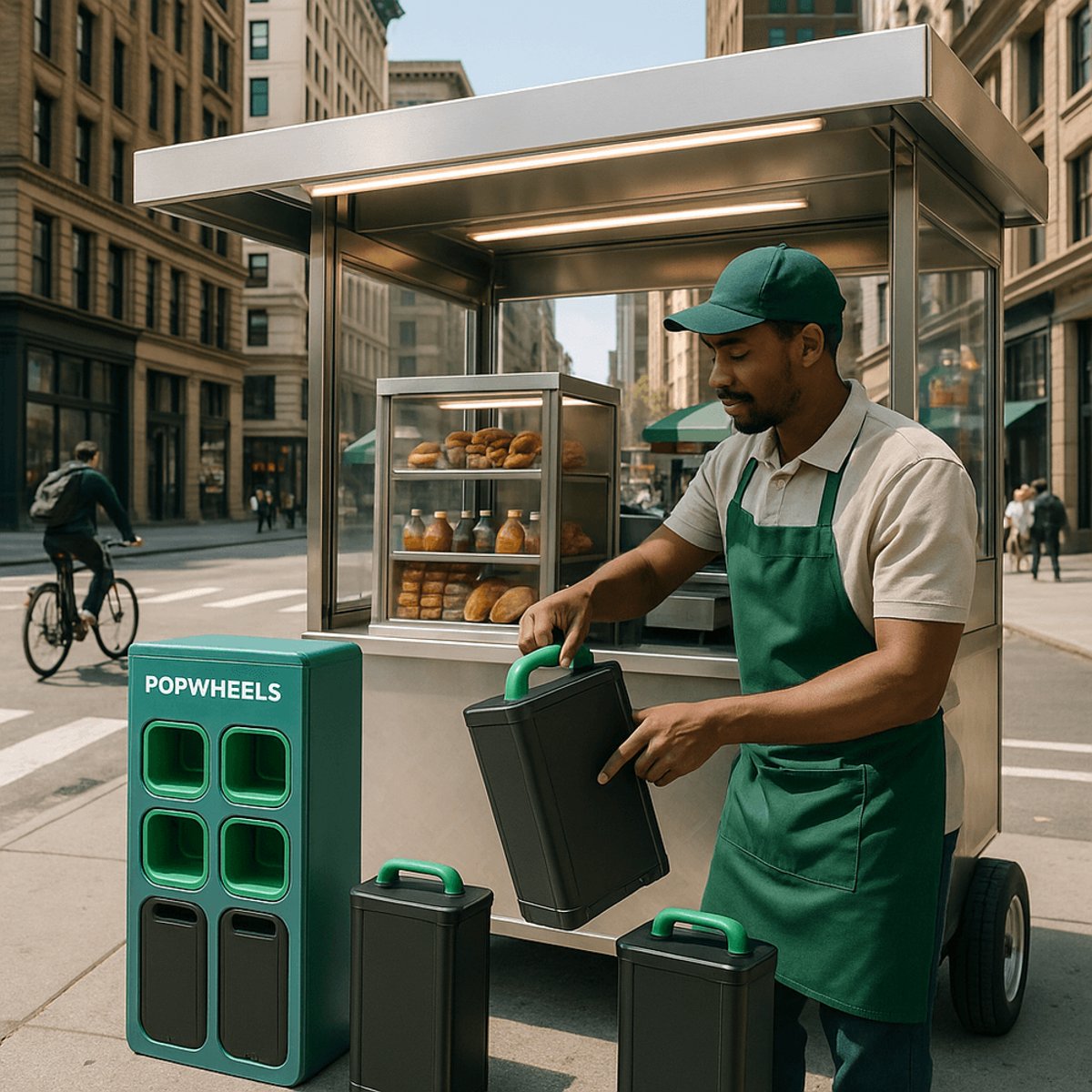
New York City food carts might finally ditch their noisy, smelly gas generators. Brooklyn-based startup PopWheels is testing its e-bike battery swapping network to power food carts, starting with La Chona Mexican on 30th and Broadway in Manhattan. The company, which raised $2.3 million in seed funding last year, plans an aggressive summer rollout that could transform how thousands of street vendors operate across the city.
PopWheels just cracked open a new market hiding in plain sight. The Brooklyn startup, which built a battery swapping network for food delivery workers, realized its infrastructure could solve one of New York City's most persistent street-level annoyances - the rumbling gas generators that power food carts.
"This really started out as a lark last summer," CEO and co-founder David Hammer told TechCrunch. "I'm an ex-Googler from the early days, and this felt like a classic, old-school 20% project." But what began as an experiment has evolved into a full-blown business opportunity that could reshape New York's street food economy.
The company successfully powered La Chona Mexican food cart for a full day last week using four e-bike battery packs, marking the first real-world test of technology that could eliminate the noise and fumes customers endure while waiting for their dosas and doner kebabs. Food cart owners who witnessed the demonstration immediately wanted in. "I had multiple food cart owners come up to me and say, 'Wait, there's no noise with this cart. What are you guys doing? Can I get this?'" Hammer said.
PopWheels isn't starting from scratch. The company already operates 30 charging cabinets across Manhattan, serving gig workers who ride Arrow and Whizz e-bikes for food delivery platforms. That infrastructure created what Hammer calls a "de facto decentralized fleet" - hundreds of customers cycling through a standardized system that stocks just a few battery types. The company charges delivery workers $75 monthly for unlimited battery swaps, undercutting the $100 per month that bodegas typically charge for charging services.
The economics for food carts look just as compelling. Cart owners currently spend around $10 daily on gas to run generators that power lights and small appliances. Four PopWheels batteries delivering five kilowatt-hours would cost roughly the same through a subscription model, while eliminating the generator's noise, emissions, and maintenance headaches. If a cart needs more power mid-shift, owners can swap batteries at any of PopWheels' stations throughout Manhattan.
"Are e-bike packs the perfect energy type to be powering food carts? Maybe, maybe not," Hammer said. "I would argue it doesn't matter. What matters is, can you solve distribution and charging?" That's where PopWheels' existing network becomes the competitive advantage - the startup already solved the hardest infrastructure problems.
The company raised a $2.3 million seed round in 2025, originally focused on addressing e-bike battery fires that plagued New York City a few years ago. PopWheels designed its 16-battery cabinets to quickly extinguish fires during charging, turning safety concerns into a selling point. Each cabinet draws about as much power as a Level 2 EV charger and fits into small urban spaces like parking lots with minimal retrofitting.
Hammer's thinking about food carts started when someone sent him an article about New York City's push to decarbonize street vendors. The PopWheels team ran the numbers and realized their battery network could serve a market well beyond delivery workers. "There was always a little bit of an underlying thesis that there's something bigger here," Hammer said. "If you build urban-scale, fire-safe battery swapping infrastructure, you're creating an infrastructure layer that lots of people are going to want to get on board with."
The startup tested a prototype adapter at a Brooklyn Navy Yard event during New York Climate Week last year, then partnered with the nonprofit Street Vendor Project to refine the concept. Last week's full-day demonstration with La Chona proved the technology works in real operating conditions, with cart owners handling battery swaps themselves.
PopWheels plans to roll out the food cart service aggressively starting this summer. With hundreds of delivery workers already on the waitlist for e-bike subscriptions and growing interest from food cart operators, the startup is betting that its infrastructure play can capture multiple segments of New York's gig economy. "We think we could be cost neutral with gasoline for a food cart owner while solving all of the quality of life issues," Hammer said.
The pivot shows how infrastructure startups can unlock adjacent markets once they reach critical density. PopWheels built a network for one customer segment, then discovered the same assets could serve entirely different users with minimal adaptation. For New York's estimated thousands of food cart operators, that means a path away from generators that doesn't require waiting for purpose-built solutions or city mandates.
PopWheels stumbled into a market opportunity that perfectly illustrates how infrastructure plays can expand once they hit critical mass. What started as a 20% project to eliminate generator noise has become a legitimate business line that could accelerate New York's decarbonization goals while improving quality of life for vendors and customers alike. The summer rollout will test whether food cart operators embrace battery swapping as readily as delivery workers have - but with cost parity, zero noise, and no emissions, the value proposition practically sells itself. Watch for other cities with dense street vendor populations to follow if New York's experiment succeeds.