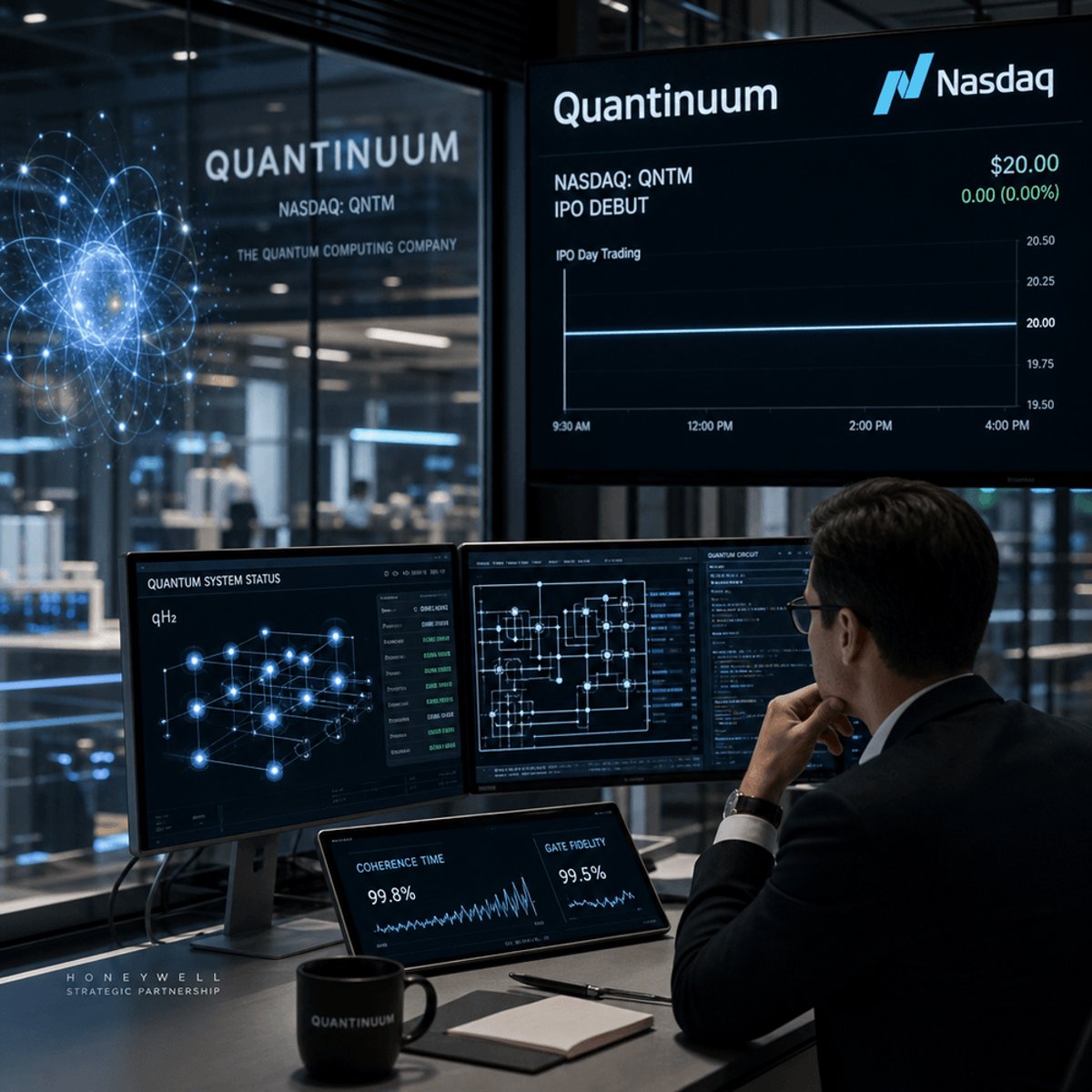
Quantum computing heavyweight Quantinuum made its long-awaited public debut on Nasdaq today, closing flat after upsizing its initial public offering in a muted start that underscores investor caution around the emerging technology. The company, which emerged from Honeywell's quantum division, priced shares that drew enough demand to expand the offering size, but failed to capture the first-day pop that typically rewards quantum and AI-adjacent startups. Honeywell will maintain majority control post-listing, positioning the industrial giant to leverage quantum breakthroughs while giving public investors their first pure-play bet on commercial quantum computing.
Quantinuum hit the public markets today with a whimper rather than a bang. The quantum computing company closed its first trading session essentially unchanged from its IPO price, despite expanding the offering size in response to institutional demand. It's a sobering reality check for a sector that's been riding waves of hype about quantum supremacy and breakthrough algorithmic advances.
The flat debut comes after Quantinuum upsized its offering, a move that typically signals strong investor interest during the roadshow. But that enthusiasm didn't translate into the kind of first-day rally that's become almost obligatory for tech IPOs, particularly those touching AI or quantum computing. According to CNBC, shares traded sideways throughout the session as public market investors took a wait-and-see approach to the company's commercialization timeline.
Honeywell, the industrial conglomerate that birthed Quantinuum through a 2021 merger of its quantum division with Cambridge Quantum Computing, isn't backing away. The company will retain a majority stake in Quantinuum and continue as both a strategic customer and development partner. That arrangement gives Honeywell ongoing exposure to quantum breakthroughs while providing Quantinuum with a built-in enterprise client and the credibility that comes from association with a Fortune 100 industrial powerhouse.
The listing marks a watershed moment for quantum computing's transition from lab curiosity to commercial enterprise. Quantinuum has positioned itself as a leader in trapped-ion quantum systems, a technology that competes with superconducting qubits favored by IBM and Google. The company claims its systems achieve higher fidelity and longer coherence times, critical metrics that determine whether quantum computers can solve real-world problems or remain science experiments.
But public market investors appear unconvinced that quantum computing's commercial moment has arrived. The technology still faces massive hurdles, from error correction challenges to the scarcity of quantum algorithms that deliver practical value. Most analysts peg mainstream quantum utility at five to ten years away, an eternity in public markets that demand quarterly progress. The flat debut suggests institutions priced in both the promise and the timeline uncertainty.
Quantinuum's public offering comes as the broader quantum computing landscape heats up. IonQ went public via SPAC in 2021 and has traded volatilely as it burns through cash pursuing similar trapped-ion technology. Rigetti Computing followed a similar path, with shares experiencing wild swings tied more to quantum computing headlines than fundamental progress. Quantinuum's traditional IPO route and Honeywell backing may insulate it from some of that volatility, but today's debut shows investors aren't willing to pay a premium just for quantum exposure.
The upsized offering detail is particularly telling. Investment banks typically expand deal sizes when they're overwhelmed with institutional orders, a sign that large funds wanted meaningful positions. Yet those same institutions apparently weren't willing to chase shares higher on day one. That suggests a calculated long-term bet rather than momentum-driven speculation, potentially healthier for Quantinuum's trajectory but less exciting for early investors expecting quick gains.
Quantinuum will now face the quarterly scrutiny that comes with public company status. Management will need to demonstrate progress on key metrics like system uptime, error rates, and crucially, customer adoption beyond Honeywell. The company has touted partnerships in pharmaceuticals, materials science, and cryptography, but converting pilot programs into recurring revenue will determine whether the stock finds buyers willing to pay up.
The quantum computing market remains tiny compared to classical computing, with most revenue coming from cloud access to quantum systems rather than hardware sales. Amazon Web Services and Microsoft Azure both offer quantum computing as a service, aggregating various providers' systems. Quantinuum will compete in that ecosystem while also pursuing direct enterprise relationships, a dual strategy that hedges bets but also dilutes focus.
Quantinuum's flat Nasdaq debut delivers a reality check to quantum computing's commercial promise. The upsized offering shows institutions want exposure to the technology's long-term potential, but the lack of first-day gains reveals skepticism about near-term revenue inflection. With Honeywell retaining majority control and remaining a key customer, Quantinuum has a cushion to execute its roadmap without immediate public market pressure. But investors will watch closely whether the company can expand beyond its parent's ecosystem and demonstrate that quantum computing is ready to move from research budgets to production workloads. The flat debut isn't a rejection, it's a cautious nod that says prove it.