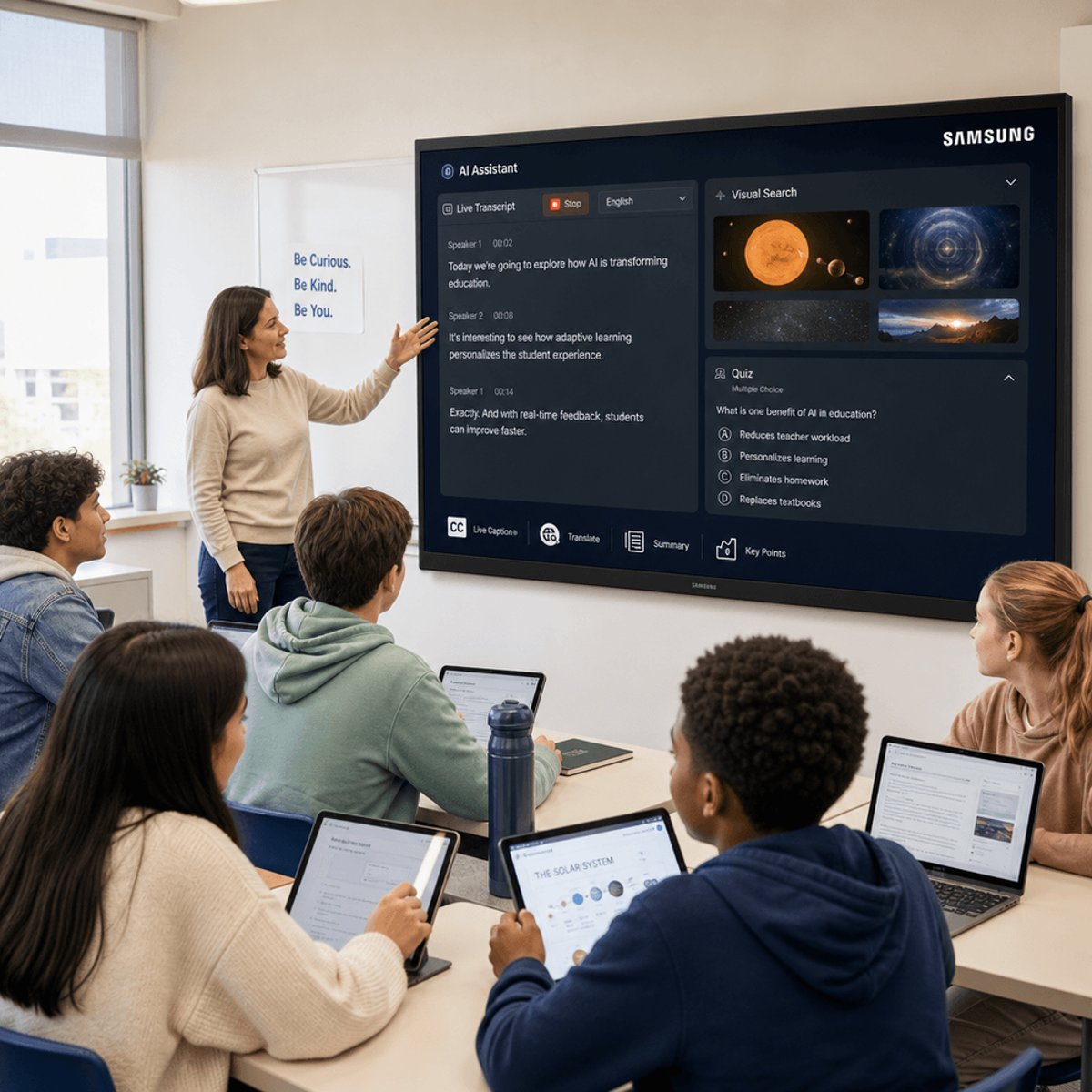
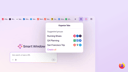
Samsung just rolled out AI Assistant, a built-in teaching tool that turns its interactive classroom displays into full-blown educational command centers. The new features—Live Transcript, Circle to Search, AI Quiz, and My Lessons—help teachers convert spoken lectures into real-time captions, instantly pull up contextual resources mid-lesson, and auto-generate quizzes from recorded class sessions. It's Samsung's latest push to embed AI directly into enterprise hardware, this time targeting the $8 billion education technology market where accessibility and engagement are constant pain points.
Samsung is betting that the future of classroom tech isn't just about bigger screens—it's about smarter ones. The company just unveiled AI Assistant, a suite of AI-powered teaching tools baked directly into its Android-based Interactive Displays. It's a direct play for the education vertical, where teachers are drowning in administrative tasks and schools are desperate for tools that actually boost engagement without adding complexity.
The headline feature is Live Transcript, which converts everything a teacher says into real-time text displayed on the main screen. Teachers can adjust language, font size, and screen position, and when paired with Samsung's screen-sharing app, students can view the transcript on their own devices. That means kids in the back row or those with hearing difficulties get a front-row seat to every word. "Kids these days are turning on transcripts, even as they're watching movies at home, and it's helping with their understanding," Grant Wilson, Solution Architect at STS Education, told Samsung Newsroom. "What I really like is that you can pair it with the Samsung screen sharing app, so every student in the classroom has a front-row seat to the screen from their own device."
It's a smart accessibility play, but it also reflects a broader trend: students now expect real-time captions as standard, not accommodation. Samsung is just packaging what Gen Z already demands at home and bringing it to school.
Then there's Circle to Search, which feels like a teacher's dream feature. Mid-lesson, a teacher can circle any image or word on the display, and the system instantly pulls up related images, videos, and web resources. Results can be dragged directly onto the whiteboard, keeping the lesson flowing without breaking for awkward Google searches. "Being able to use that Circle to Search feature just saves a lot of time where you don't have to go in and type in certain words, content or videos," Tambra Clark, Technology Integration Facilitator at Birmingham City Schools and a Samsung Solve for Tomorrow Top 10 winner, told Samsung. "Everything comes up at once simply by circling that word."
It's a small feature, but it's the kind of micro-friction removal that actually changes how teachers use tech in real time. Instead of planning every resource in advance, they can respond to student questions on the fly, pulling in context as the conversation unfolds.
But where Samsung really pushes into AI territory is with AI Quiz. Teachers can generate multiple-choice or true/false quizzes based on voice-recorded lesson transcripts and uploaded materials. Students join via QR code or link, submit answers from their own devices, and teachers can reveal correct answers on-screen after each question. The results dashboard shows completion rates, average scores, and which questions stumped the class—giving teachers instant feedback on what concepts need reinforcement.
"You can see where the students are at, and you're able to identify areas of improvement with that quiz," Clark said. It's not revolutionary AI, but it's practical. The quiz questions are auto-generated from what was actually taught, not some generic test bank, which keeps assessments aligned with instruction.
Voice-recorded lessons are automatically saved in My Lessons, where teachers can revisit transcripts, review AI-generated summaries, and share materials with future classes or students who missed the session. It's a lightweight learning management system baked into the hardware.
Shaun Taylor, Director of Sales at STS Education, framed it as a differentiation tool. "The word that I would use from my experience is differentiation," Taylor told Samsung Newsroom. "Having tools that allow students to engage at their own pace helps support different learning needs."
That's the pitch: AI that adapts instruction to individual students without forcing teachers to create five different lesson plans. It's a bet that schools will pay for hardware that reduces workload rather than just looking prettier.
Samsung isn't alone in this space. Google has been embedding AI into Classroom for years, and Microsoft just integrated Copilot into Teams for Education. But Samsung's play is different—it's selling AI as a feature of the physical display, not a cloud service. That means no subscription fatigue, no data privacy debates about student transcripts living on external servers (though Samsung's disclaimers note the AI "may provide inaccurate information" and requires external microphones for voice features).
The education tech market is hungry for AI that actually works in messy, real-world classrooms. Live Transcript needs clean audio. Circle to Search depends on decent internet. AI Quiz is only as good as the lesson transcripts it's trained on. But if Samsung can deliver on the basics—reliable transcription, fast visual search, and quiz generation that doesn't hallucinate answers—it's positioned to own a slice of the classroom AI stack that competitors are still figuring out.
This isn't just about selling screens. It's about Samsung proving it can compete in enterprise AI, one vertical at a time. Education is the test case. If teachers actually use these features, expect Samsung to roll similar AI toolkits into conference room displays, retail kiosks, and anywhere else a smart screen meets a captive audience.
Samsung isn't reinventing education—it's embedding AI where teachers actually need it. Live Transcript, Circle to Search, and AI Quiz solve real classroom friction points without requiring teachers to learn new platforms or juggle subscriptions. If the features work as advertised, Samsung's just turned its interactive displays into must-have infrastructure for schools betting on AI-powered differentiation. The real test isn't the demo—it's whether teachers in underfunded districts with spotty Wi-Fi and worn-out microphones can rely on these tools every single day. If Samsung pulls that off, it's not just selling hardware. It's owning the classroom AI layer.