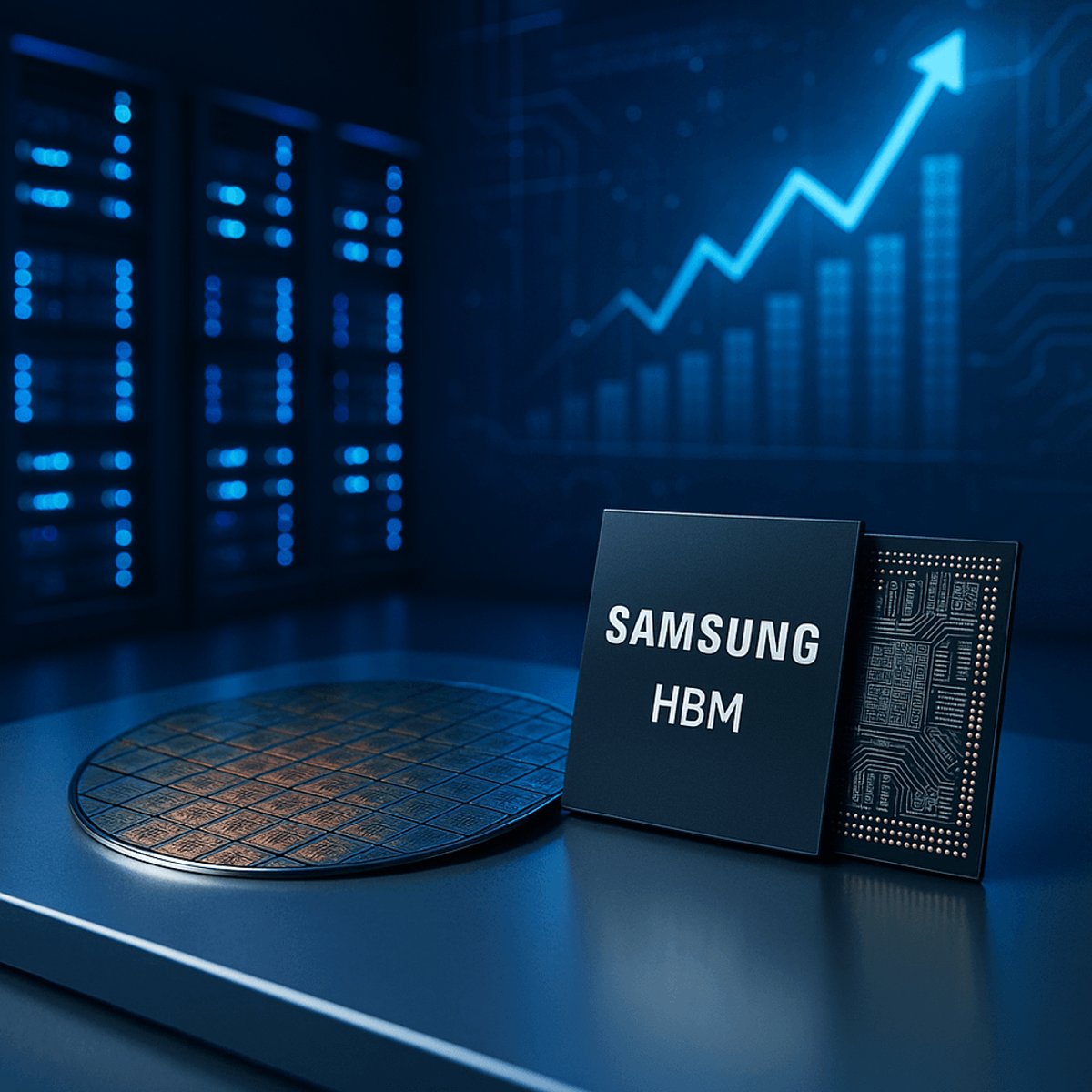
Samsung Electronics just posted the biggest quarter in its history, crushing expectations with $65 billion in revenue and $14 billion in operating profit. The Korean tech giant's Memory Business hit all-time highs as AI infrastructure spending sent demand for high-bandwidth memory (HBM) chips into overdrive, with the division's revenue surging 33% quarter-over-quarter. According to Samsung's earnings filing, this represents a decisive moment in the AI hardware race as the company gears up to ship its next-generation HBM4 chips this quarter.
Samsung Electronics just delivered the kind of blowout quarter that reshapes market dynamics. The company's Q4 2025 results represent the highest quarterly revenue and operating profit in its history, fueled almost entirely by an AI infrastructure buildout that's creating unprecedented demand for advanced memory chips. With KRW 93.8 trillion in quarterly revenue (roughly $65 billion) and KRW 20.1 trillion in operating profit ($14 billion), Samsung's numbers reveal just how much money is flooding into AI hardware right now.
The real story lives in Samsung's Device Solutions division, which houses its semiconductor operations. According to the official earnings release, the Memory Business alone achieved record quarterly revenue and operating profit despite what Samsung describes as "limited supply availability." That constraint didn't matter - the division posted 33% quarter-over-quarter sales growth as customers scrambled for HBM chips, server DDR5 memory, and enterprise SSDs. Overall market prices surged as supply struggled to keep pace with AI training and inference demand from hyperscalers.
But Samsung isn't just riding a wave - it's making aggressive moves to recapture market share from SK Hynix, which has dominated the high-end HBM market supplying Nvidia. Samsung confirmed it will begin delivering HBM4 products in Q1 2026, including variants with what it claims is "industry-leading 11.7Gbps performance." That's a direct shot across the bow at SK Hynix, whose recent earnings also showed explosive HBM growth. The timing matters - Nvidia's next-generation Blackwell Ultra and Rubin AI accelerators will need massive quantities of HBM4, and Samsung is positioning to win back that business.
The numbers tell the competitive story clearly. Samsung's Memory Business generated KRW 44.0 trillion in Q4 revenue with KRW 16.4 trillion in operating profit. The company's strategy centers on what it calls "high-value-added products" - a category that includes HBM, DDR5 for AI servers, GDDR7 graphics memory, and enterprise-grade NAND flash for inference workloads. Samsung is betting that AI infrastructure spending will keep accelerating through 2026, and it's pouring capital into production capacity to meet that demand.
Samsung's Foundry Business also hit significant milestones that could reshape its competitive position against TSMC. The division commenced mass production of first-generation 2nm process chips in Q4 and began shipping 4nm HBM base-die products to memory customers. Those 2nm chips represent Samsung's most advanced manufacturing node and put it in direct competition with TSMC for cutting-edge chip production. The company expects foundry revenue to decline sequentially in Q1 due to seasonal weakness, but it's targeting double-digit revenue growth for the full year 2026 driven by advanced node demand from high-performance computing and mobile customers.
The mobile and consumer businesses showed more mixed results, revealing the uneven nature of Samsung's current position. The Device eXperience division saw revenue drop 8% sequentially as launch effects from new Galaxy smartphones normalized and competition intensified. Samsung's Mobile eXperience unit posted KRW 29.3 trillion in Q4 revenue with KRW 1.9 trillion in operating profit - decent numbers but down from peak quarters. The company is betting heavily on AI features to drive its 2026 smartphone lineup, including what it describes as "Agentic AI experiences" in the upcoming Galaxy S26 series launching in Q1.
Samsung's Display division (SDC) generated KRW 9.5 trillion in revenue and KRW 2.0 trillion in operating profit, benefiting from strong smartphone panel demand from major customers (read: Apple) and year-end TV panel sales. The company expects softer smartphone demand in Q1 but plans to offset that with new QD-OLED product launches for premium TVs and monitors.
The consumer electronics businesses faced headwinds from seasonal patterns and competitive pressures. The Visual Display and Digital Appliances units combined for KRW 14.8 trillion in revenue but posted an operating loss of KRW 0.6 trillion. Premium product sales - Neo QLED and OLED TVs - performed well, but intense competition kept margins under pressure. Samsung is banking on global sports events in 2026 to drive replacement demand for TVs while pushing AI-enhanced features across its appliance lineup.
What's striking about Samsung's outlook is the sheer scale of its R&D spending. The company invested KRW 10.9 trillion in Q4 alone and KRW 37.7 trillion for the full year 2025 - both records. That capital is flowing heavily into next-generation memory architectures, advanced foundry processes, and AI chip designs. Samsung sees 2026 as a make-or-break year for establishing leadership in AI semiconductors, and it's spending accordingly.
The competitive landscape in AI chips is intensifying rapidly. SK Hynix currently holds an estimated 50%+ share of the HBM market and has secured the majority of Nvidia's HBM3E supply. Micron is also ramping HBM production. Samsung's challenge is proving its HBM4 chips can match competitors on performance and reliability while scaling production fast enough to meet hyperscaler demand from Microsoft, Google, and Amazon Web Services.
Samsung's full-year 2025 results provide context for the Q4 surge. Annual revenue reached KRW 333.6 trillion with operating profit of KRW 43.6 trillion. The Memory Business's turnaround drove most of that recovery after a brutal 2023-2024 downturn in chip prices. Now the pendulum has swung hard in the other direction, with memory pricing power returning as AI demand outstrips supply.
Looking ahead to 2026, Samsung expects AI and server demand to keep climbing, creating what it describes as "structural growth opportunities." The company is prioritizing profitability over market share in memory, focusing on high-margin AI chips rather than competing on price for commodity DRAM. In foundry, Samsung needs to prove its 2nm and future 1.4nm processes can deliver competitive performance and yields to win back customers who shifted to TSMC in recent years.
Samsung's record quarter marks a pivotal moment in the AI chip wars. The company's aggressive HBM4 roadmap and 2nm foundry ramp position it to challenge SK Hynix and TSMC in the most lucrative segments of semiconductor manufacturing. But execution will determine everything - Samsung needs to prove it can deliver cutting-edge memory and logic chips at scale while maintaining the yield and reliability that customers like Nvidia demand. With AI infrastructure spending showing no signs of slowing and memory prices remaining elevated, Samsung has the market conditions it needs. Now it needs to convert that $26 billion annual R&D budget into products that win back market share in the AI era. The stakes couldn't be higher - this is Samsung's shot at reclaiming semiconductor leadership.