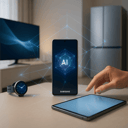
Samsung just made every living room a little smarter. The tech giant announced today that Microsoft Copilot will be built directly into its entire 2025 TV and Smart Monitor lineup, marking the first major AI assistant integration into consumer displays. The partnership transforms televisions from passive screens into conversational AI companions that can answer questions, provide recommendations, and help with everything from plot summaries to foreign language learning through simple voice commands.
Samsung just turned the living room into command central. The world's largest TV manufacturer for 19 consecutive years announced today that Microsoft Copilot will be embedded across its entire 2025 television and Smart Monitor range, creating the first mainstream AI assistant integration for consumer displays.
The timing couldn't be more strategic. As tech giants race to colonize every surface in the home with AI, Samsung is betting that the biggest screen wins. Users can now summon Copilot through voice commands or a simple remote click, transforming passive viewing into interactive experiences that span entertainment, education, and everyday problem-solving.
"Through our open AI partnerships, Samsung is setting a new standard for AI-powered screens," Kevin Lee, Executive Vice President of Samsung's Visual Display Business, told Samsung Newsroom. "Copilot makes it fun and easy to quickly get what you need through tailored experiences, whether you're learning something new, enjoying entertainment, tackling everyday tasks or more."
The integration runs deeper than simple voice queries. Microsoft Copilot will be accessible through Samsung's Tizen OS home screen, the company's lifestyle hub Samsung Daily+, and its existing Click to Search feature. This multi-entry approach means users can engage with AI whether they're browsing channels, exploring wellness content, or researching something they just saw on screen.
David Washington, Partner General Manager for Microsoft AI, positioned the partnership as a reimagining of shared screen time. "Copilot on Samsung TVs is designed to feel like an AI companion in your living room," he explained in the joint announcement. "Together with Samsung's leadership in advanced display technology, we're bringing people a shared experience that helps them discover something to watch, ask questions, make plans or simply enjoy a moment together."
The feature set reads like science fiction made real. Viewers can ask Copilot for instant facts about actors or athletes appearing on screen, request plot summaries for complex shows, get help with foreign language learning, or break down technical concepts. The AI can provide personalized recommendations based on viewing habits and respond contextually to whatever content is currently playing.
Samsung is positioning this as part of its broader Samsung Vision AI initiative, which has already enhanced features like Click to Search and the company's Bixby voice assistant. The Copilot integration represents a significant escalation in the AI arms race for smart home dominance, particularly as Amazon and Google continue pushing their assistants into every connected device.
The rollout covers Samsung's premium 2025 lineup including Micro RGB, Neo QLED, OLED, The Frame Pro, The Frame, and M7, M8, and M9 Smart Monitors. According to Samsung's announcement, availability will expand to additional regions and models over time, though specific timelines and market variations weren't disclosed.
For Microsoft, the partnership extends Copilot's reach into the most communal space in homes worldwide. While the AI assistant has found success in productivity software and enterprise applications, Samsung's massive global TV footprint offers unprecedented consumer exposure. The integration also complements Microsoft's broader AI strategy as it competes with OpenAI, Google, and Meta for AI assistant dominance.
The consumer electronics industry has been waiting for the AI breakthrough that moves beyond gimmicky features to genuinely useful applications. Samsung's Copilot integration suggests that moment may have arrived, with the living room television serving as the unlikely battlefield where AI assistants prove their worth to mainstream audiences.
Samsung's Copilot integration represents more than a feature upgrade—it's a fundamental shift toward conversational computing in the living room. By embedding Microsoft's AI directly into the viewing experience, Samsung is positioning itself at the forefront of the next chapter in smart home evolution. As AI assistants move beyond smartphones and speakers to colonize larger screens, the television may emerge as the ultimate smart home command center. The success of this partnership could determine whether voice-activated AI becomes as natural as reaching for the remote.