Samsung just released the technical playbook behind its biggest mobile video bet yet. The company's newly developed APV (Advanced Professional Video) codec, now shipping on the Galaxy S26 Ultra launched in March, promises to turn smartphones into legitimate pro video tools by maintaining near-lossless quality through multiple editing rounds. In an exclusive interview with Samsung Newsroom, developers Sunmi Yoo and Junseang Min from Samsung's Visual Solution Team revealed how they spent three years standardizing the codec with the Internet Engineering Task Force while quietly building an ecosystem with chipset makers, editing software companies, and even Samsung's own Memory Business to handle data rates hitting 6GB per minute.
Samsung is making a serious play for the creator economy, and it's betting everything on a codec most users will never know exists. The APV (Advanced Professional Video) codec debuted on the Galaxy S26 Ultra in March, but the real story is what happened behind the scenes - a three-year standardization effort that required Samsung to convince everyone from chipset manufacturers to video editing companies that mobile devices deserve professional-grade video tools.
"Conventional video codecs experience some data loss during the compression process required to reduce file size," Sunmi Yoo from Samsung's Visual Solution Team told Samsung Newsroom in an interview published this week. "In particular, as the repeated editing process tends to result in noticeable degradation in image quality, a new codec has been developed to fundamentally address these limitations."
The technical specs tell the story Samsung wants heard in Hollywood. APV delivers visually lossless quality using YUV 4:2:2 color sampling - the same standard used in professional broadcast equipment. At equivalent quality levels, it shrinks file sizes by more than 10% compared to similar codecs, a crucial advantage when you're trying to edit 8K footage on a device that fits in your pocket. Samsung worked with the Internet Engineering Task Force to get APV formally standardized, then released it as open source to accelerate adoption.
But here's where it gets interesting. Samsung didn't just build a codec and hope the industry would follow. The company orchestrated partnerships across its own business units and external partners to ensure the entire video production pipeline could handle APV's demands. "UHD 30fps footage can reach up to 6GB per minute," Junseang Min explained, "so we partnered with Samsung Electronics' Memory Business to ensure data storage stability."
That partnership resulted in nine validation cycles testing Samsung's portable SSD models across every recording resolution the Galaxy S26 Ultra supports. The team focused obsessively on thermal management and system-level optimization - the unglamorous work that separates vaporware from shipping products. They needed to prove that real-time 8K video processing wouldn't turn the phone into a hand warmer or crash mid-shoot.
The open-source gambit is strategic, not altruistic. "No matter how advanced a technology is, if it isn't widely used, it becomes obsolete," Yoo said. Samsung learned this lesson the hard way with previous proprietary technologies that never gained traction. By giving APV away, the company is trying to build the ecosystem first and bet on hardware differentiation later. The Galaxy S26 Ultra ships with four built-in cinematic LUTs (Look-Up Tables) that let creators apply film-like color grading without touching editing software.
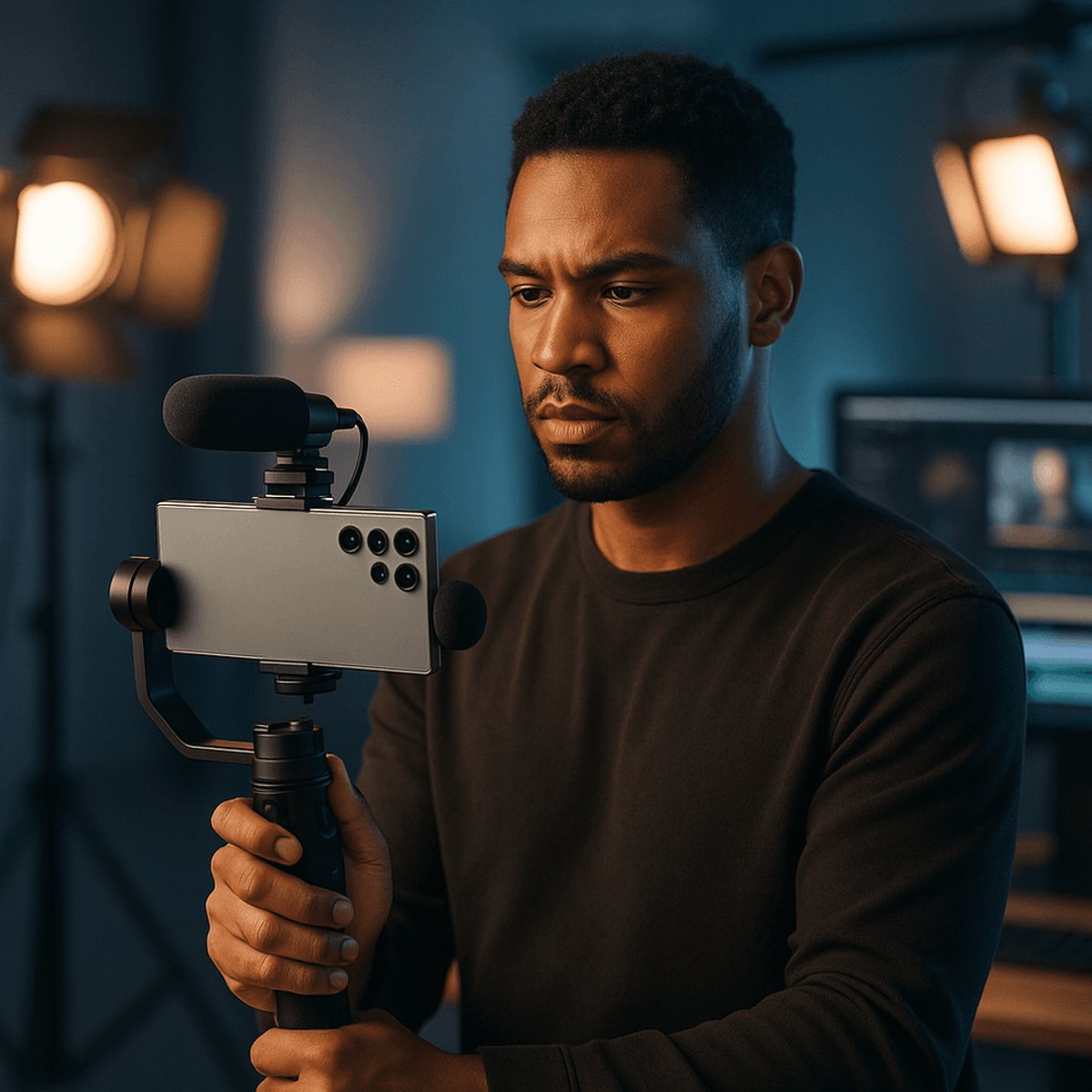
Samsung also developed a dedicated pro kit for the S26 Ultra in collaboration with camera accessory specialists, racing to finish it before the Galaxy Unpacked event in March. "Despite the tight timeline leading up to the Galaxy Unpacked where the product was unveiled, we were able to refine the overall quality," Min said. The pro kit signals Samsung's intention to compete not just with Apple's iPhone Pro lineup, but with actual cinema cameras used on professional sets.
The creator economy is booming, and Samsung sees an opening. As YouTubers, TikTokers, and Instagram influencers professionalize their content pipelines, they're hitting the limits of consumer-grade video tools. Most still need to offload footage to desktop editing suites for color grading and multi-pass editing because mobile codecs degrade too much with each export. APV is Samsung's answer to that workflow bottleneck.
"We wanted to lower the barriers to entry for video production, which has traditionally required access to professional equipment," Yoo explained. The subtext is clear: Samsung wants creators to shoot, edit, color grade, and export entirely on the Galaxy S26 Ultra without touching a laptop. If APV takes off, Samsung's vertical integration across memory, displays, and mobile processors becomes a massive competitive advantage.
The question is whether the ecosystem will materialize. Samsung needs video editing apps like Adobe Premiere Rush, LumaFusion, and CapCut to add APV support. It needs social platforms to accept APV uploads without transcoding. And it needs enough Galaxy S26 Ultra devices in creators' hands to justify all that development work. That's why the open-source strategy matters - it removes licensing friction and lets any Android device manufacturer adopt APV.
Samsung Research led the standardization effort while the Mobile eXperience Business handled the messy work of making APV run on actual hardware constrained by battery life and thermal limits. The collaboration between research and product teams is rare enough to be noteworthy, especially when it results in shipping products rather than research papers.
Looking ahead, the Visual Solution Team has ambitious plans. "Through APV, we look forward to the day when Galaxy S26 Ultra is even used in film production environments," Yoo said. That's not hyperbole - Netflix and other streamers have already approved smartphones for documentary production when paired with the right accessories. If APV delivers on its quality promises, the S26 Ultra could legitimately appear in professional production credits.
Samsung's APV codec represents a calculated bet that the future of video production is mobile-first. By open-sourcing the technology and building partnerships across the ecosystem before launch, Samsung is trying to avoid the fate of brilliant technologies that died in obscurity. The Galaxy S26 Ultra is the proof of concept, but the real test comes when editing apps add support, when creators actually use APV in their workflows, and when the next wave of Android flagships ships with the codec enabled. If Samsung pulls this off, we'll look back at APV as the moment smartphones became legitimate professional video tools rather than convenient compromises.