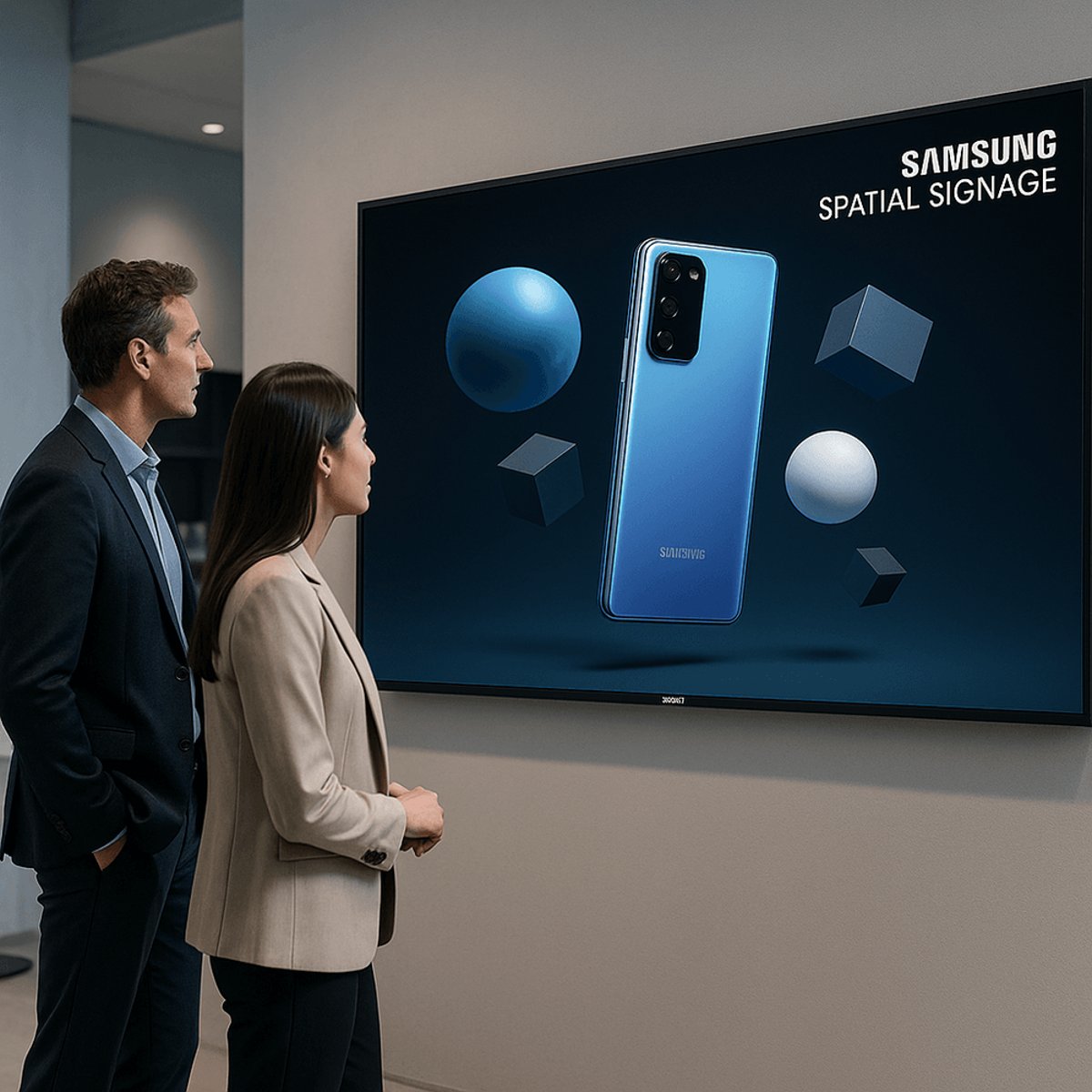
Samsung is pushing its glasses-free 3D display technology into commercial spaces with Spatial Signage, a 52mm-thin screen that creates depth without headsets. Showcased at ISE 2026 in Barcelona after winning awards at IFA 2025 and CES 2026, the 85-inch display uses what Samsung calls "3D plate technology" - combining lenticular lenses with binocular disparity rendering to send different images to each eye. The move comes as retailers and brands hunt for eye-catching alternatives to bulky LED installations, with Samsung eyeing cafés, gyms, theme parks and education sectors.
Samsung just cracked a problem that's plagued 3D displays for years - how to deliver depth without forcing viewers to wear glasses or stand in a tiny sweet spot. At Integrated Systems Europe 2026 in Barcelona this February, the company's Spatial Signage display stopped attendees cold with objects that appeared to float inside an 85-inch screen, rotating in midair with no headset required.
The technology arrives as brands scramble for display solutions that break through the noise. "We're seeing rising interest in visually striking content that captures attention, such as ultra-large LED-based anamorphic displays," Jong-Gu Sun from Samsung's Visual Display Business told Samsung Newsroom. "However, these installations typically require more space than traditional signage and dedicated 3D content."
Spatial Signage sidesteps those constraints with what Samsung calls 3D plate technology - a system that marries displays with optical components to exploit binocular disparity, the brain's natural depth perception mechanism. Think of those lenticular cards that shift images as you tilt them, but engineered for an 85-inch commercial display.
"The system combines a display with optical components to send separate images to each eye, applying the principle of binocular disparity so the brain perceives depth," explained Chang-Kun Lee from Samsung Research. The trick is rendering the main subject in high-res 2D while using the 3D plate to create depth in the background - solving the image quality and viewing angle problems that killed earlier glasses-free 3D attempts.
Building an ultra-large 3D display turned out to be brutally difficult. A 3D plate pairs lenticular lenses with printed images to generate 3D visuals, and once manufactured, it can't be adjusted. "If discrepancies between design specifications and the actual structure are not precisely accounted for, the background on screen can appear distorted," Lee said. The team developed a special printed pattern that combines with the lenticular lens to catch deviations during production, letting them tweak printing conditions on the fly.
The physics got nastier at scale. Spatial Signage uses a wafer-thin 3-4mm 3D plate to conjure a box-like space with 500mm of perceived depth, as if the screen extends backward into the wall. "With an ultra-large 3D plate, gravity can cause sagging, leading to blemishes or distortions, while vertical lenses can produce the moiré effect - a high-frequency, wave-like pattern," said Yujin Nam from the Visual Display team. "We repeatedly encountered these technical constraints. It wouldn't have been possible without close collaboration across teams."
The design challenge proved equally gnarly. Eun Vit Chung from Samsung's Corporate Design Office had to craft imagery that maximized depth perception on the massive screen. "While typical design work can rely on a single image, Spatial Signage requires images to be divided into micrometer-level segments - thinner than a strand of human hair," Chung explained. Designers had to mentally reconstruct how those microscopic slices would reassemble, demanding what Chung called "a deep understanding of optics."
The 3D plate features precision-calculated lines, surfaces and gradient backgrounds, while foreground 2D content incorporates lighting, shadows and perspective aligned with the background's depth. "This project felt like bringing virtual images from a 3D program into the real world," Chung said.
Samsung's betting the technology opens doors beyond flashy retail installations. The company plans to roll out 32-inch and 55-inch models later this year, targeting cafés, franchises and smaller venues. "Whenever I walk by a café with Spatial Signage, I notice people pausing to look at the display," Nam observed. "For cafés or franchises seeking a more engaging way to promote seasonal menus or events, it can offer a compelling alternative."
Content creation gets an AI boost through AI Studio, an app within Samsung Visual eXperience Transformation (VXT) that generates signage-ready videos from a single product image. Launching in April 2026, it includes an option to optimize content specifically for Spatial Signage's depth rendering. Samsung VXT sells separately, with AI Studio incurring additional usage fees.
Early interest spans education, fitness and entertainment. "Spatial Signage is drawing strong interest from sectors including 3D audiovisual solutions for education in Europe, virtual personal training systems for major fitness chains and augmented reality waiting areas at theme parks in Korea," Sun said. The display picked up six awards at ISE 2026 alone, adding to trophies from IFA 2025 and CES 2026.
The commercial display market has long chased immersive experiences that don't require specialized hardware. Anamorphic 3D installations - those viral LED corners that make sneakers or cars appear to leap off buildings - proved the appetite exists, but they demand custom content, specific viewing angles and significant real estate. Samsung's play is to compress that wow factor into a form factor that slots into existing signage infrastructure.
Whether the technology gains traction depends on content ecosystems and price points Samsung hasn't disclosed. But the company's clearly betting that B2B customers will pay a premium for displays that make people stop scrolling and start staring.
Samsung's Spatial Signage represents a bet that commercial customers will embrace glasses-free 3D once it's thin enough, sharp enough and easy enough to deploy. The technology solves real engineering problems - gravity sag, moiré patterns, microscopic image alignment - that killed earlier attempts. With smaller sizes coming and AI-powered content tools launching in April, Samsung's building the ecosystem needed for adoption. Whether cafés, gyms and retailers bite depends on pricing and how quickly that content library grows. But if people keep stopping to stare, Samsung might've cracked the code on making 3D displays actually useful instead of just novel.