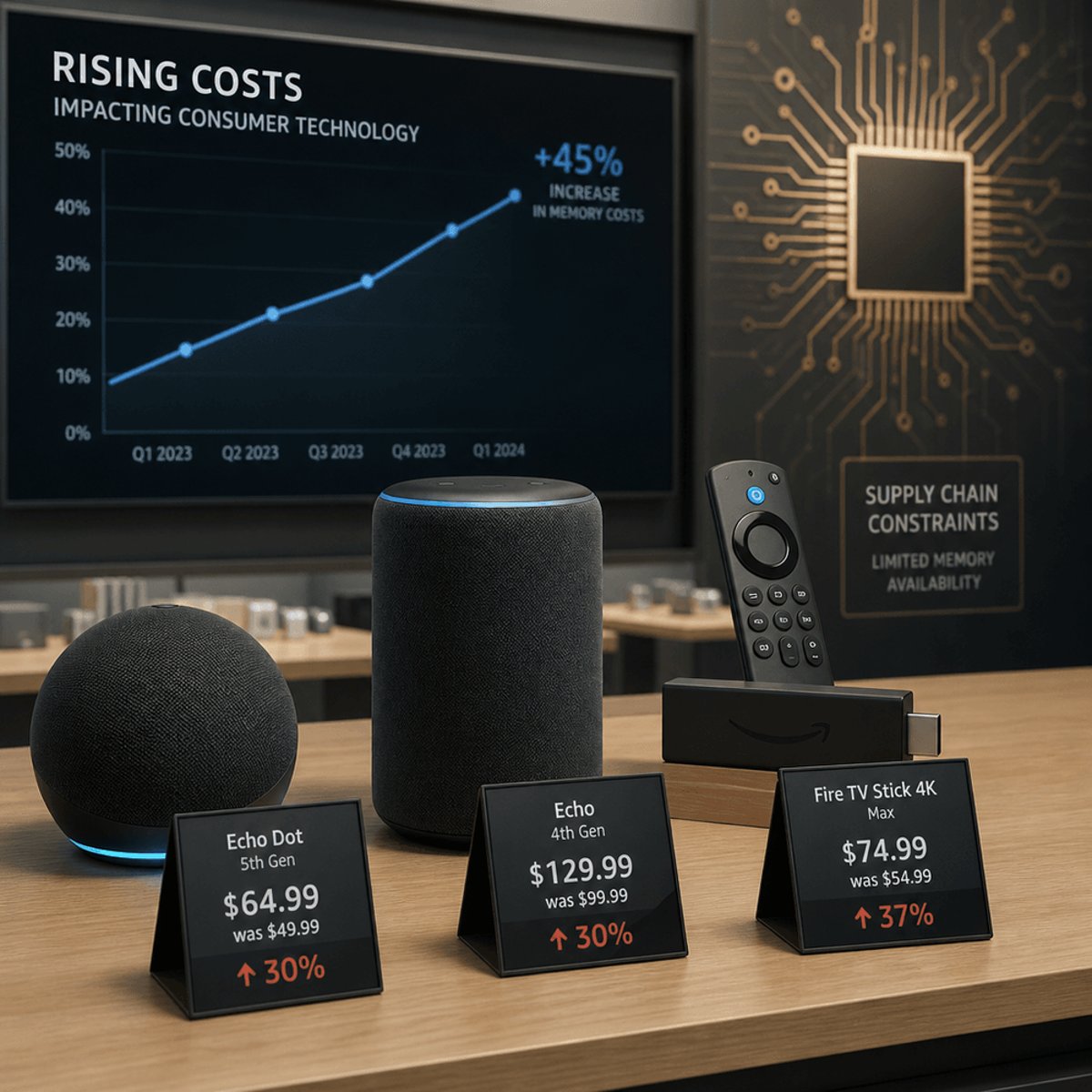
Amazon just delivered sticker shock to its hardware ecosystem. The retail giant confirmed it's raising prices on Echo smart speakers and Fire TV devices by up to 60 percent, citing an ongoing memory shortage that's squeezing margins across the consumer electronics industry. The move signals how deeply supply chain constraints are now hitting even the biggest tech players with the most purchasing power.
Amazon isn't mincing words about why your next Echo or Fire TV stick is about to cost significantly more. The company confirmed it's implementing price increases of up to 60 percent across its consumer hardware lineup, a dramatic shift that underscores how the ongoing memory shortage is reshaping the economics of consumer electronics.
The announcement comes as memory chip prices have been climbing steadily throughout 2026, driven by surging demand for AI accelerators and data center infrastructure that's soaking up available DRAM and NAND flash supply. While Amazon hasn't disclosed exact new pricing, a 60 percent increase would push popular devices like the Echo Dot from roughly $50 to $80, and Fire TV sticks from $40 toward $64.
What makes this move particularly significant is Amazon's traditional strategy of pricing hardware at or below cost to drive ecosystem adoption. The company has long treated devices like Echo and Fire TV as loss leaders, betting that revenue from Alexa services, Prime Video engagement, and Amazon shopping would more than offset thin hardware margins. This price hike suggests the memory shortage has squeezed costs so severely that even Amazon's deep pockets can't absorb the impact.
The memory crunch has been building for months. Industry analysts point to unprecedented demand from AI infrastructure buildouts, where companies like Microsoft, Google, and Meta are snapping up high-bandwidth memory for training clusters. That competition has driven memory spot prices up 73 percent year-over-year, according to industry tracker TrendForce, with little relief expected before Q2 2027.
For Amazon, the timing is particularly awkward. The company has been pushing hard into AI-powered Alexa capabilities, which require more memory-intensive chips in Echo devices to handle on-device processing. The latest Echo Show models already pack significantly more RAM than previous generations to support conversational AI features, making them more vulnerable to memory price spikes.
The ripple effects extend beyond Amazon's own ecosystem. If the retail giant is forced to hike prices this dramatically, competitors face similar pressure. Google Nest devices and Apple HomePod rely on comparable memory components, and their manufacturers are dealing with the same constrained supply. The difference is that Google and Apple have historically priced their smart home hardware at premium levels, potentially giving them more cushion to absorb cost increases without shocking consumers.
Consumer electronics brands without Amazon's scale face even tougher math. Smaller players like Sonos and Roku, which compete in the smart speaker and streaming device markets, lack the purchasing power to secure favorable memory pricing. If Amazon is raising prices 60 percent, those companies may need to implement even steeper increases or accept punishing margin compression.
The broader hardware industry has been bracing for this moment. Memory shortages tend to cascade across product categories because DRAM and NAND flash are ubiquitous components. Smartphones, laptops, tablets, and even automotive electronics all compete for the same constrained supply. When memory prices spike, every hardware maker faces the same calculus: absorb the cost, raise prices, or delay product launches until supply improves.
Amazon appears to have chosen the most transparent path, directly attributing price increases to memory costs rather than quietly shrinking specifications or delaying refreshes. That transparency might help cushion consumer backlash, but it won't eliminate the sticker shock when shoppers encounter the new pricing.
The memory shortage also complicates Amazon's competitive position against smartphone-based voice assistants. At $50, an Echo Dot was an impulse purchase that got Alexa into millions of homes. At $80, it's competing more directly with the smartphone people already own. That higher barrier to entry could slow Amazon's push to expand its voice assistant ecosystem just as AI capabilities are making these devices more capable.
Industry observers are watching whether this price increase sticks or becomes a temporary surcharge. Memory markets are notoriously cyclical, and supply tends to catch up with demand as manufacturers bring new fabrication capacity online. But with AI driving structural demand growth, this cycle might play out differently than previous shortages.
For now, consumers eyeing Echo or Fire TV purchases face a choice: buy at current prices before increases take effect, or wait and hope that memory supply improves enough for Amazon to roll back the hikes. Given the company's history of aggressive hardware pricing, a 60 percent increase isn't a position Amazon wants to maintain long-term.
Amazon's 60 percent hardware price hike marks a watershed moment for consumer electronics economics. When even the world's largest retailer can't absorb memory shortage costs, it signals how deeply supply constraints are reshaping the industry. Consumers should expect similar moves across smart home devices and streaming hardware as competitors face the same margin pressure. The question now is whether this represents a temporary shock or the new normal for an industry increasingly competing with AI infrastructure for scarce memory components. Either way, the era of dirt-cheap smart home gadgets appears to be on pause.