The Tech Buzz may earn a commission when you buy through links on this page. This never affects which products we recommend or what we say about them.
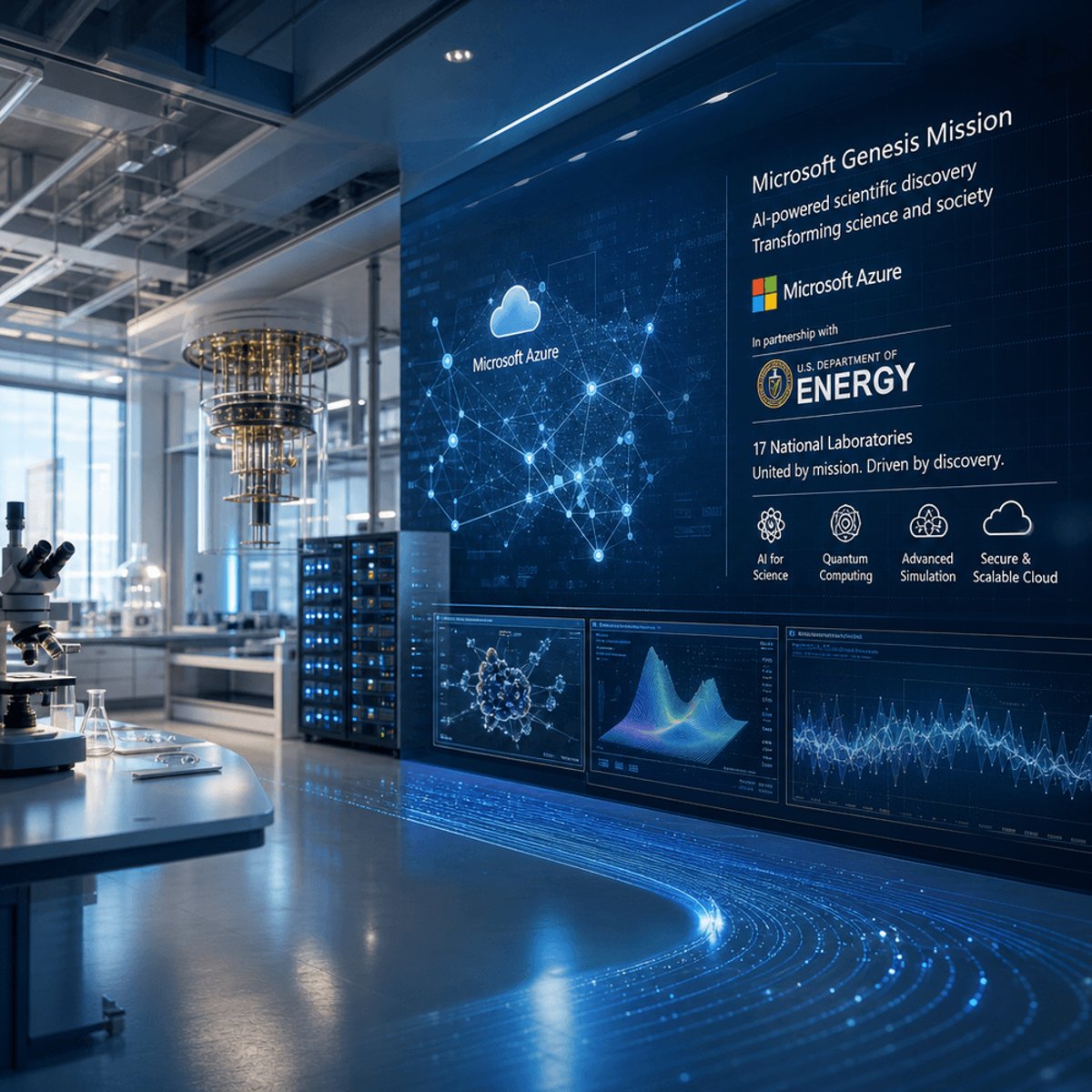
Microsoft just made its biggest bet yet on AI-powered scientific discovery. The company announced a $60 million commitment to the Department of Energy's Genesis Mission, launching SPARK - a new coordination hub designed to embed AI directly into America's national laboratory infrastructure. The move positions Microsoft as the primary cloud and AI partner for a federal initiative aiming to double US research productivity within a decade, deploying everything from Azure credits to quantum computing capabilities across 17 national labs.
Microsoft is going all-in on government scientific research, and the company's putting serious money behind it. The tech giant just unveiled a $60 million investment package for the Department of Energy's Genesis Mission, an ambitious federal program designed to transform how American science gets done. At the center of Microsoft's play is SPARK - Scientific Partnership Advancing Research & Knowledge - a newly created coordination hub that'll serve as mission control for AI-driven research across the nation's 17 national laboratories.
The Genesis Mission itself reads like a moonshot. DOE wants to double the productivity and impact of American research within 10 years by weaving AI directly into the scientific process. That means connecting world-class experimental facilities, decades of irreplaceable data, and next-generation computing into one unified platform. It's the kind of bold federal initiative that hasn't been seen since the space race, and Microsoft's positioning itself as the infrastructure backbone.
The $60 million breaks down strategically. Microsoft's allocating $40 million in Azure compute and AI credits spread over three years - giving researchers the horsepower to train models, run simulations, and iterate at scale without budget constraints strangling innovation. The remaining $20 million goes toward solution engineering enablement services: the boots-on-the-ground expertise to turn cloud capacity into actual scientific outcomes. It's a recognition that infrastructure alone doesn't deliver breakthroughs. You need people who know how to deploy it.
Chris Barry, who leads Microsoft's US Public Sector business, framed the commitment in national security terms. "At Microsoft, we believe that this goal is not only achievable, but also essential as a national security imperative and an economic engine for generations to come," he wrote in the official announcement. The subtext is clear: America's scientific edge depends on American technology.
SPARK operates as the single front door for Genesis Mission collaboration. Instead of national labs navigating Microsoft's sprawling org chart, SPARK consolidates everything - program management, technical teams, research divisions, security, compliance - into one clear pathway. The hub's built around five core commitments: a dedicated Genesis Mission Program Management Office, an AI for Science Center of Excellence, optimized Azure credit allocation, management of technical services, and joint R&D on challenge problems co-developed with DOE leadership.
Underneath SPARK sits Microsoft's full FedRAMP-authorized cloud and AI stack. That includes Azure infrastructure, Microsoft Foundry, and Zero Trust security through Defender, Sentinel, and Entra. The setup is designed to extend DOE's American Science Cloud capabilities with computing, AI, data, and collaboration services that complement existing lab infrastructure. For researchers, it means moving faster from hypothesis to discovery without compromising security or reproducibility.
Microsoft's also plugging in recently launched capabilities through Microsoft Discovery and Microsoft Quantum. Microsoft Discovery, now generally available, is an integrated platform that unites AI models, simulation, data, and experimental workflows within a single governed environment. It includes autonomous lab orchestration, integration of Microsoft Research's AI models for science, continuous AI learning through the scientific loop, and agentic memory. Researchers also get access to the Microsoft Discovery app, a local desktop experience currently in preview.
On the quantum front, Microsoft's Majorana-based quantum advances add another dimension. The company's making progress on topological qubits and scalable quantum computing, moving quantum from theoretical research toward practical scientific capability. For DOE teams, that opens new approaches to modeling complex materials, chemistry, energy systems, and national security challenges that classical computing can't crack. The same agentic AI behind Microsoft Discovery is accelerating quantum research itself, creating a feedback loop where AI speeds quantum breakthroughs and quantum expands what scientists can discover.
The work's already in motion. Four initial projects show what this partnership looks like in practice. At Pacific Northwest National Laboratory, AI is dramatically accelerating energy storage materials discovery, shrinking analysis of massive scientific data from years to weeks. Microsoft Discovery is plugging directly into PNNL's laboratory automation infrastructure to launch self-driving scientific workflows that autonomously design, run, and fine-tune biological experiments in real time.
At Lawrence Livermore National Laboratory, Microsoft's pairing advanced AI with modern bioinformatics to identify emerging biological threats faster and develop responses sooner. The collaboration is strengthening US biosecurity and biodefense priorities while supporting long-term resilience of the American bioeconomy.
Johns Hopkins University Applied Physics Laboratory is getting support for AI-enabled autonomous labs through integration of foundation models like MatterGen and MatterSim. The approach dramatically shortens the path from scientific hypothesis to validated, manufacturable materials by combining autonomous experimentation with accelerated computational materials discovery.
At Idaho National Laboratory, AI is streamlining the licensing, permitting, and review of new nuclear projects. The lab's also demonstrated that secure, distributed, hyperscale cloud can enable autonomous remote operations for nuclear power generators. Together, these efforts are helping bring safe, reliable power online faster to meet surging energy demand.
The timing matters. AI's transforming from a support tool into an essential component of the scientific process itself. Microsoft's commitment positions the company as the infrastructure partner running alongside DOE's own world-leading systems, ensuring America's scientific strength is built on American technology. It builds on decades of collaboration through Microsoft Research and partnerships across US government and national labs, but scales those breakthroughs across the entire R&D ecosystem.
For Microsoft, this is strategic beyond the immediate contract value. Embedding Azure and Microsoft Discovery into the national laboratory infrastructure creates long-term dependencies and validates the company's enterprise AI capabilities at the highest levels of government research. It's also a hedge against competitors - neither Amazon Web Services nor Google Cloud have announced comparable Genesis Mission commitments.
The Genesis Mission aims to set a global standard for AI-driven scientific research. With SPARK operational and initial projects already delivering results, Microsoft's betting that the future of scientific discovery runs through Redmond's datacenters. DOE labs can reach out to Microsoft account teams or email genesismission@microsoft.com to get started.
Microsoft's $60 million Genesis Mission commitment represents more than a government contract - it's a strategic play to embed Azure and AI capabilities into the core infrastructure of American scientific research. With SPARK operational and early deployments already showing results across energy, biosecurity, materials science, and nuclear operations, the company's positioning itself as the indispensable partner for AI-driven discovery at national labs. The question now isn't whether AI will transform government research, but whether Microsoft's early mover advantage in this space will lock out competitors for years to come. For DOE and the 17 national labs, the bet is that doubling research productivity within a decade is achievable - if the right technology partner is in place.